
I used to think I don’t need to celebrate Hispanic Heritage Month because I celebrate our culture every day. But as a person who went to school not seeing my culture celebrated or highlighted as much in the classroom, and a mom who is raising bilingual and multicultural kids, I recognize the importance of having a special time to highlight the contributions of the Hispanic/Latino community in the United States. It’s an important time when teachers can highlight and celebrate the diversity of Hispanic communities around our country while taking part in Hispanic Heritage Month activities.
Jump to:
- What is Hispanic Heritage Month?
- What does Hispanic mean? What do Latino / Latinx / Latine mean?
- What is the theme for Hispanic Heritage Month 2026?
- When is Hispanic Heritage Month?
- Why teach Hispanic heritage?
- Tips for Teaching Hispanic Heritage
- Low-Prep Hispanic Heritage Activities
- In-Depth Hispanic Heritage Month Projects
- Reading and Writing Activities
- Cultural Exploration Activities
- Family and Community Engagement Activities
What is Hispanic Heritage Month?
Hispanic Heritage Month celebrates the 63.7 million Hispanic Americans, about 20% of the U.S. population, representing Americans who have ancestry in countries that speak Spanish. That includes Latin America, the Caribbean, and Spain. Latinos are one of the fastest-growing populations in the United States.
Hispanic Heritage Month was initially started in 1968 by Lyndon B. Johnson to celebrate the contributions of Americans who had come to the United States from Spanish-speaking countries. It was originally a weeklong commemoration until President Ronald Reagan expanded it to one month in 1988. In recent years, there has been a language shift to be more inclusive and say “Latinx” or “Latine” Heritage Month. In this article, I will be using those terms interchangeably.
Here’s a short video about Hispanic Heritage Month that you can show your students. It’s from our teacher friend Maria.
What does Hispanic mean? What do Latino / Latinx / Latine mean?
Hispanic refers to people who speak Spanish or have ancestry from a Spanish-speaking country.
“Latino” and the more recently introduced terms “Latinx” and “Latine” refer to a larger group of people, those who come from Latin American countries.
What is the theme for Hispanic Heritage Month 2026?
Every year, Hispanic Heritage Month has a theme. This year’s theme is Pioneers of Change: Shaping the Future Together.
Learn more: Hispanic Heritage Month 2026 Theme at NOTA
When is Hispanic Heritage Month?
Hispanic Heritage Month starts September 15 (Independence Day in Costa Rica, El Salvador, Guatemala, Honduras, and Nicaragua) and continues until October 15. The month also includes Mexico’s Independence Day (September 16) and Chile’s Independence Day (September 18).
Hispanic / Latinx Heritage Month is a perfect opportunity to study and celebrate cultures from Latin America, from Mexico to Chile and the Caribbean, as well as Spain.
Below is a list of fun Hispanic Heritage Month activities that honor this special time of year. But first, let’s learn about the history of Hispanic Heritage Month and why we celebrate it.
Why should we teach Hispanic heritage?
Hispanic Heritage Month is an opportunity to help students see themselves reflected in the stories, cultures, and contributions that have shaped our country. As Natalia Mejia, an MLL educator and advocate, explains, teaching Hispanic heritage is important because “it is American history.”
Natalia emphasizes that educators have the opportunity and responsibility to create space for all students to feel seen and valued in the classroom. She also notes that learning about Hispanic cultures benefits every student by helping them understand perspectives different from their own while building connections with classmates who share similar backgrounds and experiences. Ultimately, these conversations foster empathy, respect, and a stronger sense of community.
For more insights from Natalia Mejia, follow her on Instagram at @nataliapmejia.
Tips for Teaching Hispanic Heritage
Mejia suggests starting with students’ knowledge and interests and building your Hispanic Heritage Month celebrations from there. Here are more tips from Natalia:
1. Lean on students’ knowledge
Our students and their families are our greatest assets. Some of my greatest lessons about Hispanic heritage come from listening to the needs of my students and their families. For example, when I taught middle school, we completed an altar for Dia de Muertos. Once we started setting the altar, I involved parents, who helped us create papel picado. It was an amazing experience for the students and their parents.
2. Invite others in
Reach out to other teachers who may also want to engage students in Hispanic heritage. When Mejia and her class built their altar, they collected family recipes to create a Hispanic heritage recipe book.
3. Be flexible
With the current politics and actions around the country, Hispanic families may not feel comfortable or it may not be the time to celebrate in a public way. Let your students lead; you may focus just on your classroom or you may find that your community wants a big celebration. Either way, let the students take the lead.
Low-Prep Hispanic Heritage Month Activities
These Hispanic Heritage Month activities don’t take much effort, but they’re informative, fun, memorable, and great springboards for conversations about Hispanic heritage.
1. Learn about Hispanic dialects
Grades: Upper elementary, middle, high school
Prepare students for real-life conversation and teach flexibility by listening to the various accents and slang in the 21 countries where Spanish is the dominant language. Watch and listen to various dialects to hear and discuss the differences.
Learn more: Spanish Dialects Around the World on YouTube
2. Listen to mariachi music
Grades: Elementary, middle, high school
Listening to music from different cultures teaches students cultural appreciation and expands their knowledge of the world.
A mariachi is a small Mexican musical ensemble composed of a variety of mostly stringed instruments, but it can also include air instruments like trumpets. Typically they have been male-dominant ensembles that sing a variety of songs, from slow songs of love or grief to high-energy dance songs. In recent years, there have been more female mariachi bands, like Mariachi Flor de Toloache. Mariachis are a typical form of entertainment at Hispanic events including weddings, birthdays, quinceañeras, and holidays.
Learn more: Mariachi Music on YouTube
3. Make aguas frescas
Grades: Elementary, middle, high school
Make foods and drinks from around the world and expand your students’ understanding of how people approach food. In Mexico, aguas frescas are quite popular. Literally meaning “fresh water,” an agua fresca is an aromatized water drink. In Mexico you can make them from fruits and flowers like hibiscus.
Try it: Pineapple Coconut Agua Fresca Recipe at Mama Latina Tips
4. Make papel picado
Grades: Elementary, middle, high school
Papel picado translates to punched or perforated paper. This traditional paper decor is found in a variety of Hispanic cultural events. It is used to decorate during celebrations such as El Día de Muertos (Day of the Dead) and events like birthdays and baby showers, as well as to simply add festive decor to family homes. Papel picado can be purchased online or in stores, or it can even be created as a DIY craft. If students make papel picado, they’re learning about cultural traditions and art.
Buy it: Papel Picado Banners at Amazon
5. Play lotería
Grades: Elementary, middle, high school
Playing games reinforces cultural awareness and shows students how people play around the world.
Lotería is a popular game that is very similar to bingo. It dates back to the 18th century when it was brought over from Europe. The traditional Mexican version has been sold since the late 19th century. Because it is such an old game, some of the images have not aged well and may need explanations—for example, el borracho means “the drunkard” and there is an image that is called El Negrito. I suggest having conversations about these images. There is also an updated version of the traditional game called “Millennial Lotería.” It is a fun game for the classroom and for people of all ages.
Buy it: Lotería (original) and Lotería (millennial) at Amazon
6. Learn Latin American geography
Grades: Elementary, middle school
Geography is so important for kids to learn. With a basic understanding of geography, they build background knowledge that they will use to understand the world, current events, and articles and stories.
Practice Latin American geography with this puzzle that’s perfect for using in the classroom as part of a Hispanic Heritage Month lesson.
Buy it: Latin American Geography Puzzle at Amazon
7. Create an interactive map
Majia posted a huge map of Latin America and Hispanic countries on her cafeteria wall. Students posted where their families were from as well as where famous Hispanic Americans were from. A map like this is the perfect way to teach geography and celebrate the diversity in your school community.
8. Play traditional games
Grades: Elementary, middle, high school
Engage students in playing traditional games to experience how kids in Hispanic countries engage in play, and compare what is similar and different about how various cultures play.
Many countries have fun games that people of all ages will enjoy. In addition to lotería in Mexico, dominoes are popular in Caribbean countries.
Buy it: Domino Set at Amazon
In-Depth Hispanic Heritage Month Projects
Françoise Thenoux encourages teachers to move beyond the familiar Hispanic/Latinx Heritage Month activities. “The Hispanic/Latinx diaspora is extraordinarily diverse,” she told We Are Teachers. “Rather than teaching students about one culture, we can help them appreciate the diversity that exists within the diaspora itself.”
Below are Thenoux’s favorite ways to delve into the richness of Hispanic/Latinx Heritage and follow her on Instagram @TheWokeSpanishTeacher.
9. Find themes in pop culture
Grades: Middle, High School
Pop culture stars (think: World Cup, songs, artists) are natural entry points into conversations about language, identity, representation, colonialism, migration, and belonging. Invite students to critically examine a pop culture person, activity, event, film, or song they already listen to. What is the history behind it? What cultures does it represent? And how?
For example, if I were using Bad Bunny’s Super Bowl performance as an entry point, Thenoux would start with a profile of Benito Ocasio. Who is he? What experiences shaped his work? From there, students can begin learning about Puerto Rico and exploring larger questions and themes and create visual notes or a presentation.
10. Explore language
Grades: Middle, High School
“Many bilingual children rarely see their full linguistic identities celebrated in school,” said Thenoux. Hispanic Heritage month can be a chance to affirm how language is identity for students. Start with the languages that students already speak by having students create identity journals, writing affirmations in their first language, or analyzing examples of language from across Hispanic countries. The goal is not to teach students a second language, but to help them understand that language carries identity, history, power, family, and belonging, said Thenoux.
11. Encourage honest conversation
Grades: High School
As students learn about themes in Hispanic heritage, themes of justice, equity, and colonialism will come up. Take time to explore them. Thenoux suggests starting with an age-appropriate primary source, like a photo, short video, or personal narrative. Then, use inquiry to explore it:
- Who is telling this story?
- Whose perspective is missing?
- Who has power here?
- How might different people experience this differently?
- What connections do we see between this history and what is happening today?
Through conversation, students learn that Latinx/Hispanic communities are diverse and constantly developing.
12. Bring the community to school
Grades: All
Invite local community members to share their experience and work. Take a field trip to a Latino-owned business. Read books by modern authors. Listen to current music. “Help students understand that Hispanic/Latinx culture is not something frozen in history,” said Thenoux. “It is alive, evolving, and being shaped every day.”
13. Study a Latin American country
Grades: Elementary, middle, high school
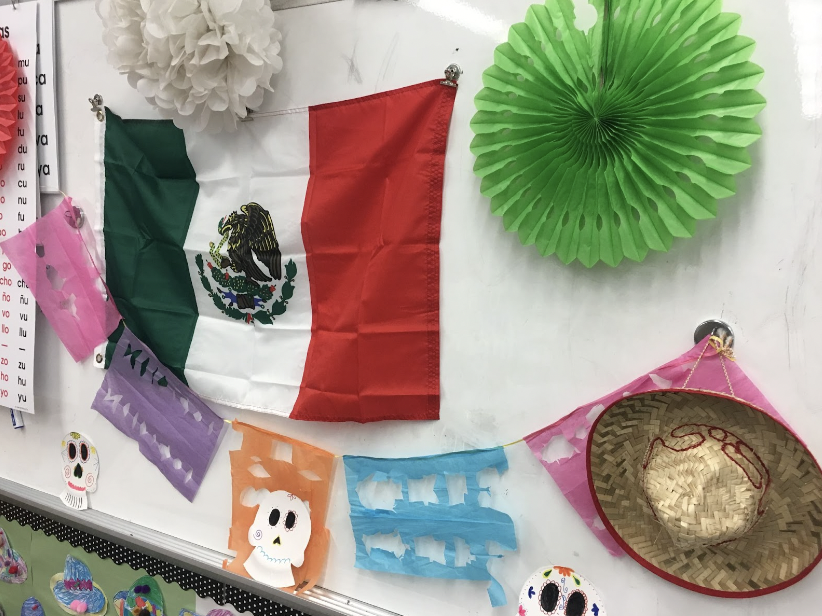
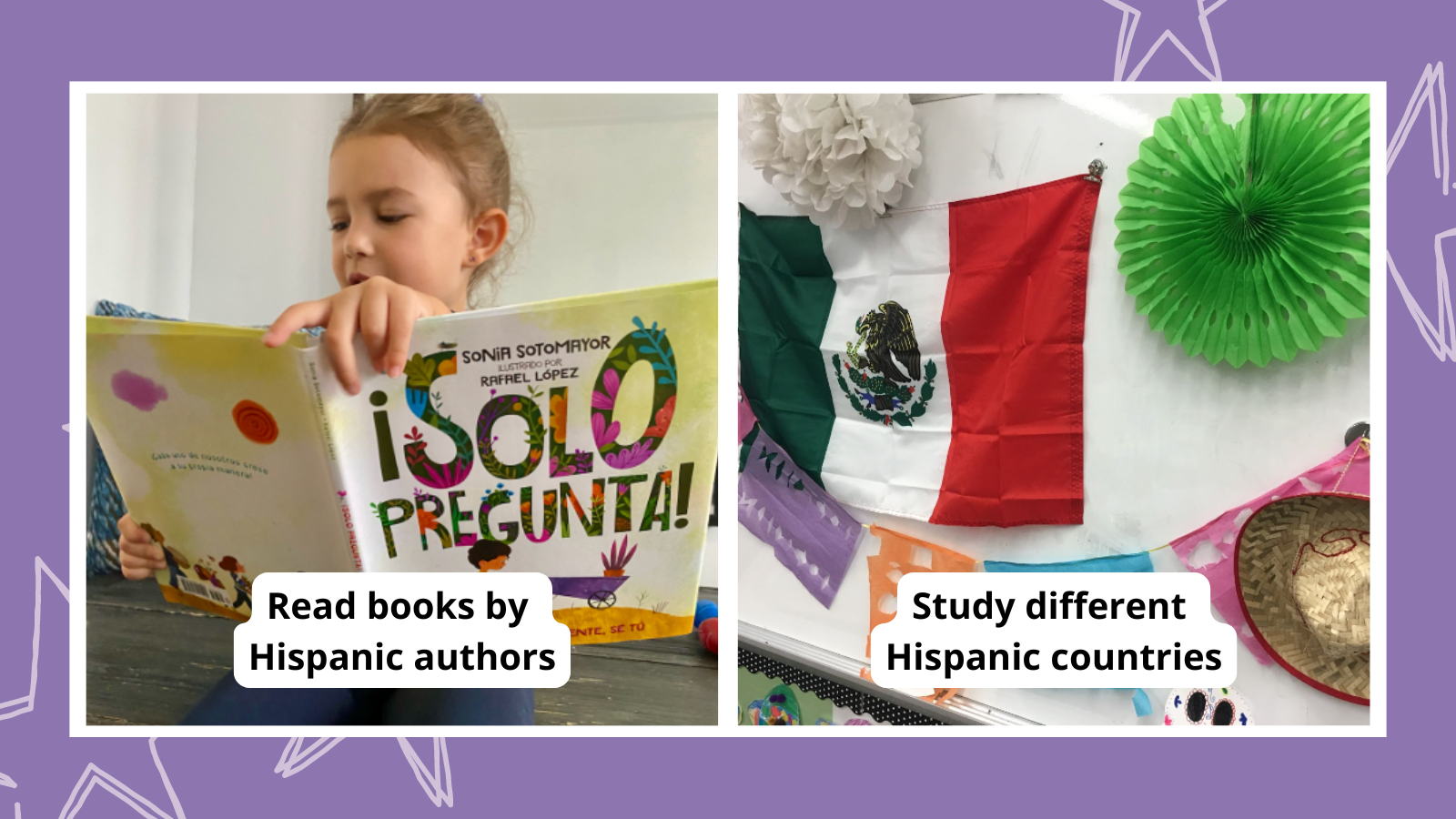
Having students do a country study can take many shapes. They can study and make oral presentations to the class or to parents. They can choose to present on the country’s music or food. They can create lively bulletin boards or poster boards to put up around the classroom … the list goes on and on! Students learn how to generate interesting questions, find the answers, and present what they learn.
14. Research El Día de los Muertos
Grades: Upper elementary, middle, high school
El Día de los Muertos (The Day of the Dead) is a Mexican holiday. It is celebrated from midnight on October 31 until November 2. During this time, it is believed that the gates of heaven are open and spirits of people who have passed on can rejoin their families here on Earth for those two days. People gather at cemeteries to welcome back the souls of their relatives with food, drinks, decorations, and celebration. Engage students in researching this holiday and presenting what they learn in a presentation, skit, or museum exhibit.
Learn more: El Día de los Muertos on YouTube
15. Make a retablo
Grades: Upper elementary, middle, high school
Peruvian retablos are a folk art made in the Andes mountains. They usually show religious scenes inside a box with doors, but they can also show cultural, political, or social events. It’s 3D storytelling in a wood box. Have students make their own with cardboard, paint, and other craft materials or buy one premade. Learning about retablos shows students how some Hispanic cultures tell stories and share information.
Buy it: Retablo at Amazon
Hispanic Heritage Reading and Writing Activities
You can read and write about Hispanic heritage long after the official month is over. Here are three activities specifically focused on reading and writing.
16. Read books by Hispanic / Latinx authors
Grades: Elementary, middle, high school
Reading builds vocabulary, empathy, and perspective-taking. There are many books for people of all ages that explore Hispanic and Latino themes and celebrate Latinx community members and contributions to our country.
Check out Books To Savor During Hispanic Heritage Month.
17. Read and write poetry
Grades: Middle and high school
Poetry is a great way to challenge students to analyze texts from various cultures. Read poems by Hispanic and Latinx poets and have students write poetry that is inspired by their culture or by pioneers that came before them.
Buy it: Yes! We Are Latinos: Poems and Prose About the Latino Experience at Amazon
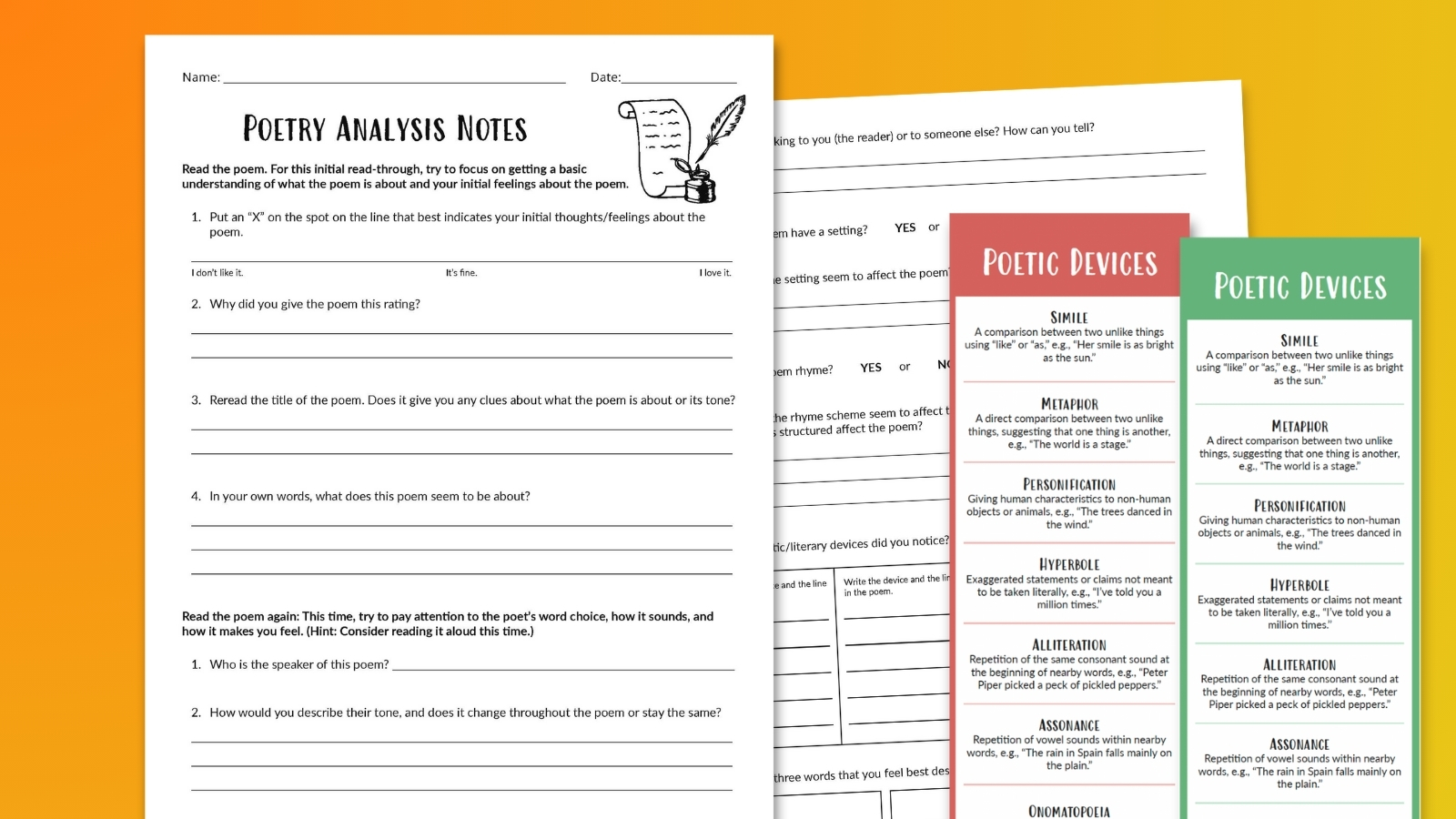
Poetry Analysis Worksheets
Use the poetry analysis bundle to engage students in analyzing poetry from Octavio Paz to Sandra Cisneros.
18. Learn about Hispanic pioneers
Grades: Elementary, middle, high school
Hispanic and Latin American individuals have contributed so much to the world, but sometimes they don’t receive the recognition they deserve. In fact, according to a 2023 study conducted by UnidosUS in collaboration with Johns Hopkins University School of Education Policy, only 13% of historically significant Hispanic-related topics are included in curriculum materials, often receiving only minimal coverage. Help close the gap by encouraging students to learn about prominent Latino figures by reading books, listening to speeches, or watching movies or documentaries about their lives. Then, they can show what they learned through a monologue, poster, or another presentation.
Here are some prominent people to learn about:
- Songwriter and director Lin-Manuel Miranda
- Supreme Court Justice Sonia Sotomayor
- Indigenous activist Rigoberta Menchú
- Labor rights and immigrant rights activist Dolores Huerta
- Baseball player Roberto Clemente
- Singer Celia Cruz
When students learn about Hispanic pioneers, they’re building cultural competence and background knowledge.
Hispanic Heritage Month Cultural Exploration Activities
Hispanic Heritage Month is an opportunity to explore something new to your students. These activities are open-ended and encourage students to learn more by asking questions or reading.
19. Try a free language-learning app
Grades: Elementary, middle, high school
Spanish is the second-most spoken language in the United States, so why not incorporate Spanish lessons into your Hispanic Heritage Month activities? Even learning a few phrases or words can ignite students’ interest in language learning. Duolingo is an incredibly popular app that allows students to learn Spanish, and there’s even a free standards-aligned version for schools where you can create assignments and see student progress. My daughter uses it to practice her Spanish skills. She loves the points and seeing progress.
Try it: Duolingo for Schools
20. Tour Frida Kahlo’s home (virtually)
Grades: Middle and high school
Frida Kahlo was an influential, now-iconic Hispanic artist. Tour her house, La Casa Azul, and study her art in this virtual tour. The virtual tour teaches students about Kahlo’s life and legacy.
Try it: Virtual Tour of La Casa Azul
21. Take a virtual tour of the National Museum of the American Latino
Grades: Middle and high school
From lawmakers, advocates, and artistic creators to entertainment superstars, Hispanic Americans are making a huge impact in today’s society. Explore the Molina Family Latino Gallery at the Smithsonian National Museum of American Art online, where students can learn about famous and influential Hispanic Americans. The virtual tour teaches students about Hispanic pioneers and builds general knowledge about U.S. history.
Try it: Molina Family Latino Gallery Virtual Tour at the Smithsonian’s National Museum of the American Latino
22. Learn a new dance
Grades: Elementary, middle, high school

Learning dances teaches cultural awareness and the benefits of dance—spatial awareness and coordination. There are so many rhythms and dances throughout Latin America—merengue, salsa, cumbia, vallenato, tango … and on and on. Invite dancers to your classroom or bring in a residency so kids can learn. My daughter’s school had a flamenco residency in 1st grade. You can also simply watch some videos, listen to the rhythm, and practice the dance moves in the classroom.
Here are some great YouTube videos to get you started:
- La Clave by 123 Andres
- La Pachamama (Spanish/Quechua) by Flor Bromley feat. Wendy Sulca
- Ballet Folklorico from PBS
23. Make and taste Latinx treats
Grades: Middle and high school
Like music, traditional foods help students understand and appreciate a country’s culture. Many students have heard of tacos and quesadillas, but there is so much more than that in Latinx cuisine.
Students can research how a Latinx recipe reflects the country it’s from, and then make it and share it. You can make quick treats in the classroom or at home such as:
- Tostones (fried plantains) from the Caribbean and many countries in Latin America
- Pan de yuca from Ecuador
- Arroz con leche from various Latinx countries
24. Celebrate Afro-Latinidad
Grades: Middle and high school
Due to the transatlantic slave trade, which brought people of Africa to the American continent, there are sizable Black populations in numerous countries in Latin America. That includes Colombia, which has the first free Black city, Palenque, created by runaway enslaved people. Engage students in asking questions, then finding the answers, to deepen their knowledge of what it means to be Latinx.
Learn more: How Much Do You Know About Afro-Latinidad on YouTube
25. Virtually tour ancient Indigenous ruins
Grades: Middle and high school
Hispanic Heritage Month includes celebrating the Indigenous communities and history in Latin America. There is a lot of Indigenous history and archaeology to explore. Check out one of Mexico’s Mayan pyramids, Chichén Itzá. Or for more Hispanic Heritage Month activities, take a tour of the historical city of Teotihuacán, also in Mexico.
Once students have learned about Chichén Itzá or Teotihuacán, they can build a replica of the site, explore how ancient cultures applied their knowledge to impressive technology, or read more myths and legends.
Learn more: Chichén Itzá and Teotihuacán on YouTube
26. Explore ancient Indigenous cities
Grades: Middle and high school
Combine geography, history, and culture by studying ancient cities. There are multiple sites that explore the different Indigenous communities of Latin America. Of course, the most popular one may be Machu Picchu in Peru, an archaeological site of the ancient Inca. There are others that are less famous but equally important such as Ingapirca in Ecuador, which stands at 10,500 feet in the Andes. Another one is Isla del Sol in Bolivia’s Lake Titicaca, which is said to be the birthplace of the first Incas. Indigenous cultures are often overlooked, so inviting students to do research on these would be powerful. The truth is that Indigenous cultures are a part of Latin American cultures and should be studied and celebrated.
27. Make hot chocolate
Grades: Elementary, middle school
Sometimes studying culture means learning about how a modern treat has a rich history. Despite the popularity of Swiss chocolate, chocolate actually originated in Latin America. Cacao beans are still cultivated in multiple Latin American countries including Mexico, Colombia, and Ecuador. Every country has a specific hot chocolate recipe.
In Colombia, you make hot chocolate with cheese.
Try it: How To Make Hot Chocolate With Cheese on YouTube
In Mexico, it is called champurrado. Make this Mexican hot chocolate exactly how an abuelita (grandma) would make it.
Try it: How To Make Champurrado on YouTube
Family and Community Engagement Hispanic Heritage Activities
For a Hispanic Heritage Month family celebration, bring families together to eat, watch a movie, or share paletas. Your team can plan an activity or two, and invite parents to bring their own foods, music, and experiences to share.
28. Host a Hispanic Heritage Week
Mejia celebrated Hispanic heritage with her students over the course of a week. Here are five ideas for a Hispanic Heritage Week:
- Bring your flag to school: Students bring or wear their native country’s flag.
- Wear clothing that showcases your native country: Students can wear traditional clothing, soccer jerseys, or a tribute to their favorite singer.
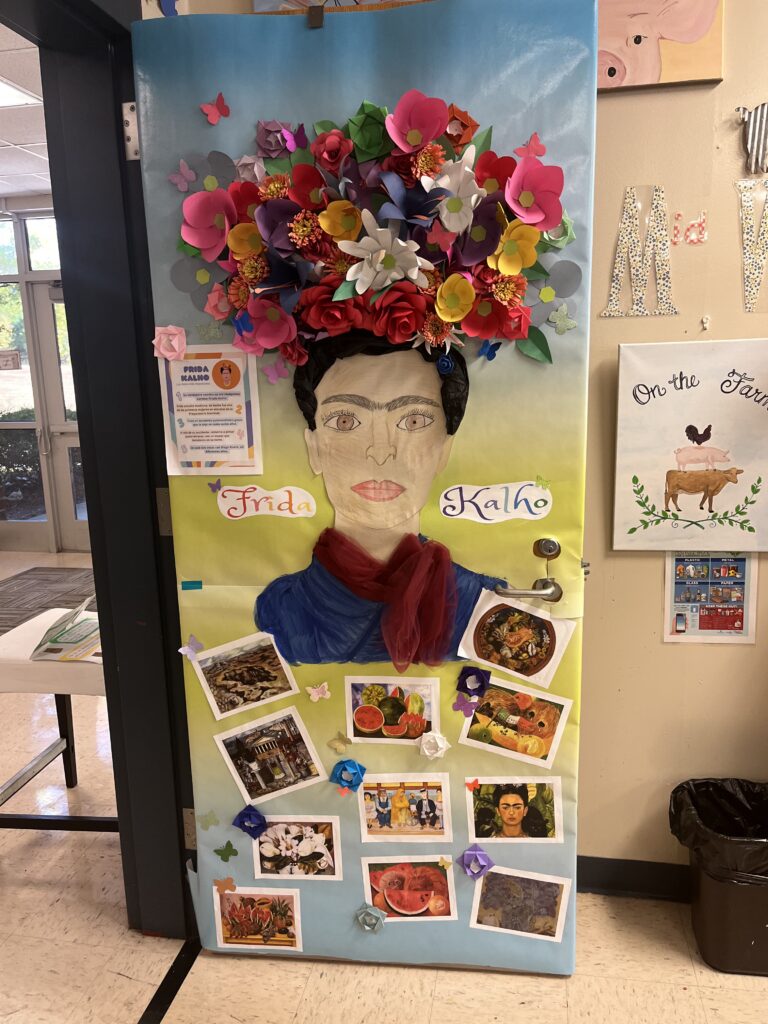
- Hold a door-decorating contest: Each class decorates a door to celebrate a Hispanic country or person. (The winning door at Mejia’s school was the Frida Kahlo door below).
- Taste of …: Students bring in their favorite foods or snacks to share.
- Famous person day: Students dress like a famous person from their country and are ready to introduce themselves as that person.
A spirit week takes a community and some advance planning to bring together, but it’s worth it.
29. Host a Hispanic potluck
Grades: Elementary, middle, high school
There are so many foods, recipes, and traditions that vary from country to country and region to region. Students can bring in treats and have a food potluck in the classroom or as a school. Students can also do research on what foods are available in their neighborhoods, visit a local panadería (bakery) to see what they can find, or you can invite chefs or home cooks (or parents!) to the classroom to present and talk about foods they enjoy making and how they celebrate their Latino culture.
30. Watch a movie
Grades: Elementary
Movies bring people together and teach a thing or two. Here are some great Latinx stories that you can create a community night around:
- Vivo (by Lin-Manuel Miranda): Set in Cuba and Florida, this film tells a story of lost love.
- Encanto: Set in Colombia, Encanto explores themes of family and identity.
- Coco: Set in Mexico, this movie celebrates Día de los Muertos.
31. Have a paleta party
Grades: Elementary
Paletas are Mexican Popsicles that are often fruit-flavored. They’re made with water (paletas de agua) or milk (paletas de leche). Read Paletero Man by Lucky Diaz, a celebration of paletas and the vendors who push carts full of paletas for kids to buy, and try a new flavor of paleta.
Try it: Paleta recipe at Live Eat Learn
Buy it: Paletero Man by Lucky Diaz
Get free Hispanic Heritage Month printable worksheets!

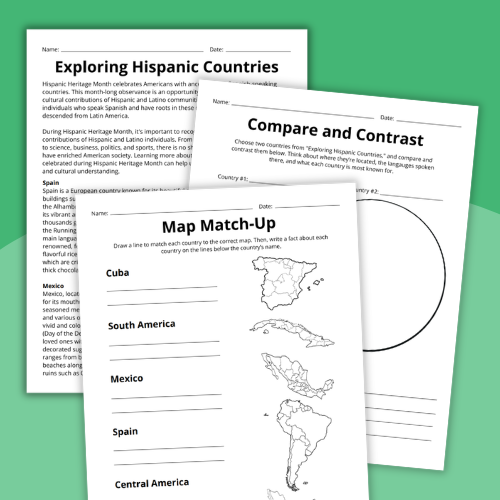
Print our Hispanic Heritage worksheet bundle with fun and educational activities for your students, including:
- Informational text about Hispanic countries with comprehension questions
- Venn diagram to compare and contrast Hispanic countries
- Hispanic countries map-matching activity
- Hispanic countries research activity