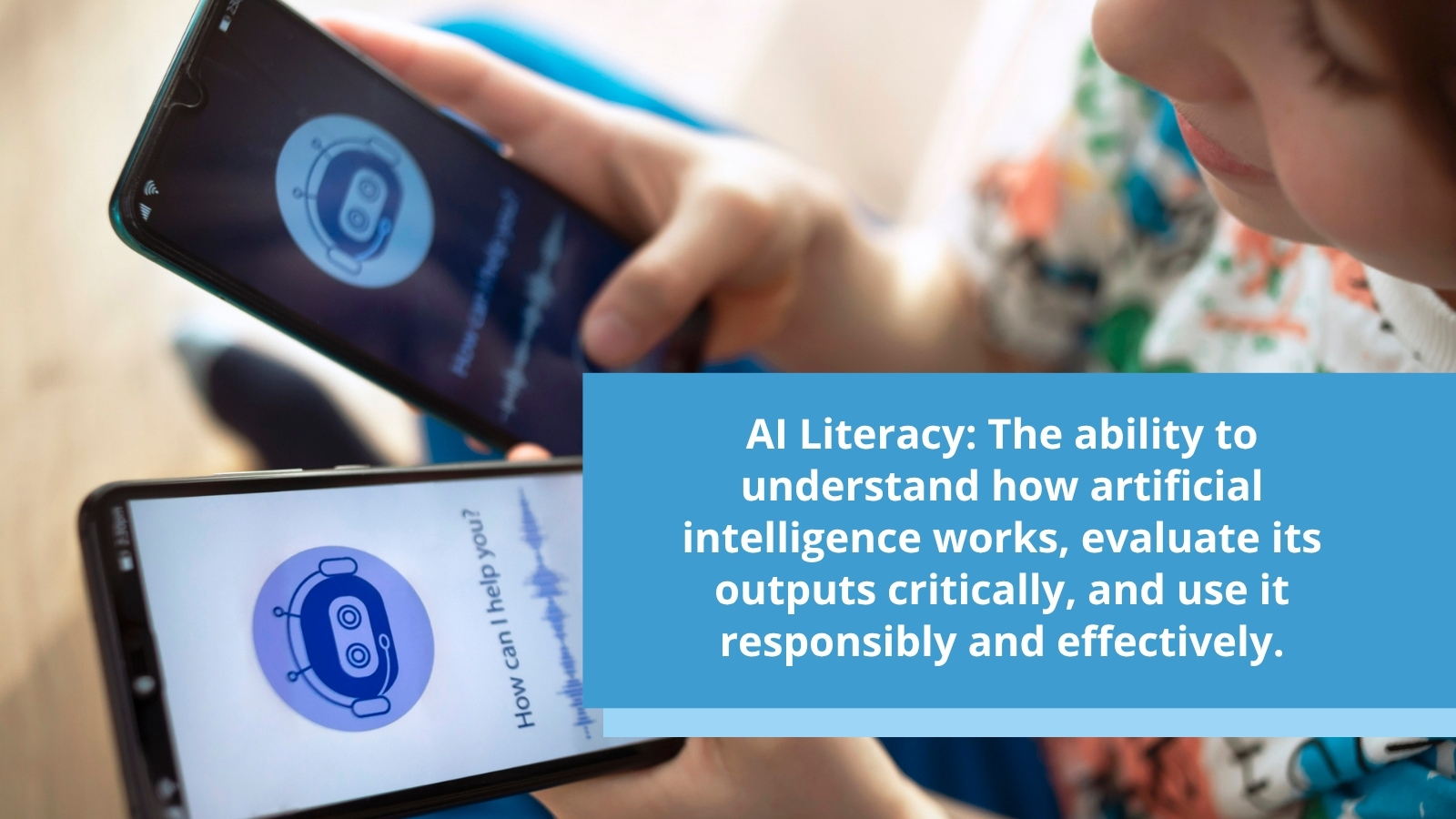

As AI transforms every aspect of our lives, equipping students with AI literacy is no longer a choice—it’s a necessity. This critical skill set empowers students to understand, evaluate, and interact with AI technologies, preparing them for a future where AI is ubiquitous. Just as smartphones have become indispensable, AI is here to stay, and classrooms must adapt.
To help teachers and schools tackle AI literacy, we asked Jennifer Womble, Chair of the Future of Education Technology Conference (FETC), to share her thoughts on why AI literacy is so vital in today’s classrooms. We’ve also rounded up a variety of resources to support a strong AI literacy framework, including a variety of helpful books from our friends at Solution Tree.
Jump to:
- Why We Must Teach AI Literacy Instead of Avoiding It
- AI Literacy and Generative AI Tools
- Empowering Students With AI Literacy
- Addressing AI Misuse
- Preparing Students for AI-Ready Futures
- AI Literacy vs. AI Competency
- Teaching Strategies for AI Literacy and Competency
- AI Literacy Activities for the Classroom
- Discover AI Literacy Resources for Real Classrooms
- Teaching AI Literacy FAQs
Why We Must Teach AI Literacy Instead of Avoiding It
Teaching AI literacy equips students with future-ready skills, enhances critical and creative thinking, and fosters responsible digital citizenship. —Jennifer Womble
AI tools cannot replace meaningful learning, but they can support it—just like any other tool.
Think of it this way: We teach young students to understand basic arithmetic functions like addition, subtraction, multiplication, and division, so they can apply those concepts to more complex math tasks later on. Later on, we introduce calculators as a possible tool. Calculators help students save a little time and ensure accuracy as they tackle algebra, geometry, and trigonometry, allowing them to focus on complicated concepts and equations. They’re an accepted (and valuable) part of higher math education today.
Can students use calculators to cheat? Of course they can, and sometimes they do. But most students simply use them as a supportive tool, because teachers have both shown them how to use calculators properly and when it’s appropriate to use them.
We can—and must—do the same with AI tools. In a 2025 HEPI study, two-thirds of students (67%) said they think using AI is “essential” in today’s world. But only about a third (36%) of students have received training in AI skills. That’s where AI literacy comes in and why every school needs to make it part of the curriculum.
Featured resource: Irreplaceable: How AI Changes Everything (and Nothing) in Teaching and Learning, by Maya Bialik and Peter Nilsson at Solution Tree
AI Literacy and Generative AI Tools
It’s important to note that when we talk about AI literacy these days, it often refers to the use of generative artificial intelligence tools, frequently called GenAI. Examples include ChatGPT, Copilot, Gemini, and Khanmigo. AI literacy is a broader concept, but GenAI tools have begun to dominate the conversation in schools and classrooms.
Many GenAI tools are powered by large language model (LLM) systems, which learn patterns in language so they can read, write, answer questions, and hold conversations in a way that sounds human. LLMs don’t “know” information the way humans do. Instead, they predict the words that are most likely to come next based on previous patterns. They can and do make mistakes, and using their output means learning to think critically—a key skill for students in every part of life.
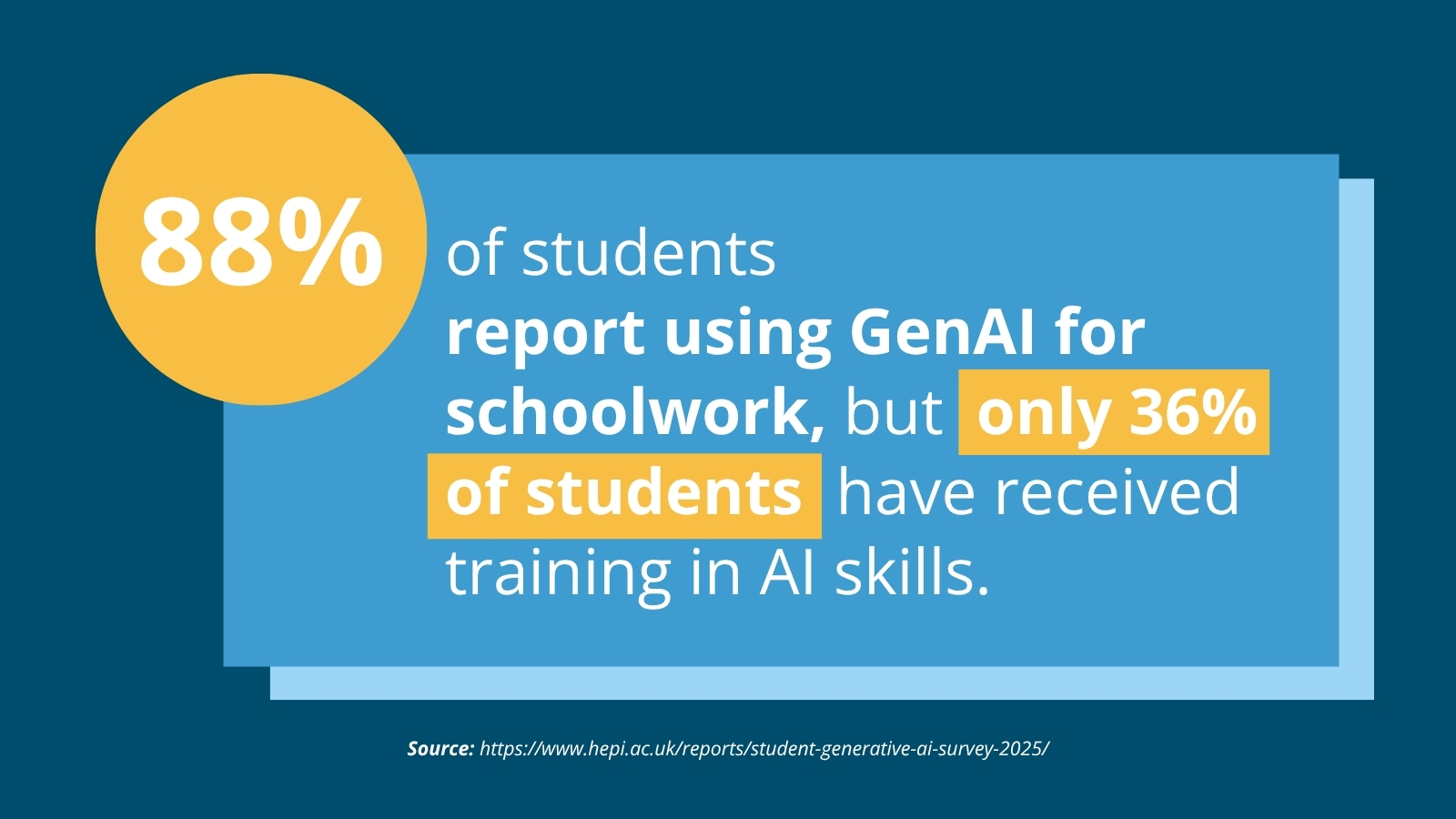
For today’s teachers and schools, generative AI tools (GenAI) like ChatGPT, Gemini, or Copilot aren’t optional. The reality is that most students are already using these tools. In 2025, 88% of students surveyed reported using GenAI for schoolwork, up from 53% in 2024. The question is no longer “Should they use it?” but instead “How can we empower them to use AI responsibly?”
Empowering Students With AI Literacy
“AI literacy empowers educators and students with knowledge on how to responsibly use AI tools to create engaging learning experiences,” says Womble. “Educators can leverage AI to personalize learning, while students and families gain awareness of ethical concerns like bias and privacy.”
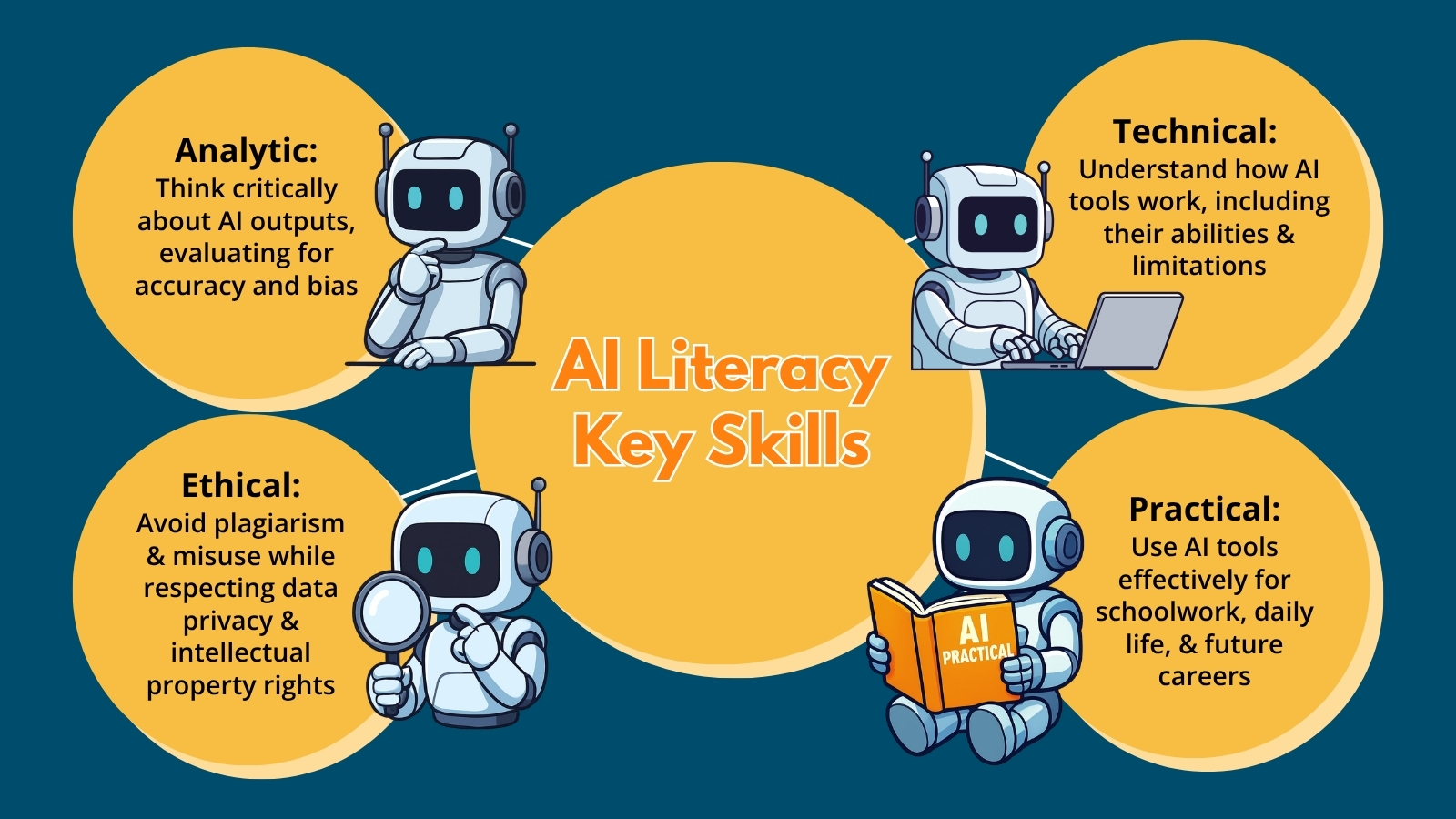
Strong AI literacy programs empower students to:
Understand How AI Works
We often take artificial intelligence for granted, as it’s such an integrated part of our daily lives. AI itself isn’t new. Weather forecasts, bank fraud detection systems, and even autocorrect—they’re all forms of artificial intelligence that have been around for decades. But most of us don’t really know how they work, which means we often don’t understand their full capabilities and limitations.
Knowledge is power, and the more students know about the way AI tools work, the better equipped they’ll be to use them. By teaching students the way AI tools function, including GenAI, we can help them understand when using it makes sense and when it’s more harmful than helpful.
Recognize Limitations and Biases
AI tools powered by LLMs are especially susceptible to errors and bias. After all, these tools learn from human-created data—they’re only capable of reflecting back what we put into them. Most importantly, we must help students realize that GenAI tools cannot think critically. That’s something students must learn to do for themselves.
Build Critical Thinking Skills
Developing critical thinking skills may be one of the most vital ways to empower students, whether they’re working with technology or not. Knowing how to evaluate and analyze information allows students to recognize errors and bias, make smart choices, and become responsible citizens in all walks of life.
Teaching AI literacy naturally builds the skills students need to analyze and evaluate information by showing them how to challenge assumptions, emphasize data over beliefs, and question everything rather than taking it at face value.
Promote Ethical, Responsible Use
Critical thinking skills also help students learn to use AI ethically and responsibly. AI-literate students know that with great technology comes great responsibility—just because you can doesn’t mean you should. Teaching AI literacy shows students how to avoid plagiarism and bias while respecting data privacy and intellectual property rights.
As AI tools continue to develop and expand, it’s also important to help students understand the potential societal implications of using and relying on this type of technology. For some, GenAI use presents an ethical dilemma—helping kids see all sides of the story empowers smart, responsible choices.
Strengthen (Not Replace) Academic Skills
AI-literate students know how to use AI to enhance their own thinking, rather than taking a shortcut. In 2025, 85% of college students surveyed said they use AI to explain difficult concepts, and 82% use it to summarize texts. Another study showed that about half of high school students use AI for brainstorming, editing their writing, or research.
In many ways, AI tools can serve as a sort of substitute teacher when students aren’t in the classroom—supporting brainstorming, clarifying complex ideas, and providing feedback.
Increase Confidence and Independence
When students understand AI tools, they can use them confidently and independently, leaving more time for teachers to work closely with students who need their help. “The goal of leveraging AI in the classroom is to create time for more human interactions, elevating the teacher role as the instructor, coach, and mentor,” Womble notes. Teachers can focus on building relationships with students to support their learning and success.
Addressing AI Misuse
AI technology comes with many benefits, but using it improperly is a major concern for schools and students. According to a 2025 study, 18% of students admit including AI-generated text directly in their work, while 10% to 15% of students use AI to complete entire assignments. And many others may not even realize they’re using AI in ways that are unethical or unhelpful.
This is why it’s vital for schools to develop a comprehensive AI policy, one that includes much more than just telling students “Don’t use AI to cheat.” Schools should be specific in their guidelines, helping everyone understand what is and isn’t appropriate. Find help and templates for developing strong school AI policies here.
Then, incorporate these policies into your AI literacy curriculum. Teach students not only how to comply with the policy but why it matters. And don’t stop there! Teach kids the right way to use AI by demonstrating, modeling, and even requiring these tools in classroom activities and assignments. Take away the mystery of AI by bringing it out into the open, and you’ll cut down on the temptation to use it improperly.
Learn more: Dealing With AI Cheating at School
Featured resource: The AI Balancing Act: Policies, Practices, and Purpose for Schools by Samantha K. Dykes and Rachel E. Morris at Solution Tree
Preparing Students for AI-Ready Futures
By integrating AI literacy, schools prepare students to engage critically, ethically, and effectively with AI. This ensures they can harness AI’s benefits while mitigating risks in an increasingly AI-driven world and future careers. —Jennifer Womble
As schools navigate the integration of technologies like AI, it’s essential to move beyond addressing misuse and instead focus on educating educators and students on responsible use. By embracing AI literacy, schools can unlock its potential to enhance learning and prepare students for an AI-driven future.
- Future-proofing careers: AI is transforming industries, creating new job roles, and making other jobs obsolete. Understanding AI helps students prepare for the future job market.
- Enhancing problem-solving skills: AI literacy encourages critical thinking and data-driven decision-making.
- Informed citizenship: As AI impacts society in various ways, students need to be informed citizens who can contribute to discussions about its ethical use.
- Empowering creativity and innovation: Understanding AI allows students to leverage technology creatively in fields like art, science, and business.
AI Literacy vs. AI Competency
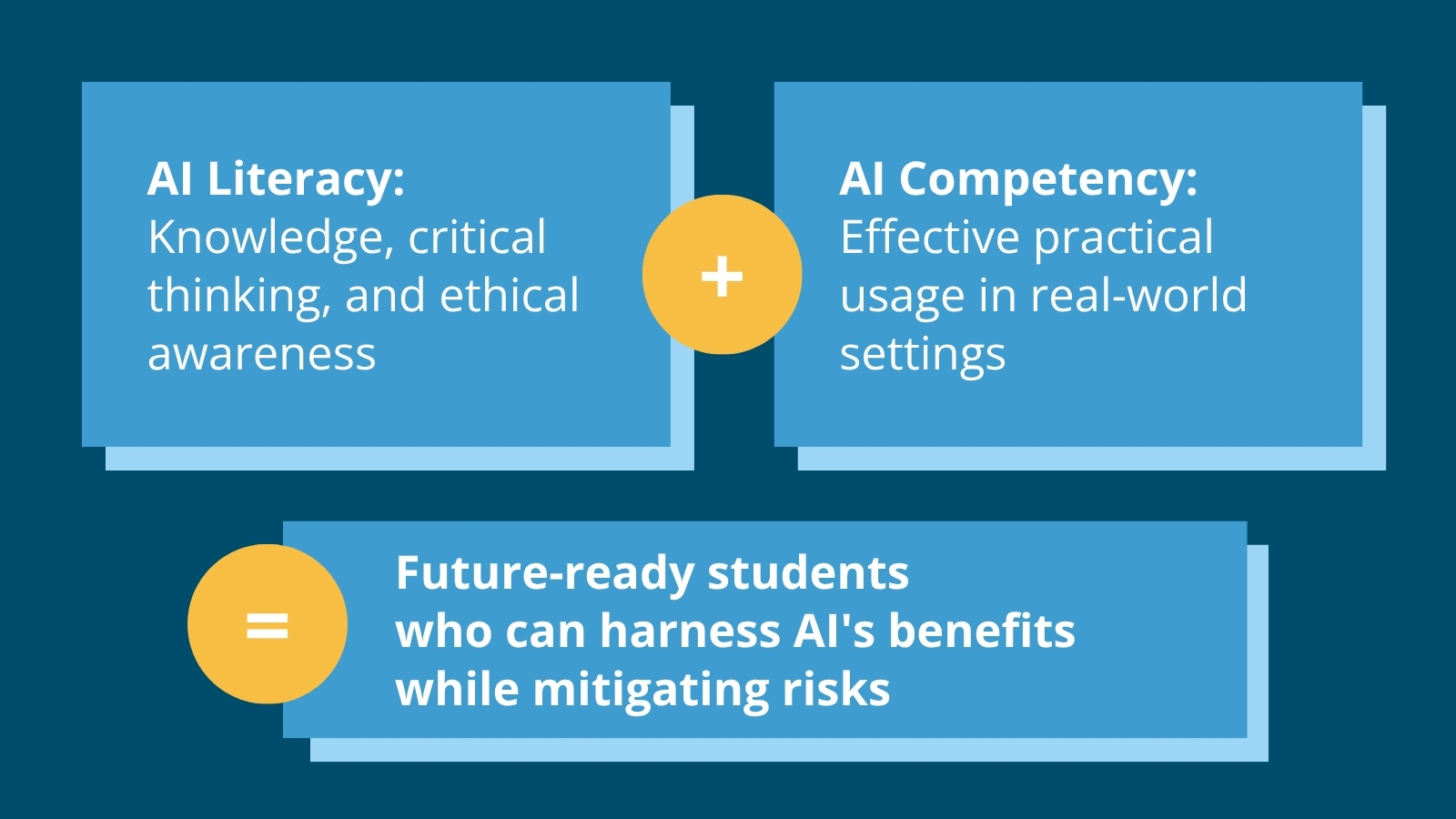
What is AI literacy, and how is it different from AI competency? Essentially, AI literacy means understanding what AI is and how it works, while AI competency is the ability to use these tools effectively. Here’s how Professor Thomas K.F. Chiu, an e-learning policy expert from Hong Kong University, breaks down these two skill sets.
AI Literacy = Understanding
“AI literacy refers to a foundational conceptual understanding of AI,” Professor Chiu explains. “It focuses on knowledge, critical thinking, and ethical awareness rather than technical skill.”
According to Professor Chiu, AI-literate students can:
- Explain what AI systems are (e.g., machine learning, neural networks)
- Identify their real-world applications (like recommendation engines or facial recognition)
- Discuss societal implications such as bias, privacy risks, or economic disruption
AI Competency = Application
“AI competency, in contrast, denotes practical proficiency in using, engaging, interacting, developing, or managing AI systems in real-world contexts,” Professor Chiu says. “It moves beyond knowledge and understanding into capacity.”
Professor Chiu expects AI-competent students to “have the confidence and ability to use AI to complete specific tasks ethically, healthily, responsibly, and productively.” That includes the ability to:
- Critically evaluate their AI tools and knowledge
- Communicate and collaborate with AI tools
- Effectively use AI to support self-regulated learning
A strong AI curriculum includes both literacy and competency, supporting students as they learn and grow.
Teaching Strategies for AI Literacy and Competency
AI literacy for K-12 students should include understanding AI basics, recognizing AI’s strengths and limitations, ethical and responsible AI use, critical thinking, and media literacy. —Jennifer Womble
Here are our top tips for teaching AI literacy at any grade level.
Choose a Comprehensive AI Literacy Framework
Look for a program that teaches both AI literacy and AI competency. Educators can use frameworks like the one developed by Digital Promise, which includes three key components:
- Understand: Acquire basic knowledge of AI capabilities and functioning.
- Evaluate: Critically assess AI systems, their outputs, and societal impacts.
- Use: Learn how to interact, create, and problem-solve effectively with AI tools.
Learn more: Digital Promise AI Literacy Framework
Explore Ethical and Responsible Use
Acknowledge up front the risks and challenges of using AI and the ethical and moral dilemmas it can raise. Discuss the pros and cons, and spend time helping students understand your school’s AI policy and why it’s so important. Be very clear about what AI can and can’t do and when AI use is definitely inappropriate.
Use Age-Appropriate Scaffolding
As with other technology topics, start simple and build concepts gradually across grade levels. Young students don’t need too many technical details, so be sure what you’re presenting is basic enough for them to understand. As students get older, you can revisit ideas and concepts in increasing depth.
Emphasize Real-World Relevance and Transferable Skills
Remember that your ultimate goal is to prepare students for a future where they can use AI tools responsibly and confidently. Students should understand that AI tools are likely to be part of their daily working lives, not just a classroom tool. Give them plenty of chances to practice using the tools to navigate real-world scenarios.
Assess AI Literacy and Competency
As schools begin to teach AI literacy, the question will arise: How can educators effectively assess students’ AI literacy skills, given the rapidly evolving nature of AI technology?
“To assess AI literacy effectively, educators should prioritize application-based evaluations,” Womble advises. “By using diverse, hands-on assessments embedded in the curriculum, educators ensure students develop AI comprehension, critical analysis, creativity, and ethical awareness—equipping them to navigate and apply AI technology responsibly in an evolving digital landscape.”
Model Responsible AI Use
Demonstrate how to use AI tools ethically and effectively in the classroom. Show students how to:
- Verify information from AI sources
- Properly cite AI-generated content
- Use AI as a tool to gather ideas and enhance, not replace, critical thinking or writing
Make AI Equitable and Accessible for All
AI is a new technology and, as when computers were introduced, has the potential to be implemented without equity in mind. That means that some students receive more training and opportunity with AI while others are left behind.
Plus, as a technology that is trained on the data that we give it, AI presents its own privacy challenges. And, similar to equity concerns, AI can revolutionize education for students with disabilities and ELL needs, or it can leave them behind. It’s all in how we use it.
Learn more: How Schools Can Use AI While Protecting Student Equity, Privacy, and Inclusion
AI Literacy Activities for the Classroom
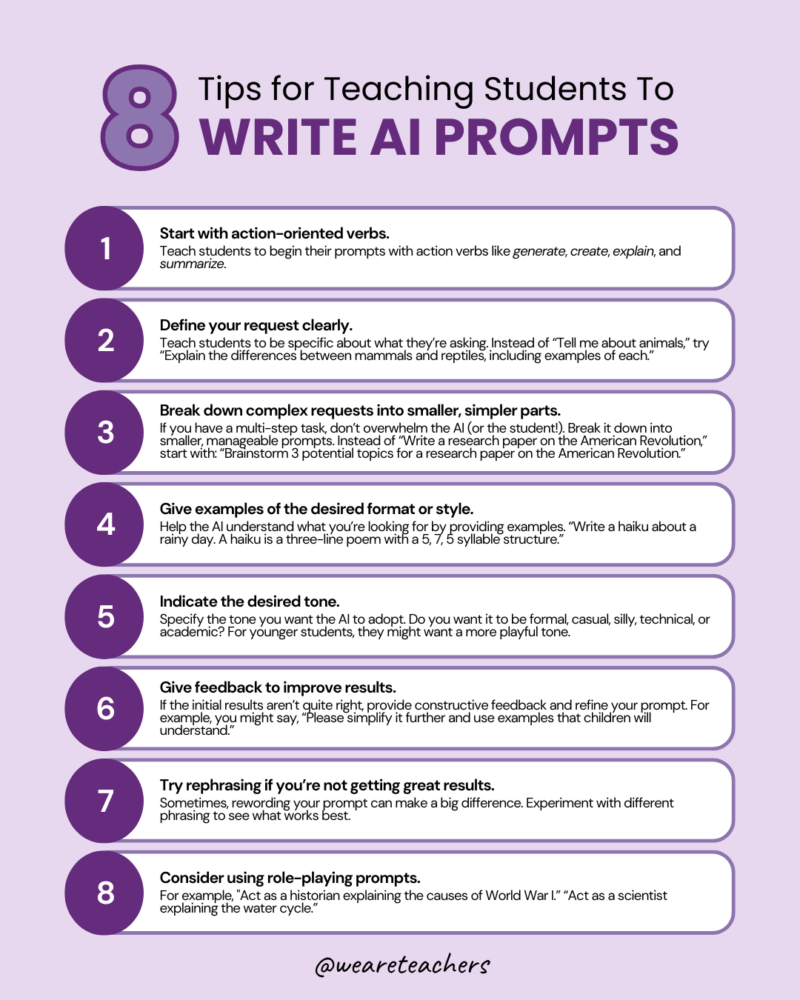
Teaching AI means actively modeling and using it in the classroom across the curriculum. Try these ideas!
Featured resource: Experimenting With AI: Activities, Discussions, and Prompts for the Classroom and Beyond by Stacie Chana at Solution Tree
Hands-On AI Literacy Activity Ideas by Subject
- ELA: Analyze AI-generated writing and discuss authorship. Discuss how AI is a tool and does not replace the art and craft of writing.
- Social Studies: Explore the impact of AI on jobs and society. Debate the ethical implications of AI in government decision-making, such as privacy concerns and bias in AI-driven policies.
- Science: Learn how AI is used to analyze large datasets in scientific research, helping students understand AI’s role in discovery and experimentation.
- Math: Integrate AI by using machine learning algorithms to solve mathematical problems or analyze datasets, teaching students about AI’s role in pattern recognition and prediction.
- Art: Explore how AI can generate art and design elements, discussing the intersection of creativity and technology. Consider the ethical implications of AI-generated art.
- Computer Science: Teach programming skills using AI tools, focusing on ethical coding practices and responsible AI development.
Activities for Exploring Responsible, Ethical AI Use
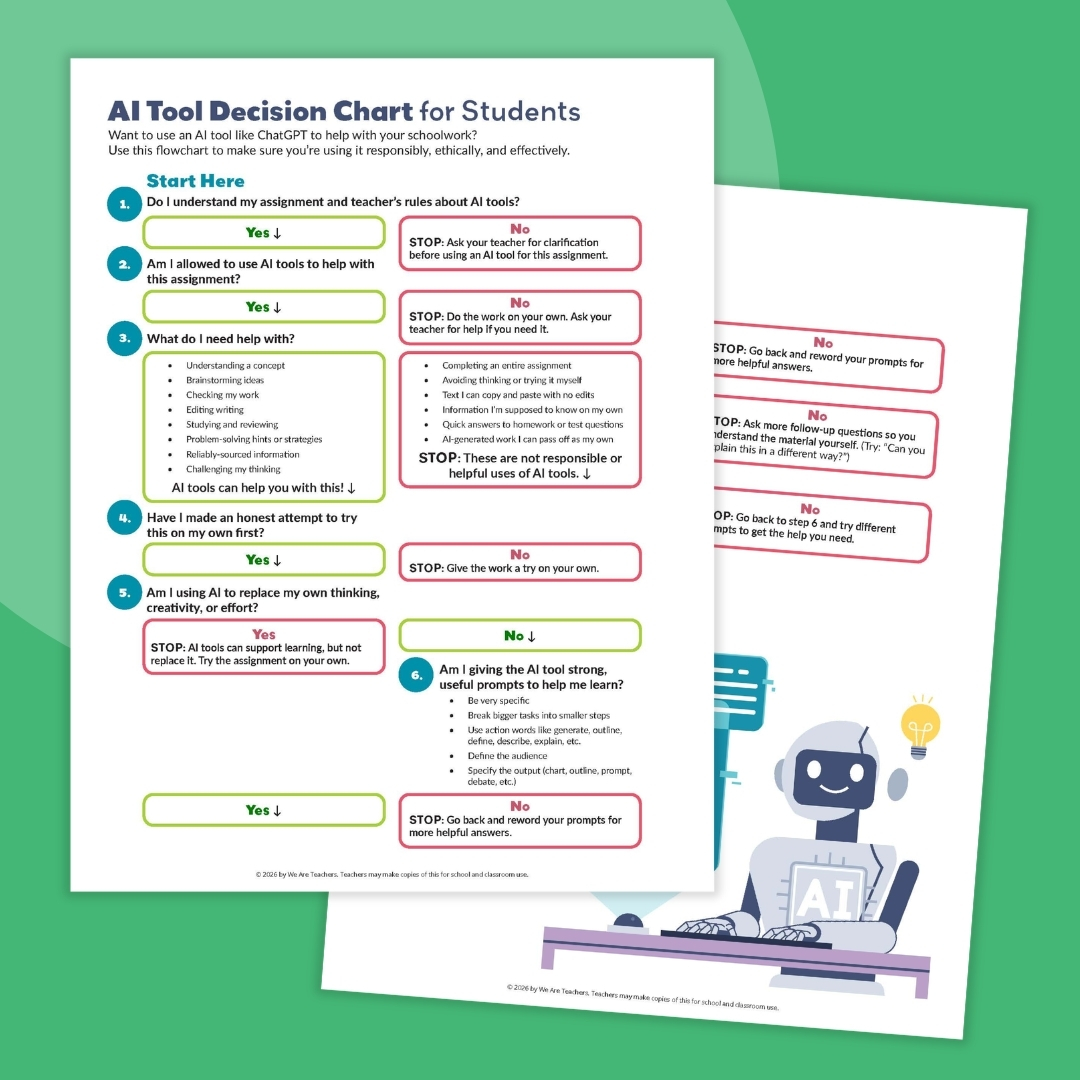
- Explore our AI Tool Decision Guide Flowchart together as a class, and practice using it.
- Ask students to write an essay about biases in AI systems and the societal implications of AI-generated content.
- Invite students to prepare presentations on ethical considerations of AI use in various contexts like news, social media, and schoolwork.
- Analyze images, text, or videos with students to determine if they’re AI-generated or human-created.
- Host a classroom debate on the ethics of AI tools (or debate an AI tool itself!).
- Use several AI tools for the same task, then compare and contrast their similarities and differences in a Venn diagram.
AI Prompts for Students
GenAI responses are only as good as the prompts that we feed in. But writing good prompts takes practice (and honestly, it’s a skill that most of us are still learning as GenAI grows and changes). First, learn how to write good prompts yourself as a teacher. Then teach students the process and give them examples of helpful prompts they can try, like these:
- Suggest five research questions related to [topic] for a 5th grade essay.
- Generate three practice problems about [mathematical concept].
- Explain the water cycle to a 3rd grader.
- Summarize this article in bullet points as if you were taking notes.
- Generate practice questions for a math test on adding improper fractions.
Learn more: 60+ Best AI Prompts for Students To Build Digital Skills
Discover AI Resources for Real Classrooms
AI Resources for Teachers and Schools
- Featured resource: AI education books from Solution Tree
- Wharton Interactive: Free five-part online course for educators on Large Language Models in teaching
- Microsoft: Offers a free online course for educators on using AI to improve learning outcomes
- ISTE AI in Education resources: Offers standards and guides for responsible AI use in schools
- The AI Education Project: Provides a free curriculum for students
- Eduaide: Teacher-created AI workspace
- FETC Conference
AI Tools for Students
- Use AI-powered tools like Wayground AI or Eduaide.AI for interactive lessons.
- Explore chatbots like School AI and Khanmigo with support.
- MIT App Inventor provides tutorials for building AI-powered mobile apps.
- Magic School builds AI literacy and personalizes learning.
- Try MIT’s AI Literacy Units and MIT RAISE Playground for hands-on activities for various grade levels.
Videos
- Crash Course AI video series for teens
- What Is Artificial Intelligence? | Quick Learner for teens from Duke University
- What Is AI: Artificial Intelligence Facts for Kids
- AI Explained for Kids | What Is Artificial Intelligence? | How can AI help us? from CodeMonkey
- What Is Artificial Intelligence for Kids
- What Is AI? | Artificial Intelligence Explained from Super Sema
Teaching AI Literacy FAQs
AI literacy is the ability to understand how artificial intelligence works, as well as understanding its limitations. AI-literate students can use AI tools effectively, responsibly, and ethically, creating effective prompts that generate helpful responses. They know how to think critically, evaluating AI-generated responses for accuracy and bias. These students are prepared to use AI tools successfully in their future careers and daily lives.
“Teaching AI literacy equips students with future-ready skills, enhances critical and creative thinking, and fosters responsible digital citizenship,” says Jennifer Womble, Chair of the Future of Education Technology Conference (FETC). In a 2025 HEPI study, two-thirds of students (67%) said they think using AI is “essential” in today’s world, but only about a third (36%) of students have received training in AI skills. In a world where AI tools have become ubiquitous, schools must make teaching the right ways to use them a priority.
Every school needs a comprehensive AI policy, one that goes beyond simply saying “Don’t use AI to cheat.” This policy should lay out the accepted uses for AI in schoolwork, as well as approved AI tools. Good policies provide examples and resources to help students and families understand expectations, backed by strong AI literacy curriculum programs across grade levels. Learn how to write a strong school AI policy here.
AI-literate students know how to use AI to enhance their own thinking rather than using it as a shortcut. Surveys show that students often use AI to explain difficult concepts and summarize texts, as well as for brainstorming, editing writing, or research. They also think critically, evaluating responses and using their own judgement, common sense, and knowledge.
AI literacy helps students avoid plagiarism and bias while respecting data privacy and intellectual property rights. At no time should students pass off any generative AI responses as their own or use these tools to avoid doing the work that’s meant to help them learn.
Students need strong critical thinking skills to evaluate AI responses for accuracy and bias. They also need to know how to use AI tools effectively while staying in control of their own learning. AI-literate students have strong digital and media literacy skills, and they understand the importance of using AI as a tool, not a work substitute.
Be sure to grab your free printable AI Decision Guide and Prompts for Students!
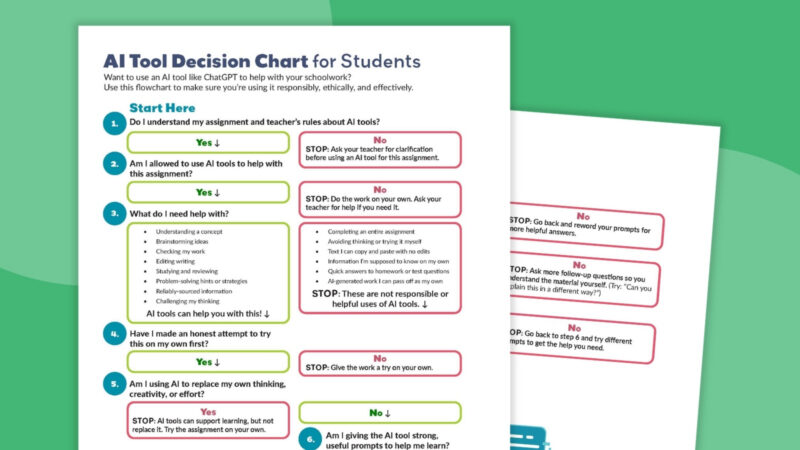
This indispensable guide helps students learn to make smart, ethical choices about using AI tools in their schoolwork. It also includes a roundup of prompts across subjects to get them started. Just fill out the form on this page to get your free printable.
Plus, see all our AI in the Classroom resources here!