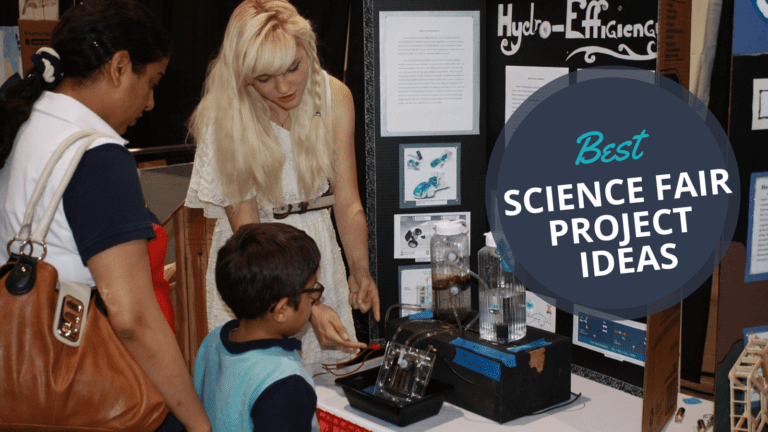
Seventh graders study everything from cells to food chains, all using the scientific method. Capitalize on students’ natural curiosity with classroom demonstrations, hands-on experiments, and long science fair projects. Whatever your approach, we have the best science fair ideas for 7th grade. Check out this list to find experiments that teach biology, physics, chemistry, and more.
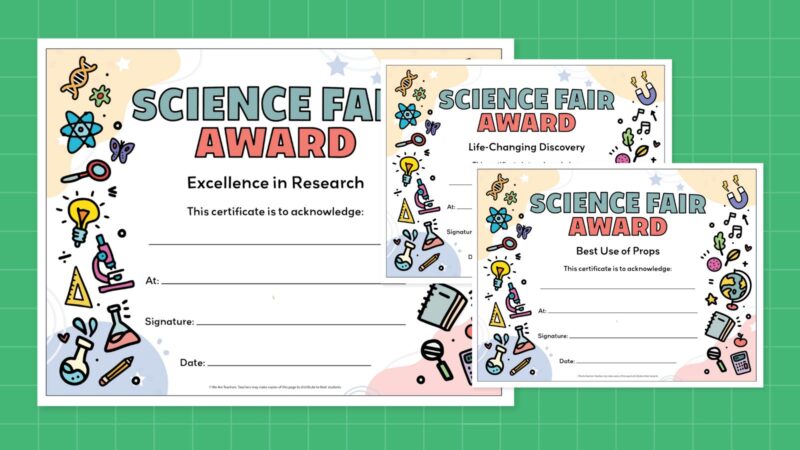
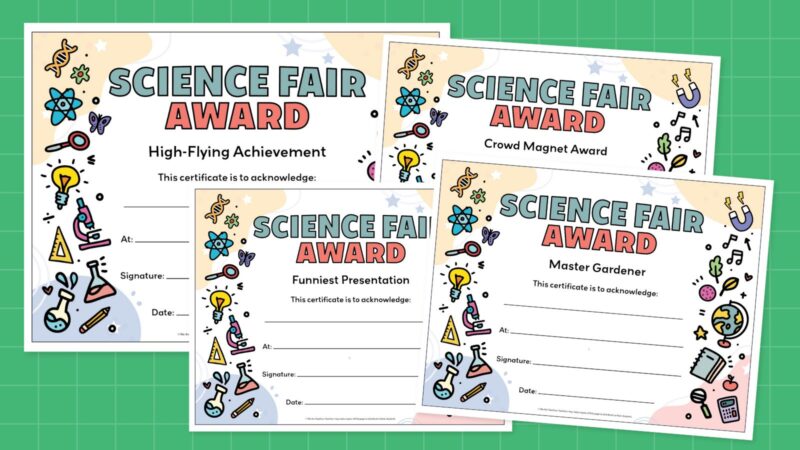
If you’re organizing a science fair, be sure to grab our free printable bundle of award certificates with more than 40 categories along with a customizable blank certificate so you can create your own awards. Just click the button below to get them.
Seventh graders are naturally curious, and they want to know how the world works. So it’s not necessarily about engaging them but deciding on the best experiments to introduce to them and when. Here are our favorite opportunities to get 7th graders working with science concepts.
Attention-getters: Use a quick demonstration, like making a density rainbow, to get students asking questions about what happened.
Centers: Many experiments are short enough to complete within a 15-to-20-minute rotation. Plan for students to move through centers that involve understanding the topic, practicing it, and writing about it.
Project-based learning: Longer projects are great for students to develop science knowledge alongside research, writing, and math concepts. Start with a real-world question, like how can we use science to help people who have survived a natural disaster? Then, let them apply their knowledge to come up with creative, science-based solutions.
7th grade science fair: Science fairs allow students to explore a topic they may not be able to at school. Get students started with their question and hypothesis, then send them home to set up the experiment and run it. Science fairs are great for students to monitor and collect data over a week or more, then present it during the fair.
Here’s our list of science fair projects and experiments for 7th graders.
Biology and Environmental Science
These projects teach biology concepts (mitosis, meiosis, genetics) and environmental science (ecosystems and habitats, etc.). Students will find projects that lend themselves to data collection, demonstration, and experimentation.
Grow biofilm
Difficulty: Medium Materials: Medium Time: 1 week Best for: Science fair project
Learn about biology by growing biofilm, the bacteria that grow on surfaces. Students can grow biofilm, and explain how they may grow differently on different surfaces. They can also explain any benefits or drawbacks to having biofilm on surfaces.
Build a light maze for plants
Difficulty: Medium Materials: Basic Time: Multiple weeks Best for: Science fair project
Students build a maze for a plant to grow through using a shoebox with obstacles students build in and a light source at one end. This experiment takes some planning but the result is impressive.
Demonstrate phototropism
Difficulty: Easy Materials: Medium Time: 1 week Best for: Science fair project
Phototropism is the way that plants move in response to light. Students set up a demonstration and record what happens. They can use paper and pencil or a video to show and explain what happens to their plants.
Record bird sightings
Difficulty: Easy Materials: Medium Time: 1 week or more Best for: Science fair project
This is a great way to build a love of birding for life. Students can make and hang their bird feeders, then record their data over a month or more and share it at the science fair.
Use Oreos to model mitosis
Difficulty: Medium Materials: Medium Time: 30 minutes Best for: Hands-on experiment
A 7th grade science activity that doubles as a sweet treat? Your students are going to love this activity using Oreo cookies and colorful sprinkles to make cellular mitosis models.
Model meiosis with pipe cleaners
Difficulty: Medium Materials: Medium Time: 30 minutes Best for: Hands-on experiment
Meiosis is similar to mitosis, but it’s specific to the production of gametes. These hands-on models use basic materials like pipe cleaners and beads to make the process easier to visualize.
Jelly bean genetics
Difficulty: Easy Materials: Medium Time: 1 class period Best for: Hands-on experiment
If you’re learning about how genetic traits are passed along from parent to child, try this jelly-bean demo. The demo will show students how animals and plants pass down traits, like Mendel did with his pea experiment.
Model the carbon cycle
Difficulty: Medium Materials: Basic Time: 1 class period Best for: Hands-on experiment
Take students’ knowledge of cycles up a notch by focusing on the carbon cycle. Students create and explain a model of the carbon cycle. (Bonus: Add in some physics by seeing if students can add movement to their models.)
Measure carbon content
Difficulty: Medium Materials: Basic Time: 1 class period Best for: Hands-on experiment
In this experiment, students measure the carbon content in various household products.
Create a taxonomy system
Difficulty: Medium Materials: Medium Time: 1 class period Best for: Hands-on experiment
Students can step into Linnaeus’ shoes by creating their own system of taxonomy using a handful of different dried beans. This is a fun 7th grade science project to do in groups, so students can see the differences between each group’s system.
Demonstrate the greenhouse effect
Difficulty: Easy Materials: Medium Time: 1 class period Best for: Hands-on experiment
Using two clear bottles or containers, fill one with carbon dioxide by mixing baking soda and vinegar. Cover the bottle and shine a light on it. Measure the temperature in each bottle to see how the greenhouse effect works.
Make an edible cell model
Difficulty: Medium Materials: Medium Time: 1 class period Best for: Classroom demonstration
Sure, students could build a cell model out of clay, but this option is so much more delicious! Watch the video to see how one teacher does it.
Simulate natural selection
Difficulty: Medium Materials: Medium Time: 1 class period Best for: Hands-on experiment
Travel to the Galápagos Islands and follow in Darwin’s footsteps as students explore finch beak adaptations in this clever natural selection lab.
Food chain marble maze
Difficulty: Medium Materials: Medium Time: 1 class period Best for: Hands-on experiment
Combine a STEM challenge with learning about food webs in this clever project. Kids will love the hands-on aspect, and it will really help the learning stick.
Create water filtration
Difficulty: Easy Materials: Basic Time: 1 class period Best for: Hands-one experiment
Show how different materials filter water and how we can clean water using different methods. Students can create filters with one type of material in each and different combinations to compare how well each filters water.
Test the effect of acid rain
Difficulty: Easy Materials: Basic Time: 1 week or more Best for: Science fair project
Create acid rain by mixing vinegar and water. Then, water one plant with acid rain and another with non–acid rain. Students record the results.
Create a grow box
Difficulty: Medium Materials: Medium Time: 1 week or more Best for: Science fair project
Students show what they know about how plants grow and what plants need by creating a grow box. Students who are especially interested in building will enjoy this project.
Extract DNA from an onion
Difficulty: Medium Materials: Medium Time: 1 hour Best for: Hands-on experiment
Students break down onion cells with a soap-and-salt solution, then add rubbing alcohol to separate visible DNA strands. They can observe the cloudy strands that form and connect the lab to cell structure, chromosomes, and genetic material. You’ll need an onion, dish soap, salt, water, rubbing alcohol, containers, a filter or mesh, and adult supervision.
Astronomy Science Project Ideas
For students who want out-of-this-world projects, eclipse viewers and models are a great way for kids to learn about astronomy and share all the fun facts they learn.
Make a solar eclipse viewer
Difficulty: Easy Materials: Basic Time: 1 day Best for: Science fair project
If you have a science fair that occurs during a solar eclipse event, making a solar eclipse viewer and documenting the experience of viewing and understanding the eclipse makes a great science project.
This project is good for 7th graders who love art and can get creative with how they present what they learn about the solar system.
Chemistry Science Fair Ideas
Chemistry experiments can be the most fun because they create the biggest bang, literally. Here are a variety of chemistry science experiments that 7th graders can run with.
Freeze water in an instant
Difficulty: Easy Materials: Medium Time: 1 class period Best for: Classroom demonstration
Explore the concept of nucleation (the process of chain reactions) by turning water into ice in seconds! Make this a 7th grade science fair project by trying the same process with other liquids.
Show how salt impacts density
Difficulty: Easy Materials: Medium Time: 1 class period Best for: Classroom demonstration
Explore the salinity of various bodies of water, then re-create their waters to see if you can make an egg float or sink. Experiment with other objects too.
Make a density rainbow
Difficulty: Easy Materials: Medium Time: 1 class period Best for: Classroom demonstration
We learn early on that oil floats on water, but where do other liquids fit in? Students find out when they conduct this colorful density experiment that has them layer different substances, making a rainbow.
Demonstrate how different materials impact teeth
Difficulty: Medium Materials: Basic Time: 1 class period Best for: Hands-on experiment
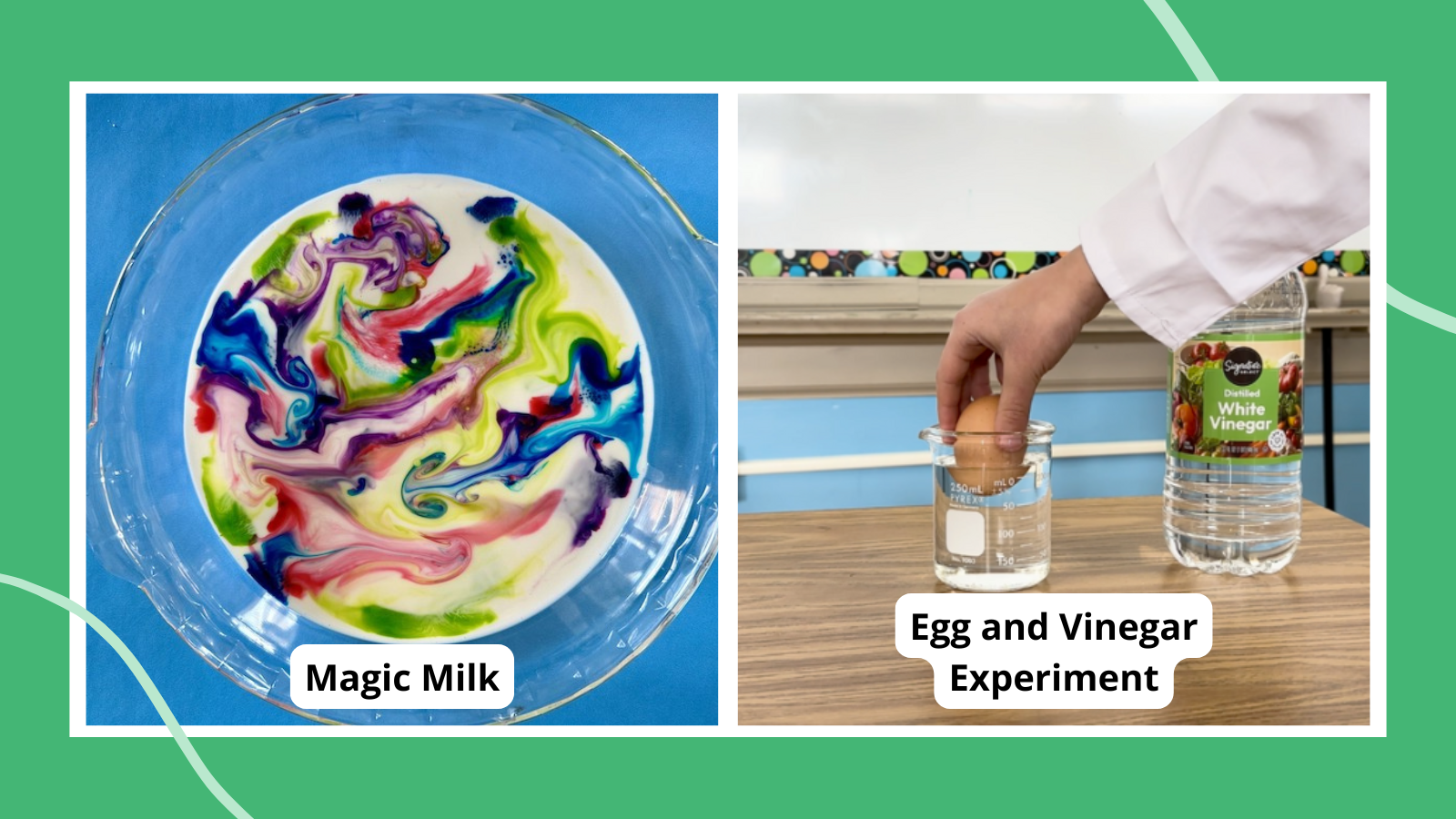
Show how different liquids impact our teeth using eggs as a stand-in for our pearly whites. A great experiment to talk about acids and bases, pH, and the practical implications of chemistry.
Make “magic” milk
Difficulty: Easy Materials: Basic Time: 1 class period Best for: Hands-on experiment
The Magic Milk Experiment, where students show how molecules and substances interact, is a great one to do on the spot. Push the science by having students explain what is happening at the molecular level and hypothesize how this interaction could happen using other substances.
Difficulty: Advanced Materials: Advanced Time: 1 class period Best for: Classroom demonstration
Students use a battery and pencils to show how water splits into hydrogen and oxygen. They can tell which gas is which by observing the number of bubbles that are in each stream (hydrogen will have double the bubbles as oxygen). This is another great experiment to model at a science fair.
Blow up a balloon with soda and candy
Difficulty: Medium Materials: Basic Time: 1 class period Best for: Hands-on experiment
Show how a chemical reaction (candy and soda) can blow up a balloon. Students can demonstrate and be ready to answer questions about how this reaction is strong enough to inflate the balloon.
Test the speed of melting ice
Difficulty: Easy Materials: Basic Time: A few hours Best for: Science fair project
This is another experiment that can be done at home and reported on at school. Students put ice into different bowls and see which conditions make it melt fastest. Challenge 7th graders by having them create their conditions to isolate the dependent variable as much as possible, and to be as specific as possible in their explanation.
Make elephant toothpaste
Difficulty: Easy Materials: Basic Time: 1 class period Best for: Classroom demonstration
Who doesn’t love an exploding experiment? This experiment uses a reaction between hydrogen peroxide and yeast, soap, and food coloring to create a huge multicolored foam explosion.
Difficulty: Easy Materials: Basic Time: 1 class period Best for: Hands-on experiment
Students who want to understand how chemicals react can use basic household materials to create invisible messages, then add other chemicals to reveal the messages. Explain the reaction and set up a station for students to explore how to write their own invisible messages.
Translucent egg experiment
Difficulty: Easy Materials: Basic Time: 1 class period Best for: Classroom demonstration
Students explain acids, bases, and chemical reactions with this demonstration. They’ll have to conduct the experiment at home and be ready to answer questions on fair day.
Difficulty: Easy Materials: Basic Time: 1 class period Best for: Hands-on experiment
Another science demonstration with a fun outcome. Students demonstrate how changing the ingredients that you use to make a ball changes its properties.
Make rock candy
Difficulty: Medium Materials: Basic Time: 1 class period Best for: Hands-on experiment
Show how crystals grow and how seed crystals change the rate that rock candy grows. Kids make different batches of rock candy to test which factors impact the final result.
Demonstrate metal corrosion
Difficulty: Medium Materials: Medium Time: 1 week Best for: Science fair project
In this experiment, students set up the conditions for different materials to rust and then collect data as the materials, well, rust. It’s a good way to practice a controlled experiment and data collection.
Difficulty: Easy Materials: Basic Time: 1 class period Best for: Hands-on experiment
Students add varying amounts of salt and other soluble materials to water and see how it affects the boiling point. A great opportunity for data collection.
Make a lava lamp
Difficulty: Easy Materials: Basic Time: 1 class period Best for: Hands-on experiment
Students demonstrate a common chemical reaction by making a lava lamp. This is a fun option for a science fair project because students can lead participants through the process.
Physics experiments and projects are all about moving things around in lots of different ways. These cool physics experiments will test students’ physics knowledge and perseverance as they try to get their projects to work just right.
Generate electricity
Difficulty: Medium Materials: Medium Time: 1 class period Best for: Hands-on experiment
Students use magnets, copper wire, and a spinning mechanism to create an electromagnetic generator. Turn it into an experiment by varying the materials to see if you can increase the amount of energy it produces.
Test balloon elasticity
Difficulty: Easy Materials: Medium Time: 1 class period Best for: Classroom demonstration
Explore whether heat and cold have an effect on elasticity using balloons. Try this with other materials too to expand the project.
Can you build a device that feeds your pets automatically? Even better, can you make it inexpensive and easy for others to build too? This project has real practical applications.
Design a pinball machine
Difficulty: Medium Materials: Medium Time: 1 week Best for: Science fair project
Give your class basic supplies like rubber bands, plastic cups, and cardboard boxes. Then challenge them to create their very own pinball machines!
Demonstrate centrifugal force
Difficulty: Medium Materials: Medium Time: 1 class period Best for: Classroom demonstration
This classic science experiment teaches kids about centripetal force. Be forewarned: This could potentially make a bit of a mess, so consider where this science fair project is placed.
Explore paper airplane dynamics
Difficulty: Medium Materials: Basic Time: 1 class period Best for: Hands-on experiment
Students can explore aerodynamics by making and testing paper airplanes. Which paper airplane features make the plane fly the farthest? How does aerodynamics explain this?
Difficulty: Medium Materials: Medium Time: 1 class period Best for: Hands-on experiment
Another way to make a battery—students can use what they have in their pantry. After they create a potato battery, they figure out how to use it and explain why it works.
Make a paper roller coaster
Difficulty: Medium Materials: Basic Time: 1 class period Best for: Hands-on experiment
Test and demonstrate the laws of physics with a paper roller coaster. Students can talk about and demonstrate potential and kinetic energy.
Assemble a maglev train
Difficulty: Medium Materials: Advanced Time: 1 class period Best for: Hands-on experiment
Show how magnets work by creating a maglev train. Students use wooden blocks with magnets to show how magnets can attract and repel to create movement or attraction.
Churn up a tornado in a bottle
Difficulty: Easy Materials: Basic Time: 1 class period Best for: Classroom demonstration
Another classic science experiment, students show how tornadoes funnel using 2 liter bottles, water, and a tornado connector tube. Add LEGO bricks or small toy animals to show how a tornado impacts objects it comes into contact with.
Demonstrate waves
Difficulty: Medium Materials: Basic Time: 1 class period Best for: Hands-on experiment
Students learn about compression and longitudinal and transverse waves, and how to show each with a common slinky. This is a great project for a student who has mastered the middle school content and is ready for more.
Make a balloon-powered car
Difficulty: Medium Materials: Basic Time: 1 class period Best for: Hands-on experiment
Use a balloon and building materials to create a car that shows how force works. If more than one student selects this as their project, compare the result. Which car moves the fastest and why?
Test the strength of a magnet
Difficulty: Medium Materials: Medium Time: 1 class period Best for: Hands-on experiment
Test what impacts the strength of a magnet by changing the temperature of the magnet. This is a great introduction to both magnetism and collecting data.
Measure the surface tension of water
Difficulty: Medium Materials: Basic Time: 1 class period Best for: Hands-on experiment
Use a glass of water and pennies to observe and measure water surface tension. Students research surface tension and how to measure it, then they set up their station and teach others how to understand surface tension.
Make a penny battery
Difficulty: Medium Materials: Medium Time: 1 class period Best for: Hands-on experiment
Make a battery using pennies, aluminum foil, and a water-salt solution. Seventh graders can explain what’s happening to make the battery work and find a creative way to show the power of their battery.
Engineering Science Fair Ideas
For students who like to build, build, build, engineering projects are a perfect science fair project. These engineering ideas are doable for middle schoolers and have practical applications they can talk about.
Make a robotic hand
Difficulty: Medium Materials: Basic Time: 1 class period Best for: Hands-on experiment
Students engineer a robotic hand. Challenge students to use materials to expand on this hand demonstration or create a hand that can do more actions.
Make a light switch box
Difficulty: Medium Materials: Medium Time: 1 class period Best for: Science fair project
Students learn about electricity while making a light switch box. Challenge them to find a practical use for their new knowledge about how electricity works.
Power a rubber band helicopter
Difficulty: Medium Materials: Basic Time: 1 class period Best for: Hands-on experiment
Create a helicopter and explain how it flies using materials you have around the house. Students can also get creative using different-size rubber bands or testing various materials that are heavier or lighter.
Design an eco-friendly house
Difficulty: Medium Materials: Medium Time: 1 week Best for: Project-based learning
This project requires research into what makes a house eco-friendly, and then creativity to design a house model that would be eco-friendly. This is a perfect project to research and explore architecture, materials, and insulation.
Make a windmill
Difficulty: Advanced Materials: Medium Time: 1 class period Best for: Hands-on experiment
Another eco-friendly idea: Have students make a windmill. They’ll learn about engineering principles and kinetic energy, and they can show off their creation.
Design a disaster-proof house
Difficulty: Medium Materials: Medium Time: 1–2 weeks Best for: Project-based learning
Students choose a type of extreme event (earthquake, tornado, hurricane) and design a house or structure that they think would sustain that event. Then, they test it on a small scale and talk about their results. This project is a fun way to learn about natural disasters and how movement, pressure, wind speed, and water impact materials.
Build a hydraulic lift
Difficulty: Medium Materials: Basic Time: 1 class period Best for: Hands-on experiment
Design a lift using water. Such a cool way to demonstrate engineering and physics.
The idea behind a Rube Goldberg machine is to create a complex machine to solve a simple problem. Study Rube Goldberg machines, then students plan and create their own. This is a great project for students who want an extra challenge.
Make a weather station
Difficulty: Medium Materials: Advanced Time: 1 week Best for: Project-based learning
Students either build their own weather station or test a weather station. This is a great way to collect and measure data and build knowledge about the weather they see every day.
Difficulty: Medium Materials: Basic Time: 1 week Best for: Project-based learning
There’s a lot students can do with bridges: Design them and analyze the structure and load they can take, measure how well they do in simulated disasters, and see how much support a bridge needs to span a long distance. The possibilities are endless!
Design a catapult
Difficulty: Easy Materials: Basic Time: 1 class period Best for: Hands-on experiment
Students learn the engineering and physics of catapults and set up various examples for participants to try. Students can make catapults as large or small as they want and they can decide what they want to fling—marshmallows, bottle caps, or something larger.
Make Newton’s cradle
Difficulty: Easy Materials: Basic Time: 1 class period Best for: Hands-on experiment
Students learn about energy and conservation of energy by building their own Newton’s cradle. Can they describe what’s happening?
Create a saltwater battery
Difficulty: Medium Materials: Medium Time: 1 class period Best for: Hands-on experiment
Students demonstrate how to use salt water to create a battery and move voltage from one location to another.
Earth Science Ideas
You’ll always have students who are into rocks, dinosaurs, the earth, and more. These ideas allow those students to dive deep (pun intended) into geology and earth science.
Yes, most rocks are hard, but some are harder than others. Research how hard rocks can be and how scientists classify them. Then, search for rocks and classify them by how hard they are.
Study thermal energy by making a solar oven. It’s best for hot days or if you live in a dry, hot climate. Students create an oven using a cereal box and materials they have around the house. Then, they use it to cook a s’more.
Difficulty: Easy Materials: Basic Time: 1 class period Best for: Hands-on experiment
Students research plate tectonics and use graham crackers and frosting to model them. Delicious and educational at the same time!
Explain oil spill cleanup
Difficulty: Easy Materials: Basic Time: 1 class period Best for: Science fair project
Students research how oil can be cleaned up and model it on a small scale. This project combines physics, chemistry, and earth science.
Erupt a volcano
Difficulty: Easy Materials: Basic Time: 1 class period Best for: Classroom demonstration
This is a classic science fair experiment, but it’s worth including because 7th graders can take the explanation and volcano models to the next level with their research and explanation.
Difficulty: Medium Materials: Basic Time: 1 day Best for: Science fair project
Students show how soil erodes and discuss the implications for gardening, planners and construction, and the earth in general.
Chemically weather rocks
Difficulty: Easy Materials: Basic Time: 1 class period Best for: Hands-on experiment
Place sugar cubes in water bottles with different substances, like vinegar or plain water, to test how physical or chemical weathering breaks down rocks.
Computer and Technology Experiments
Computers and technology provide lots of science experiments that require students to generate a hypothesis, collect data, and learn new skills.
Employ AI face or object recognition
Difficulty: Hard Materials: Advanced Time: Multiple days Best for: Science fair project
Train a machine-learning model to recognize and classify everyday objects or facial expressions. The trial and error involved is a great learning opportunity.
Block Wi-Fi signals
Difficulty: Medium Materials: Advanced Time: 1 hour Best for: Hands-on experiment
Which materials block Wi-Fi signals best? Students can test various materials, from aluminum foil to brick or glass. What practical applications might their findings have?
Build a Wi-Fi reflector
Difficulty: Medium Materials: Hard Time: 1 hour Best for: Hands-on experiment
Students build and test a parabolic Wi-Fi reflector out of foil and cardboard. They measure how it changes signal strength and which factors impact the results. A great way to combine math and science.
Test how fonts affect memory
Difficulty: Medium Materials: Medium Time: Multiple days Best for: Science fair project
Students design an experiment that tests whether people read faster or remember more when text is provided in various fonts, including one serif and one sans-serif font. A great way to practice collecting data and analyzing it.
Test how caffeine affects typing speed
Difficulty: Medium Materials: Easy Time: Multiple days Best for: Science fair project
Another great controlled experiment, students collect data about typing speed and how much caffeine someone has had. When they analyze the data, what do they notice? What does this mean for middle schoolers who drink caffeine?
Get your free printable Science Fair Award certificates!
We Are Teachers
If you’re organizing a science fair, be sure to grab our free printable bundle of award certificates with more than 40 categories along with a customizable blank certificate so you can create your own awards. Just follow the link below to get them.