
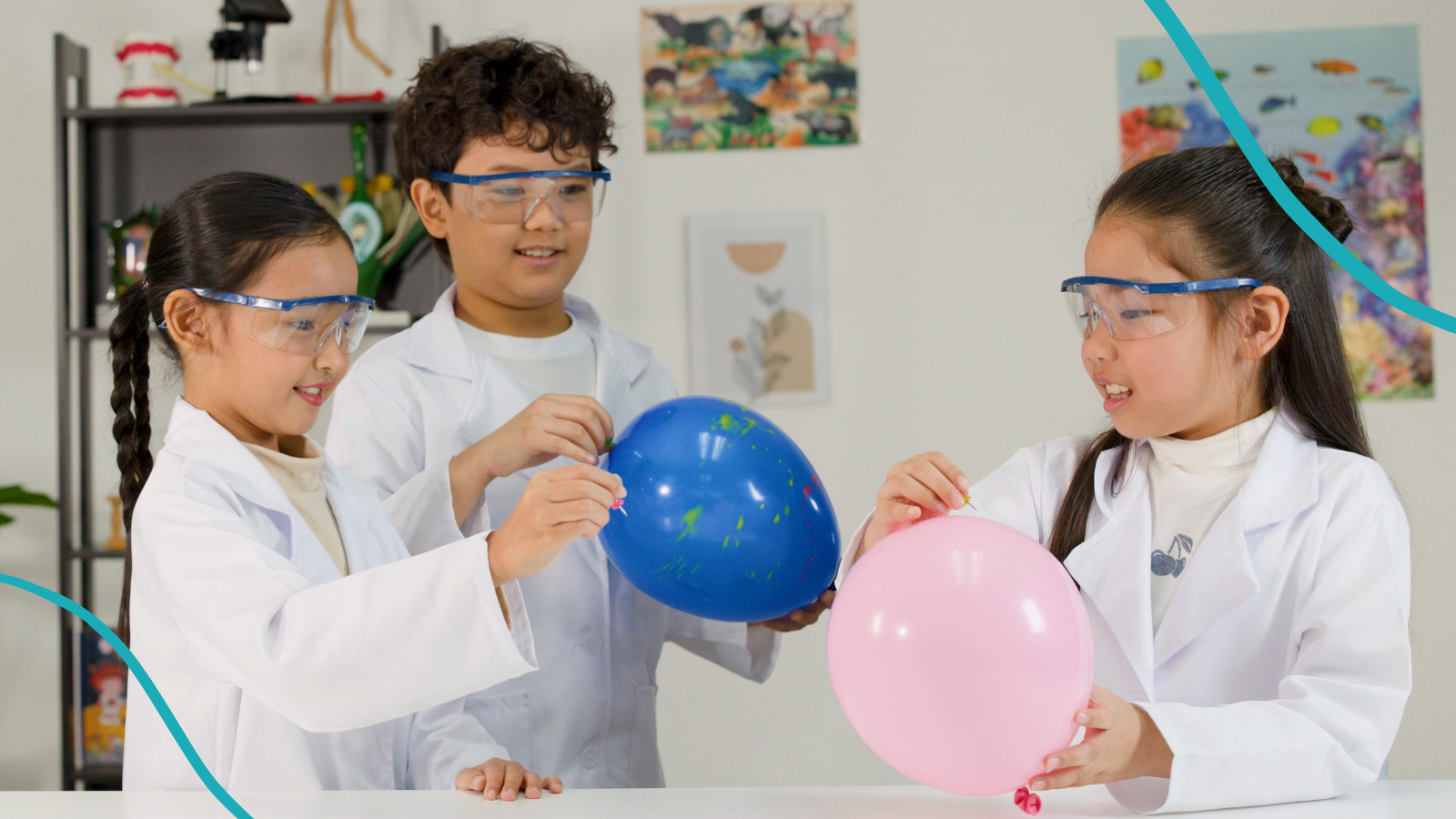

There’s something about the sight of colorful balloons that just makes you feel a little excited, don’t you think? That’s why kids will go crazy for these balloon experiments, whether they’re building a balloon-powered boat or powering a light bulb with static electricity. Plus, balloons are inexpensive, so stock up at the dollar store and get ready to throw a science party!
1. Blow up a balloon … without blowing
This is one of those classic balloon experiments everyone remembers doing in school. Kids learn about chemical reactions by mixing acids and bases. They’re always amazed at the results!
2. Design a balloon-powered car
Explore the laws of motion and encourage creativity when you challenge students to design, build, and test their own balloon-powered cars. Bonus: Use only recycled materials to make this project green! (Find more cool car activities for the classroom here.)
3. Skewer a balloon without popping it
If you do this one right, you’ll make kids’ eyes pop—but not the balloon! They’ll learn about the polymers that make balloons possible, and even a little bit about how to stay cool under pressure.
4. Float a balloon-powered boat
Discover the power of air pressure and the third law of motion with this fun and inexpensive balloon experiment. Take this one outside on a sunny day and let kids splash away while they learn!
5. Create ice crystal explosions
Fill balloons with water and leave them to freeze overnight. The next day, carefully cut open the balloons to reveal the beauty inside. Kids learn about crystallization and the expansion of water as it freezes. (Get more science experiments involving ice and snow here.)
6. Explore the science of swim bladders
Just how do fish manage to float without sinking or rising? Find out when you explore buoyancy with this swim bladder experiment using a glass bottle, balloon, and a few other basic materials.
7. Assemble a heart pump model
Anatomy lessons literally come alive when you do balloon experiments like this one. This working heart model demonstrates how blood pumps through the valves and chambers.
8. Learn how lungs work
Your students might be surprised to learn that lungs have no muscles to make them work. Instead, the contraction of the diaphragm pulls air in and forces it out. This clever model helps explain the process.
9. Blast off with a two-stage rocket
The rockets used for space flight generally have more than one stage to give them the extra boost they need. This experiment uses balloons to model a two-stage rocket launch, teaching kids about the laws of motion.
10. Build a hovercraft
It’s not exactly the same model the military uses, but this simple hovercraft is a lot easier to build. An old CD and a balloon help demonstrate air pressure and friction in this simple experiment.
11. Parachute a water balloon
Water balloon experiments make a big splash with kids! In this one, they’ll explore how air resistance slows a water balloon’s landing using a homemade parachute.
12. Sink or swim with water balloons
Fill water balloons with a variety of different liquids like oil, salt water, and corn syrup, then float them in a bucket of water to learn about density and buoyancy.
13. Perform the two balloons experiment
You have two balloons, one filled with more air than the other. When you open the valve between them, what will happen? The answer is almost certain to surprise you. Learn how it works in the video at the link below.
14. Power a light bulb with static electricity
One of the first balloon experiments most kids try is rubbing a balloon on their hair to make their hair stand on end. The next step is to hold the balloon over a compact fluorescent light bulb (CFL) to see it glow from the static electricity. Wow!
15. Spin a penny round and round
In this simple experiment, students use kinetic energy and centripetal force to spin a penny inside a balloon. They’ll want to try other objects too, so hold a contest to see which spins the longest.
16. Fire up an air cannon
Discover the power of an air vortex with this easy DIY air cannon. To really understand how it works, use some incense to create visible smoke rings that will really impress your students.
17. Create a working water fountain
See the power of air pressure when you build a balloon-activated water fountain. You’ll only need simple supplies like a plastic bottle, straw, and putty.
18. Explore the effects of hot and cold air
The concept of expansion and contraction of air can be hard to visualize. That’s where this experiment comes in to save the day. Watch the balloon expand and contract as the air around it changes temperature.
19. Fireproof a balloon
A balloon will obviously pop when touched to a hot flame, right? Not if you put some cold water in it first! Kids will be so amazed they won’t even realize they’re learning about the heat conductivity of water.
20. Experiment with balloons and pushpins
A pin pops a balloon in no time flat, so what happens when you place a balloon on a table full of them? Once again, the answer won’t be quite what your students expect until you explain the science of distributed pressure.
