
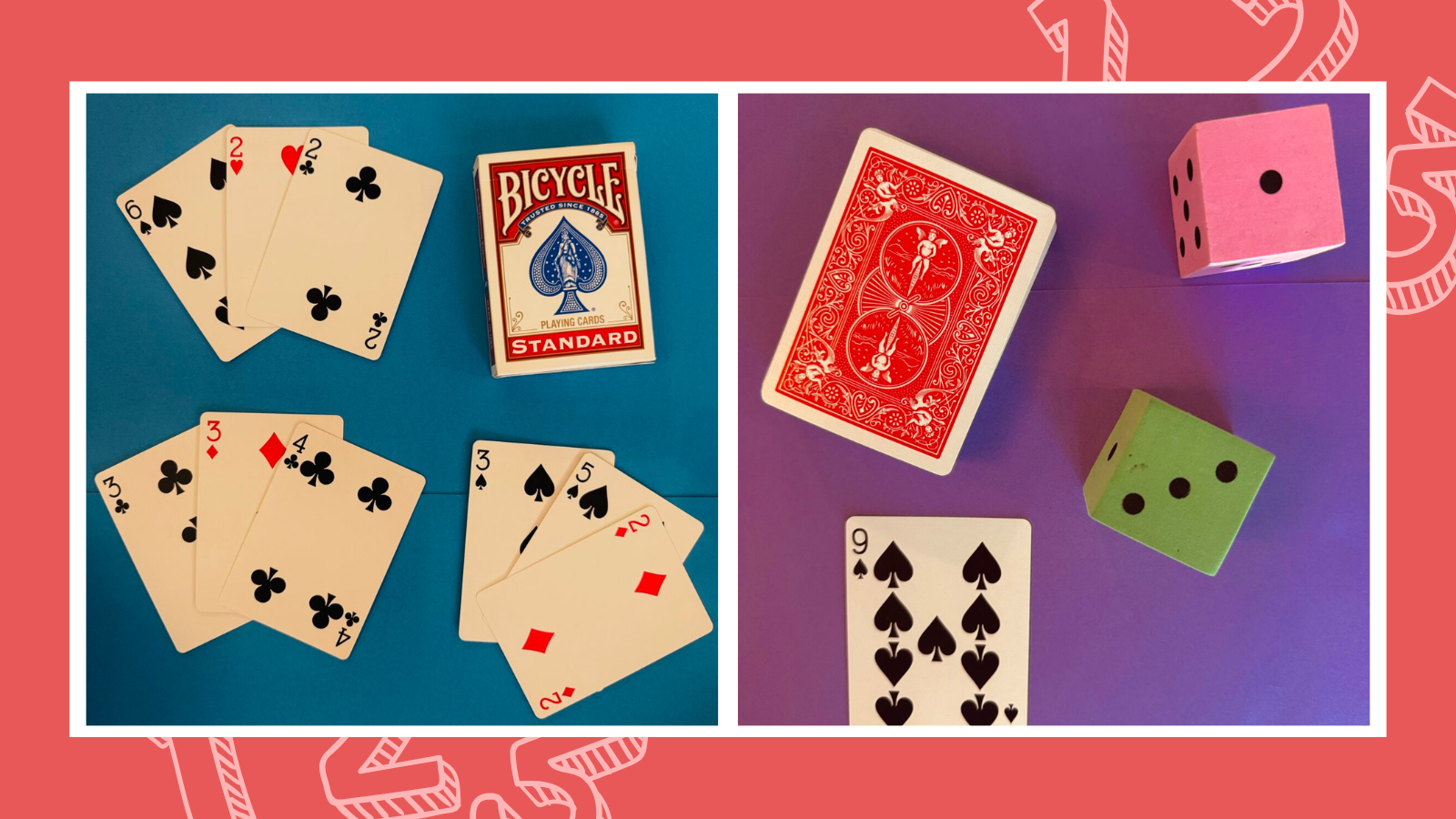

A deck of playing cards contains a lot of math just waiting to be explored! We’ve rounded up a big collection of math card games for kids, along with expert tips and recommendations.
Jump to:
- Sarah Noseworthy’s Top Math Card Games for Kids
- Math Card Games for Preschool and Early Elementary
- Math Card Games for Upper Elementary and Middle School
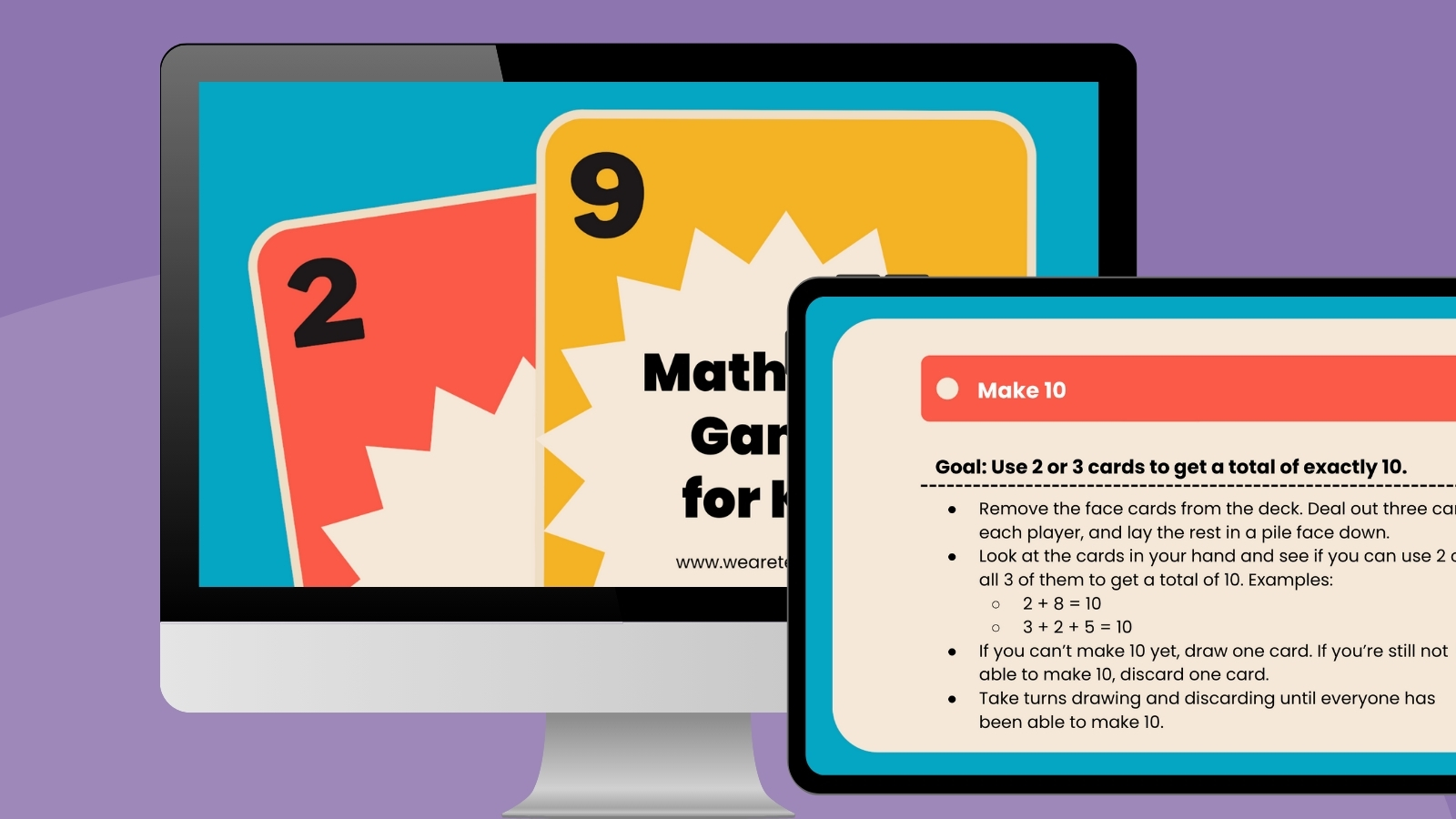
Sarah Noseworthy’s Top 3 Math Card Games for Kids
Sarah Noseworthy has been teaching for over 20 years and is an experienced classroom math teacher for grades 5 to 8. She now runs SN Learning Studio (@snlearningstudio), where she provides small-group and private math tutoring for grades 5 to 12.
“Playing cards are so versatile and accessible, and I find that students tend to see playing cards as a game rather than ‘doing math,’ which lowers anxiety and increases engagement,” Sarah notes. “You can easily adapt card games for younger players by removing the higher numbers, and I also love that each card has a symbolic and pictorial representation for the numbers from 1 to 10.”
Sarah also loves the fact that card games naturally encourage repeated practice without feeling repetitive. “Students might solve dozens of math problems during a game without realizing how much practice they’re actually getting!” she says. Here are some of her top math card game picks for all ages.
Make 10
Math Skills: Making 10, addition within 10, adding 2 or 3 numbers
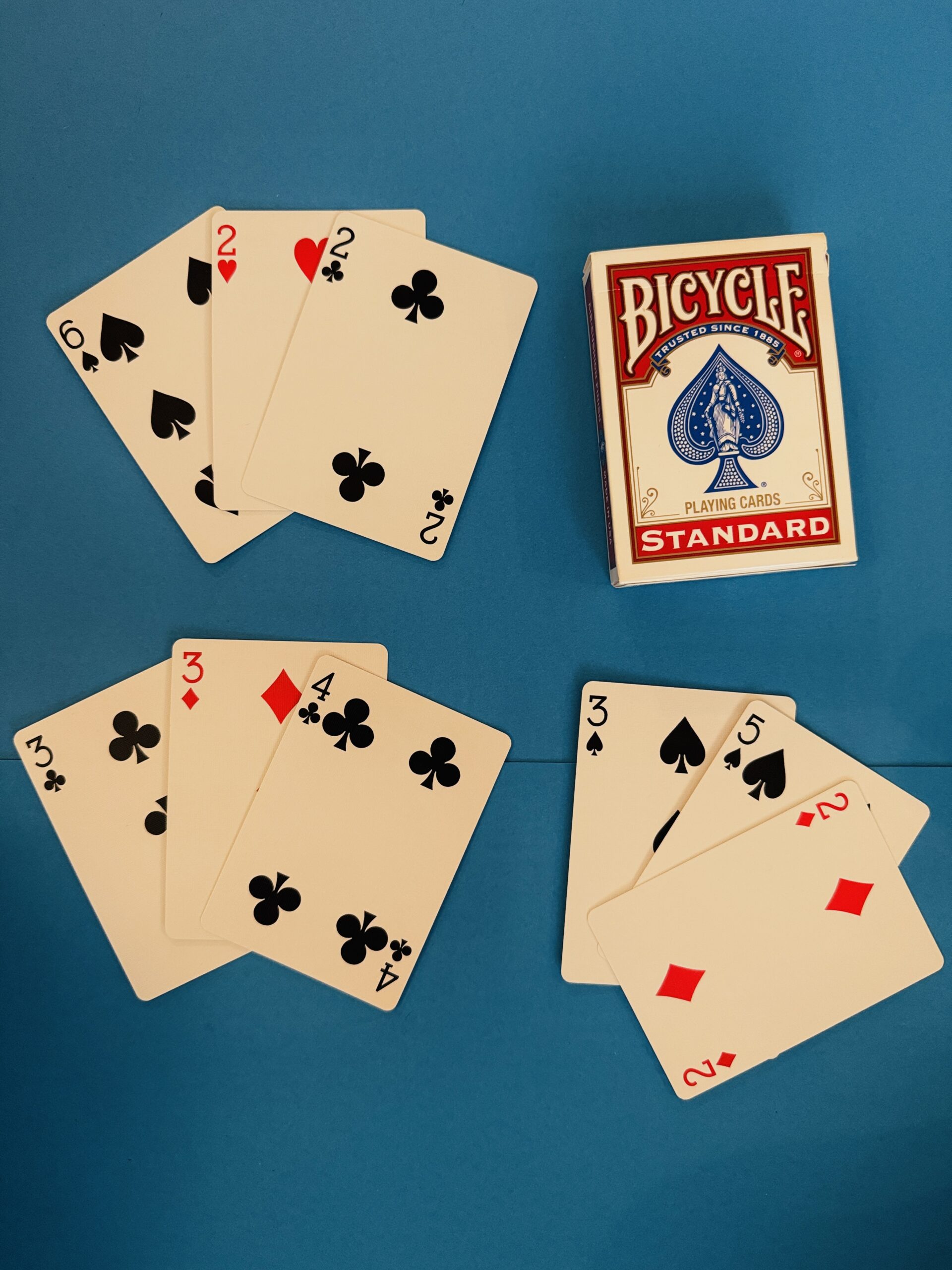
Remove the face cards from the deck. Deal out three cards to each player, and lay the rest in a pile face down. Each player looks at the cards in their hands to see if they can add 2 or all 3 of them to make a total of exactly 10. (Examples: 2 + 8 = 10; 3 + 2 + 5 = 10.) Players can discard one card in each round and pick up a new one until they have a combination that makes 10. Once they do that, they win the round.
Why Sarah Loves It: “I like this one because kids can think flexibly by putting together many different combinations of numbers that equal 10. It can easily be differentiated too by including the face cards and making 20.”
I Spy the Cards
Math Skills: Arithmetic, number recognition
Deal out 20 cards face up, and choose one player to be “I.” That player chooses one or more cards and offers clues to the other players until someone guesses the correct card or cards.
Example 1: “I spy a card that’s even and greater than 3.” One player points to 6, which happens to be the card “I” was thinking of, so that player wins the round.
Example 2: “I spy two cards that add up to 15.” One player points to a 7 and an 8, but “I” says those aren’t the right cards. The next player guesses a 9 and a 6, which are the cards “I” was thinking of, so they win the round.
Why Sarah Loves It: “This is another game that gets students thinking flexibly by breaking larger numbers down into smaller pieces. It also gives students an opportunity to practice their math vocabulary.”
Close to 100
Math Skills: Adding within 100, logic and reasoning
The object of this game is to get as close to 100 as possible and not go over. Players each pick four cards from the deck. They arrange the cards to create two two-digit numbers that when added together will give them the closest possible sum to 100 without going over.
Example: A player draws a 3, 7, 2, and 9, and creates 37 + 29 = 66. (Other combinations like 92 + 37 or 72 + 39 would result in the total going over 100.)
Why Sarah Loves It: “This is a favorite in my tutoring groups as a ‘cool-down’ game at the end of our sessions. It can easily be played with two people or with larger groups. We also play the ‘close to 1,000’ version with six cards arranged to form two three-digit numbers.”
More Math Card Games Sarah Loves
Check out Sarah’s videos for each of these games!
- The 10-Frame Game: This game is great for lower elementary and even preschoolers to develop an understanding of the unit 10.
- Pyramid: A great solitaire game to practice addition.
- Math Tic-Tac-Toe: This game is great for all ages! It allows players to think flexibly and strategically.
Be sure to follow Sarah on Instagram (@snlearningstudio) for more teaching tips and ideas!
Math Card Games for Preschool and Early Elementary
More Than / Less Than
Math Skill: Comparing numbers
Deal out cards so each player has half the deck. Players take turns being the leader and calling out either “More than” or “Less than.” Each player then takes the card from the top of their pile and turns it over. Whatever the rule was for that round is applied to the two cards. Whoever has the card that meets that rule wins both cards. The player with the most cards at the end of the deck is the winner.
“Sum” Are Odd and “Sum” Are Even
Math Skills: Odds and evens, adding small numbers
Shuffle the deck and place it between two partners. The first player declares “Odd” or “Even.” Players then each draw a card, add the two cards together, and decide if the sum is even or odd. If the lead player was right, they keep both cards. Otherwise, the other player keeps the cards. Play continues until one player has all the cards, with players taking turns calling odd or even for each round.
3 in a Row
Math Skills: Numerical order, number lines
A player takes a card from the top of the deck, which becomes their lead card. They continue to pull cards, looking to create three in a row from their lead card. They can count forward, backward, or both. Keep drawing and discarding until one player has threein a row.
Example: If the first card is 7, the player needs to draw a 6 or an 8 to add to their row. If they draw a 6, they place it to the left of the 7. Now they need either an 8 or a 5 to complete their row.
Guess My Pattern
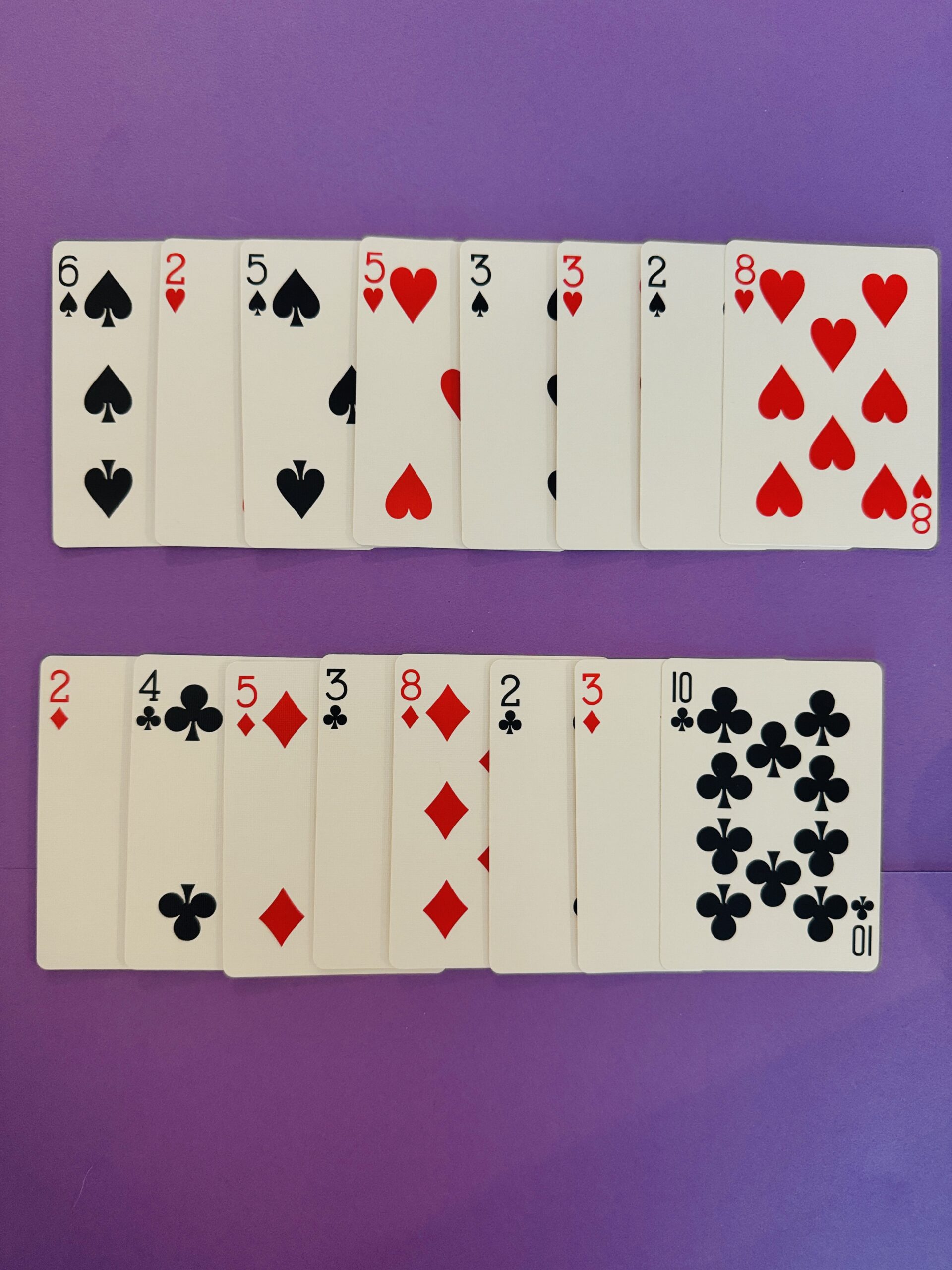
Math Skills: Pattern rules, logic
Each player takes a deck of cards and on their desks creates a pattern of at least eight cards. It could be a number pattern, a color pattern, a suit pattern, or any combination of those elements. Students then write their rule down on a piece of paper and turn it over. When everyone is ready, players walk around the room looking at each other’s patterns and trying to guess the rule.
Number Card Bingo
Math Skills: Number recognition
Appoint one student as the caller and give them a full deck of cards. Other players lay out a 4 x 4 bingo card with a total of 16 cards. The caller pulls a card and says what it is while showing it to the class. Players look at their bingo card and if they have the same number (doesn’t have to be the same suit), they turn that card over. Once you have four cards in a row turned down in any direction, that’s a bingo!
Full-Team Concentration
Math Skills: Matching, number recognition
Gather students around on the carpet. Split them into teams and have them sit in a group. Lay out all 52 cards in a deck face down in rows on the carpet. Players on each team take turns flipping two cards over. If the cards have the same value, the team keeps the cards. If they don’t, the cards get flipped back over in the same spaces. Play until every card is gone. Teams count their cards to see who won. Make sure teams let all players on the team take turns flipping cards over, although all can consult on each flip.
You Can Count on Me
Math Skill: Counting on
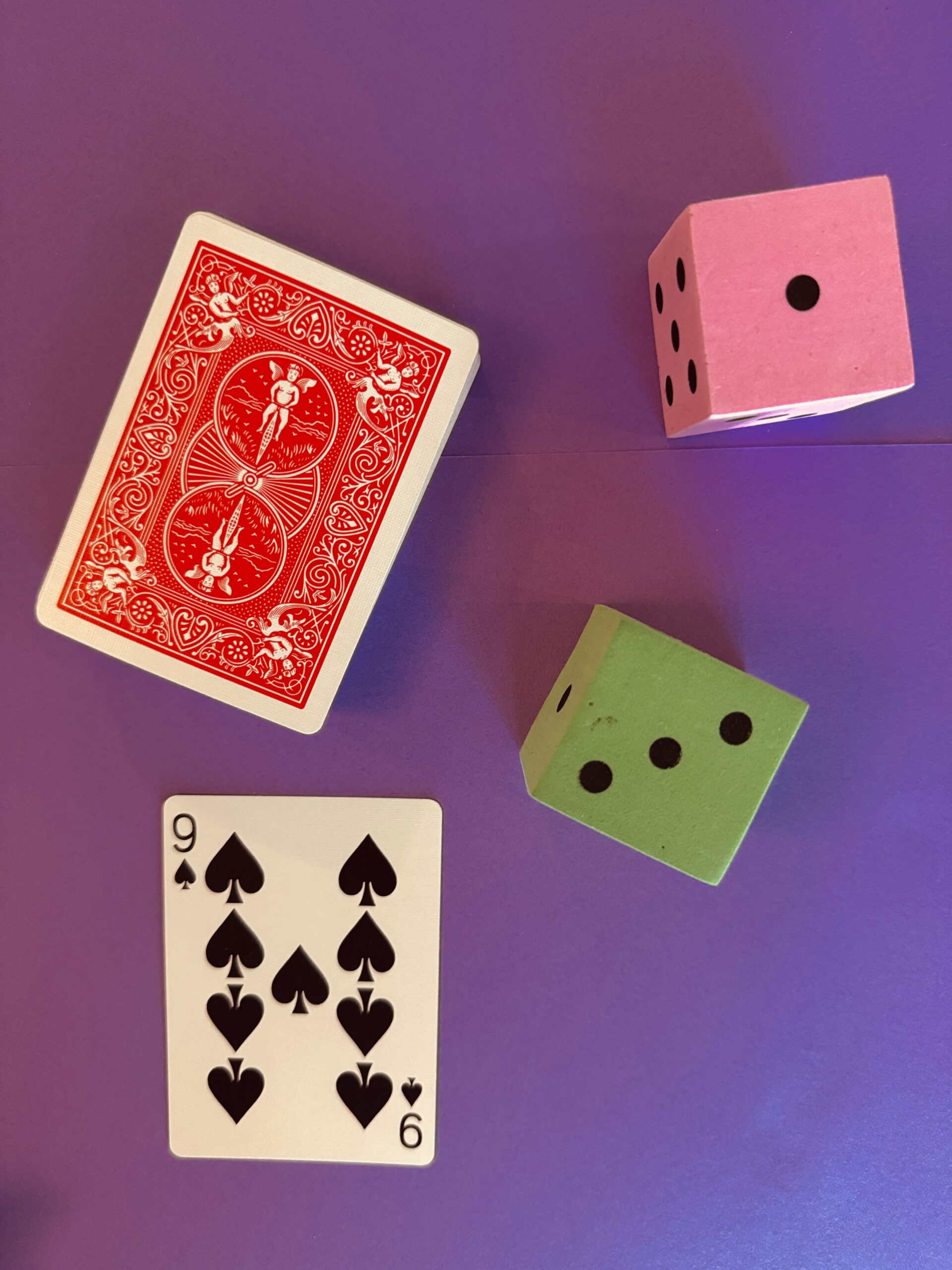
Players place the card deck face down between them. The first player flips a card up. Then they roll a pair of dice and count on from the flipped card with the number generated by the dice. If they’re correct, they keep the card, and it’s the next player’s turn.
Example: The player flips over a card showing 9 and then rolls a 3. Starting with 9, the player counts up 3 more, saying, “10 – 11 – 12.”
Beat the Dealer
Math Skills: Place value, comparing numbers, logic
Remove the face cards from the deck for this game. The dealer draws three cards from a deck, then arranges them so the digits create the largest possible number. Then they deal three cards to the other players, who arrange their cards in an attempt to make a number larger than the dealer’s. Whoever wins gets a point.
Example: The dealer draws 5, 8, and 7. They arrange them to form 875. A player receives the cards 1, 3, and 9 and arranges them to make 931, winning the hand.
Secret Card
Math Skills: Comparing numbers, mathematical reasoning
Each player gets a set of cards with one each of 1 (ace) through 10. The first player chooses a card from their deck and lays it face down. This is the Secret Card. The second player tries to guess what the card is by laying down what they believe is the same card. The lead player gives feedback, saying one of three things: correct, too high, or too low. Based on this, the player lays down another card to guess again, repeating until they guess the Secret Card. Count how many cards (guesses) it took, and record the number. Switch roles and play again. Whoever plays the least number of cards in a round wins that round.
This Is Sort of Fun
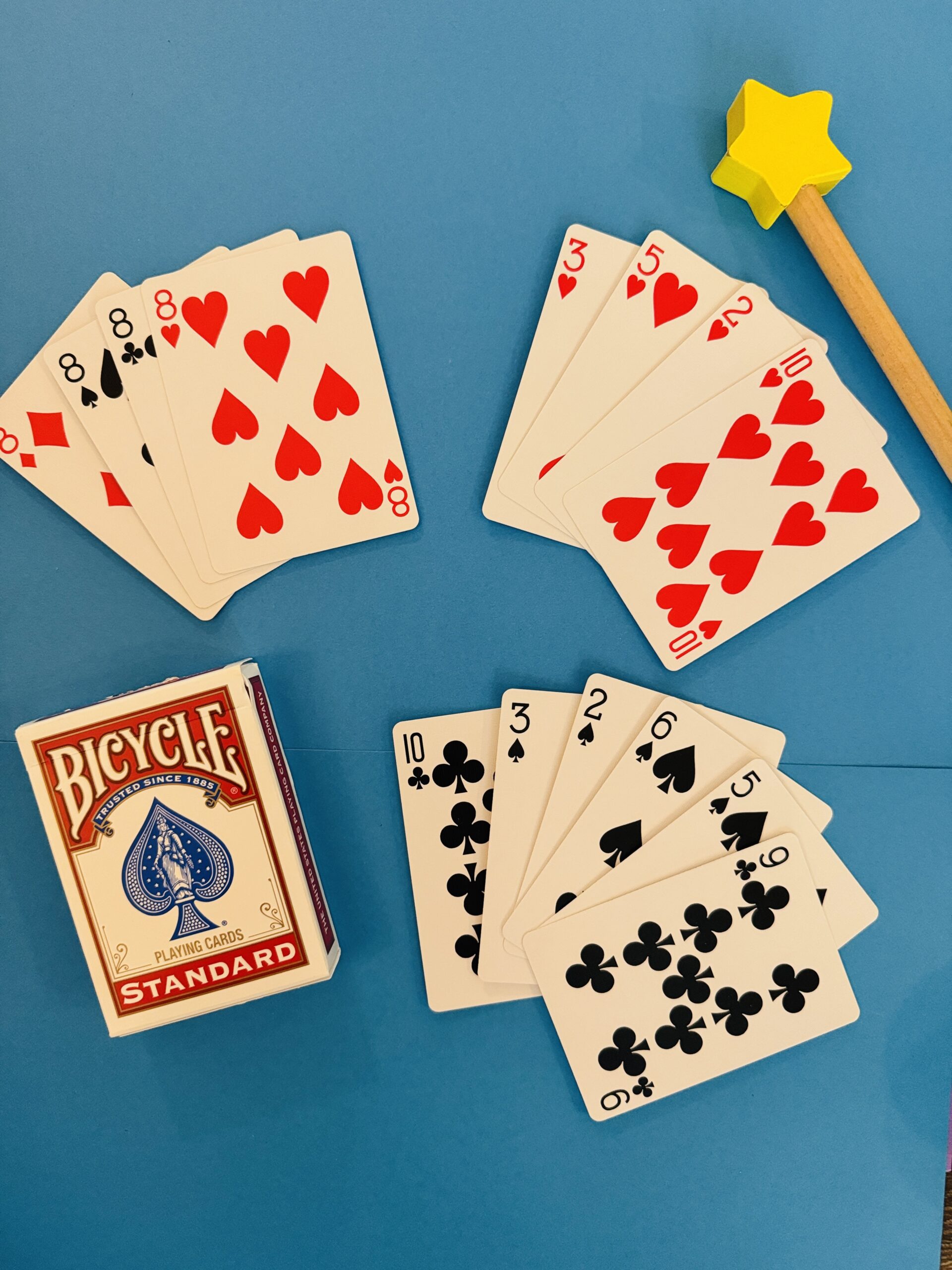
Math Skills: Sorting, pattern rules, logic and reasoning
Players sort a deck of cards into groups so that each group has a clear sorting attribute. They could choose colors, odds and evens, factors of a certain number, primes and non-primes, or any other rule they like. Invite other players to try to guess the attributes of each group.
Safe!
Math Skills: Odds and evens, logic and reasoning
For the purpose of this game, face cards are worth 10. Player one starts drawing cards from the top of the deck. They keep going as long as they pick even numbers (this includes all face cards), but if they draw an odd number, they have to place all the cards they’ve picked up into a discard pile. At any time, the player can decide to stop drawing cards and say “Safe.” Those cards are theirs to keep for the rest of the game. The other players take their turns, continuing until all the cards are claimed or discarded. The player with the most cards wins.
Skip-Count to 50
Math Skills: Skip counting, repeated addition
Here’s a good game to practice skip counting by 5s and 10s. You’ll need multiple decks of cards (at least three, but more is better). Two players take turns pulling cards from the deck. Every time they pull a 5 or a 10, they keep it and begin a count to 50. Other cards are put in the discard pile. As they collect 5s and 10s, they count up. The first person to 50 wins.
Teacher Tip: You can practice skip counting by other numbers using the same game format.
Math Card Games for Upper Elementary and Middle School
Fraction War
Math Skills: Comparing fractions
Remove face cards from the deck, and give each player a pencil. Players put the pencil down on the desk and draw a card. They place it above the pencil if they want it to be the numerator and below the pencil for the denominator. Once placed, it can’t be moved. Players take turns pulling cards from the deck and placing them. When each player has a fraction, compare the two—the player with the largest fraction keeps all the cards.
Teacher Tip: Before you begin, decide if fractions can be improper or not. If they’re not allowed, a player who creates one automatically loses the round.
Beat That Fraction!
Math Skills: Comparing fractions, logic and reasoning
Deal out the deck of cards, dividing it between the players. Each player can look at their own hand but should keep it hidden from the others. For each round, players choose and arrange two cards from their hand to create the largest fraction possible, laying it out on the table in front of them. Players compare all the fractions—the one with the largest fraction wins all the cards for that round.
Teacher Tip: This game is similar to Fraction War, but there’s more strategy involved, since players get to choose cards from their hand instead of drawing the next cards from the deck.
Clock Solitaire
Math Skills: Logic and reasoning
Shuffle the deck and deal the cards face down into 13 piles of four cards each. Arrange 12 piles in a circle like a clock, with the 13th pile in the center. Turn over the top card from the center pile and place it face up under the pile with the matching number. Then turn over the top card from that pile and move it to its matching pile. Continue until all the cards have been revealed. If all four kings reach the center before every other pile is complete, the game ends and you’ll need to deal a new clock.
Round Up
Math Skills: Rounding numbers, comparing numbers
Remove face cards from the deck, shuffle, and place them face down in the middle. Players take turns drawing two cards each, laying them side-by-side with the first card in the 10s place and the second card in the 1s place. Each player rounds their number to the nearest 10, then the player with the largest number keeps all the cards. When you’ve been through the whole deck, the player with the most cards wins the game.
Example: Player one draws a 3 and a 9, making their number 39, which rounds up to 40. Player two draws a 7 and 2, making their number 72, which rounds down to 70. The second player has the higher number and therefore keeps all four cards.
Same, Same
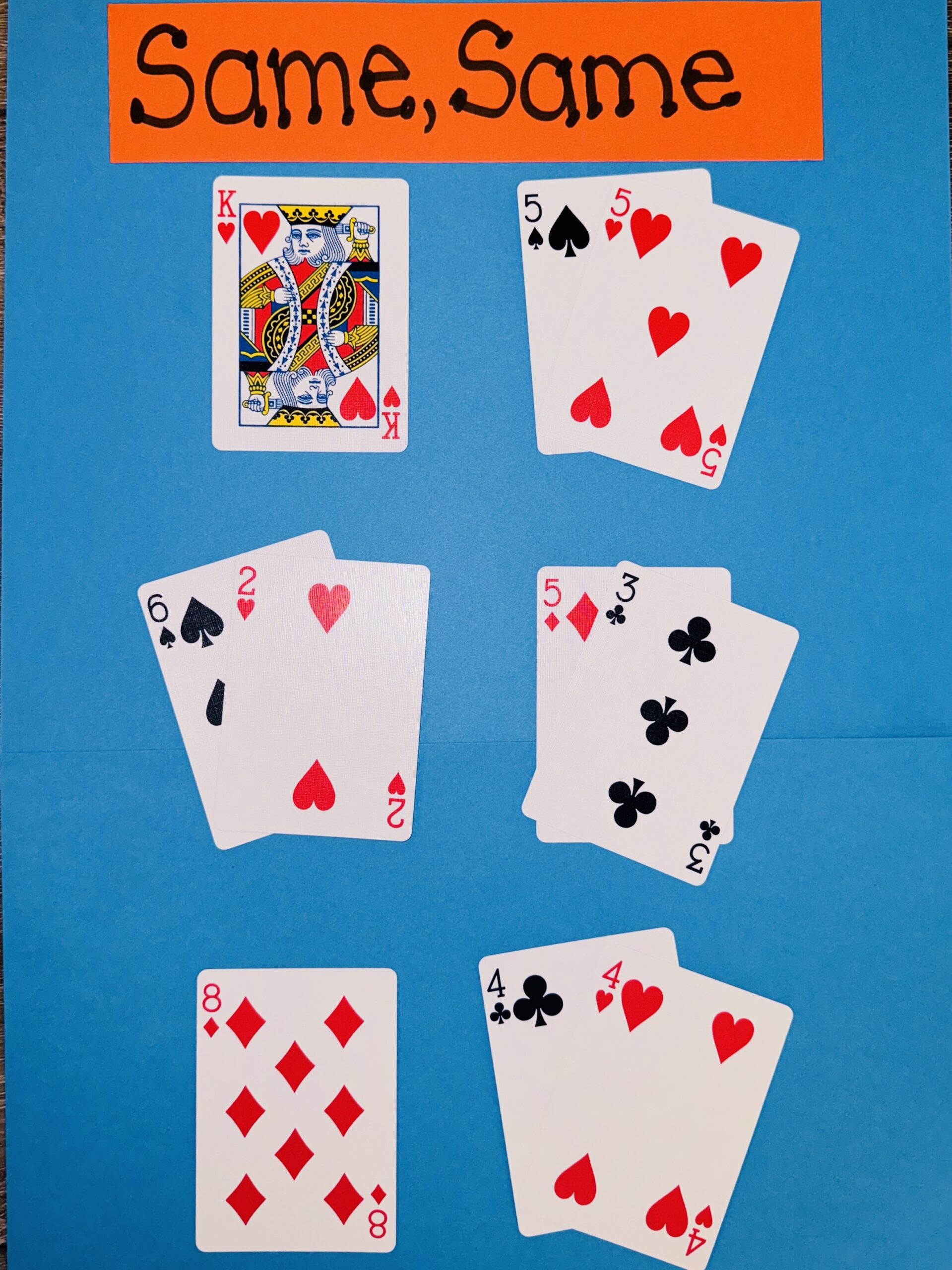
Math Skills: Simple addition, comparing numbers
Using a full deck of cards, the goal is to make sets of card pairs that represent the same total. It’s a bit of a creative-thinking challenge, especially when you encourage kids to try to use up all of the cards in the deck. Examples:
- A king (represents 10) and a pair of 5s (5 + 5 =10)
- 6 and 2, and 5 and 3 (both equal 8)
- 8 and a pair of 4s (4 x 2 = 8)
Positive and Negative
Math Skills: Adding positive and negative numbers
For this math card game, all red cards are negative numbers and all black cards are positive numbers. Each player draws two cards and adds them together, remembering that reds are negative and blacks are positive. Players compare sums, and the one with a greater total keeps all the cards.
Teacher Tip: You can also play this game with the goal being to create the lowest number.
Flipping Primes
Math Skills: Prime numbers, arithmetic skills
Players take turns drawing two cards from a deck. They can use any operation—addition, subtraction, multiplication, or division—with the two cards in whatever order they want to try to create a prime number. If they create a prime, they keep the cards. If they can’t, place the cards in a discard pile.
Example: Player one draws a 7 and a 6. They can add them to make 13, a prime number, so they keep the cards. Player two draws a 6 and a 2. 6 divided by 2 is 3, a prime number, so they keep their cards too. But player three draws a 4 and a 2. No matter how you arrange these (4 – 2, 4 + 2, etc.) you can’t create a prime number, so they discard their cards.
Mind Reader
Math Skills: Multiplication, division, factors, logic
Play this math game in groups of three. Choose one player to be the Mind Reader for the first round. The other players draw one card from the deck. Without looking at the cards, they hold them up to their foreheads so only the Mind Reader can see them. The Mind Reader multiplies the cards silently, then tells the players the product. The players take turns guessing which two cards they have. The one who figures it out first keeps the card. Switch roles and play a new round.
Example: The two cards are 4 and 3. The Mind Reader tells the players the product is 12. The first player guesses 2 and 6, but they’re wrong. The second player guesses 4 and 3 and wins the round.
Teacher Tip: You can play this game with any mathematical operation.
Flip 3
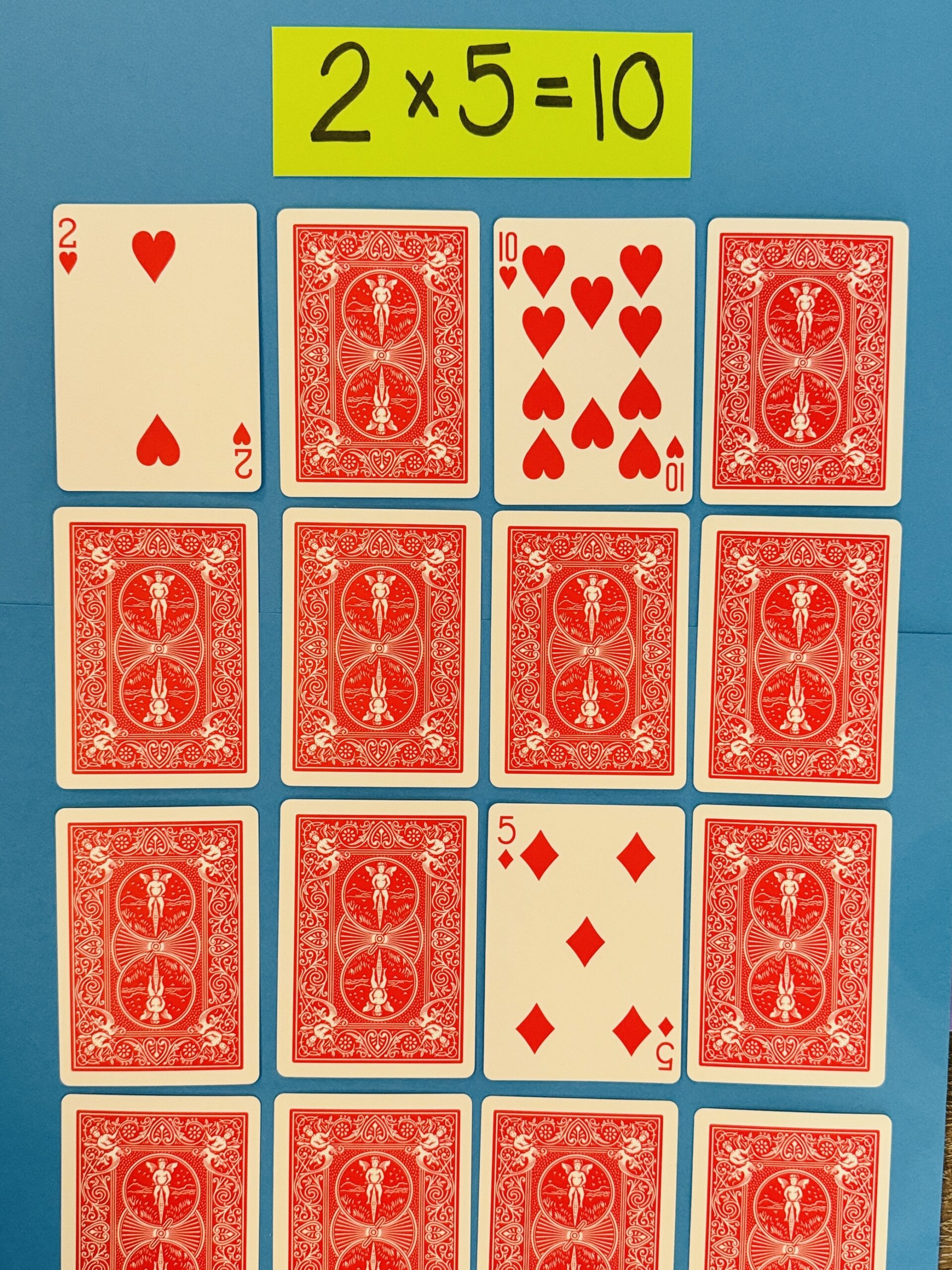
Math Skills: Arithmetic, number sentences (equations), logic
Lay 25 cards face down on the desk. Players take turns flipping over three cards. They can use any operation or arrangement to create a true number sentence. If it’s possible, they keep the cards. If not, they turn them back and play passes to the next player.
Example: A player turns over a 2, a 5, and a 10. Since this can become 2 x 5 = 10, or 10 ÷ 5 = 2, etc., they keep the cards. The second player turns over 3, 9, and 2. There is no way to combine these into a true number sentence, so they turn the cards over and the next player takes a turn.
Subtraction Action
Math Skills: Subtraction with 1 and 2 digits, running totals
Shuffle the card deck and place it face down in the middle; for this game, face cards are worth 10. All players start with 100 points. Players take turns drawing a card from the deck and subtracting it from their total. The first to reach zero wins.
Example: A player draws a 7, making their new total 93. On their next turn, they draw a king (10), so their new total is 83, and so on.
Multiplier
Math Skills: Multiplication, comparing numbers
Shuffle the deck and deal out two piles. Players each flip over two cards, then multiplies them together to find the product. Players compare products, and whoever has the highest product wins that round and keeps all the cards. If a player incorrectly multiplies their cards and an opponent catches the error, that player wins the round automatically. Continue until all the cards have been claimed. The player with the most cards wins.
Absolute Zero
Math Skills: Addition with positive and negative numbers, logic
In this game, all red cards are negative numbers and all black cards are positive numbers. Aces = 1 and face cards = 10. The goal is to create a hand that totals exactly zero. Shuffle the deck and deal each player five cards. On each turn, players may draw from the top of the deck or the card showing in the discard pile. When one player forms a hand totaling zero, they win the round. The other players total up their positive cards only and add them to their score. At the end of five rounds, the player with the lowest score wins.
Combo Challenge
Math Skills: Arithmetic, logic
The lead player chooses a double-digit target number. Players choose four cards from the deck. They then try to use their four numbers and any operations to get as close to the target number as possible. If you get the target number exactly, your score is 0. If you are one away, your score is 1; two away, your score is 2; and so on. The player with the lowest score is the winner.
Be sure to grab your free Math Card Games Google Slides!
Ready to play some math card games with your students? Grab our Google Slides to easily share with students. Just enter your email info on the form on this page, and download your copy right now!
