


Teacher burnout isn’t just common—it’s nearly universal. In a 2025 We Are Teachers survey of more than 2,400 teachers, 91.95% said they’ve experienced burnout, and nearly 75% rated their burnout as significant, serious, or severe.
Clearly, burnout is a widespread problem in teaching, but what’s driving it? The reasons can range from low pay that barely keeps a family afloat to the unhealthy working conditions in schools. For me, it was three reasons that emerged in a single school year: becoming a first-time mom (that is, realizing how incompatible teaching is with motherhood), dealing with challenging parents, and teaching during the pandemic.
But when we asked teachers to tell us why they’re burning out, it wasn’t just from pay or parents or even the pandemic. In fact, the overarching problem wasn’t even one of the multiple-choice options on our survey. I noticed that all the top responses from teachers boiled down to one single issue:
Teachers don’t have what they need to do their jobs.
The reasons are complex, but the message is simple: Teachers want to be able to do their jobs, and the system isn’t letting them.
The workload is crushing.
Nearly half of teachers (46%) said their workload is frequently overwhelming, and another 46% said it’s occasionally overwhelming. Only 9.5% described their workload as manageable.
This constant pressure is pushing teachers to the brink. A majority of 66% said they’ve considered leaving the profession in the past year. And when asked what advice they’d give to new teachers, about a third said simply: “Don’t do it.”
Others offered more nuanced guidance:
“All teachers feel behind. Choose an acceptable level of behindness and move on.” —N.P., Middle School Teacher, NY
Teachers have some support but not enough to do their job well.
While some teachers report reasonable access to professional development (47%), classroom supplies (45%), and class sizes (44%), these numbers reflect a system that’s inconsistent and often inadequate.
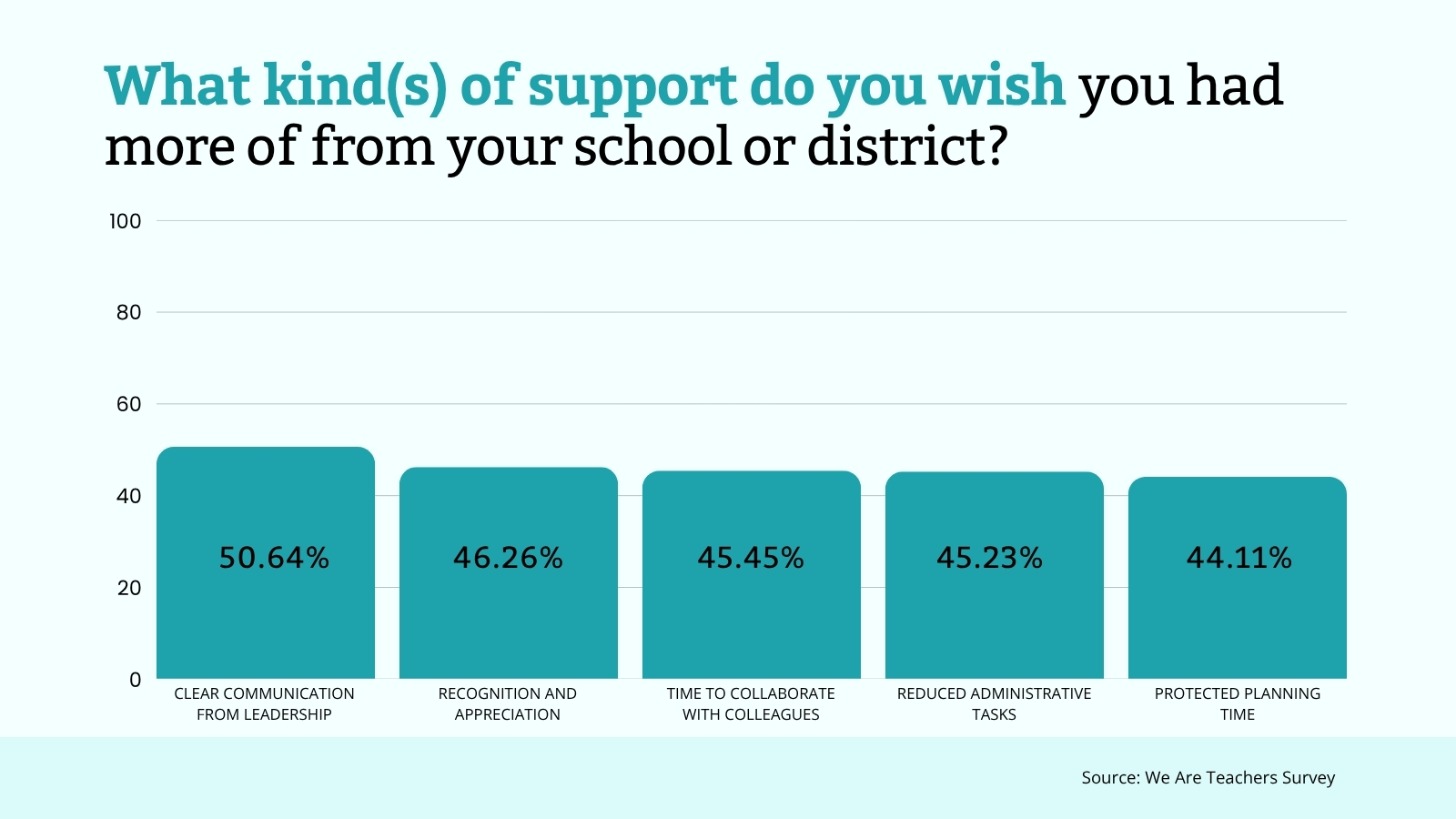
When asked what support teachers wish they had, the top responses were telling:
- Clear communication from leadership (50.64%)
- Recognition and appreciation (46.26%)
- Time to collaborate with colleagues (45.45%)
- Reduced administrative tasks (45.23%)
- Protected planning time (44.11%)
Time. Clear communication. Some tasks taken off their plates. They’re not asking for the world here.
Teachers want time, tools, and support—not just to keep their heads above water but to teach well.
What specifically is driving teacher burnout?
The top contributors were student behavior (77%), lack of administrative support (53%), and lack of planning time (48%). Again, teachers just want to do their jobs … because they love their jobs.
You can’t do your job when your dysregulated 3rd grade student is throwing furniture and school supplies in your classroom while you and your 29 students wait and watch from a window in the hallway.
You can’t do your job when your administrator says, “I don’t know, do the best you can” when you explain that you have an 8th grader in your classroom who has attended in-district schools from kindergarten yet is still illiterate.
You can’t do your job when your job doesn’t give you the time to do it.
“We are teachers, not therapists or psychologists. Violent behaviors—especially repeatedly from the same student—need to be addressed and not swept under the rug.” —N.A., Elementary Teacher, VA
“I don’t mind working 60-hour weeks. I mind when administration is preventing me from being efficient.” —Wendy R., High School Teacher, MA
“My yearly budget is $600 as a science teacher. Most of what I need I pay for out of pocket.” —B. Roderick, Middle School Teacher, CO
How are they coping?
Teachers who haven’t burned out credit work-life balance, mindset, and setting boundaries—all strategies that reflect adapting to a system that doesn’t meet their needs.
Those who have burned out but stayed in the profession anyway say they rely heavily on setting limits around work, leaning on their support networks, and practicing time management. In other words, instead of thriving in a system designed to support them, they’ve learned how to keep the parts of teaching that are trying to break them at arm’s length.
And nearly every teacher mentioned one thing that still brings them joy: the students.
It’s no surprise—to me or to any teacher—that students are both the reason teachers stay and the reason they leave. Burnout often stems not from the students themselves, but from the system’s failure to support teachers in helping those students, whether it’s with behavior or academics.
What’s been lost?
Teachers spoke passionately in our survey about how the profession has changed, especially in the last 10 years.
“Creative expression and the time to deeply explore topics of student interest have mostly disappeared. The joy of learning has been sucked out of classrooms.” —H. Karram, Elementary Teacher, MI
“The lack of respect and support for the educator’s career is the most egregious problem of all.” —L.N., Elementary Teacher, OK
Here’s the bottom line: When teachers are supported, they thrive. They love their jobs. They stay. The solutions to solving teacher burnout is clear—and it’s not complicated. We’re just choosing not to listen.