300 Philosophical Questions for Kids To Encourage Critical Thinking and Self-Exploration
Our world is full of mysteries—why not try to solve a few? One of the most incredible ways to encourage critical thinking and self-exploration is to ask kids thought-provoking questions. Hearing the responses and exchanging ideas can really expand our perspectives and leave us with important food for thought. Want to try? Here are some philosophical questions to share with students in the classroom.
Jump to:
- What is a philosophical question?
- Characteristics of Philosophical Questions
- Fun Philosophical Questions
- Philosophical Questions About Life and Society
- Philosophical Questions About Growing Up
- Philosophical Questions About Love and Relationships
- Philosophical Questions About Animals
- Philosophical Questions About Death
- Philosophical Questions About the Universe
- Philosophical Questions About Law and Governance
- Philosophical Questions About the Paranormal
- Philosophical Questions About Science and Technology
- Tough Philosophical Questions
- Philosophical Questions About Imagination and Creativity

What is a philosophical question?
Philosophical questions aren’t about easy answers. They tackle big ideas like why we’re here, what it means to live a good life, and the mysteries of the universe. These types of questions don’t have clear answers, and that’s what makes them so interesting.
The best philosophical questions make us think in new ways. Have you ever asked yourself if free will is real or wondered why anything exists at all? Philosophical questions help us pause and reflect on what we believe and why we believe it, giving us a fresh perspective on ourselves and the world.
What makes these questions special is how open they are. They’re also great for conversation because there’s no single right answer! Whether you’re exploring the ethics of artificial intelligence, the meaning of happiness, or what might exist beyond the universe, philosophical questions challenge us to think bigger and see things differently.
Characteristics of Philosophical Questions
Philosophical questions stand out because they explore ideas that go beyond everyday concerns. They challenge us to think deeply about the abstract and complex aspects of life. Here are three characteristics of philosophical questions.
They Don’t Have Simple Answers
These questions are open-ended, inviting endless discussion and interpretation. You can’t answer something like “What’s the meaning of life?” or “Can we truly be happy without pain?” with a single fact. Meant to be explored, not solved, abstract philosophical questions get people thinking, talking, and offering different perspectives that keep the conversation alive.
They Focus on Big Ideas
Philosophical questions also dig into the fundamental concepts that shape how we see the world. They explore morality, existence, and reality—ideas that influence the way we think and act every day. Topics like justice and free will ask us to reflect on the beliefs and principles that guide our lives. These aren’t surface-level musings—they go straight to the core.
They Help Us Think Critically
These questions demand more than casual thought. They push us to analyze, reflect, and question assumptions we might not even realize we hold. For instance, “Is it ever OK to break the law?” makes us weigh ethical values against societal expectations. Wrestling with questions like these doesn’t just challenge our thinking, it sharpens it.
In the end, abstract philosophical questions are less about finding answers and more about exploring ideas. They encourage us to embrace complexity, think in new ways, and connect with others through meaningful conversations. By doing this, we understand ourselves and the world a little better, one thought at a time.
Fun Philosophical Questions
1. Which really came first, the chicken or the egg?
2. If you’d been given a different name, would you be a different person?
3. Would the world be more peaceful if kids were in charge?
4. What is kindness?
5. Do you think music is a universal language?
6. What does happiness feel like in your mind and body?
7. Can one person really change the world?
8. If it were possible to live forever, would you want to?
9. If people live in a time zone ahead of us, does this mean they live in the future?
10. Can a person be happy and sad at the same time?
11. Is it possible to think of nothing?
12. If a tree falls in the forest and no one is there to hear it, does it make a sound?
13. Do animals have thoughts and feelings like humans?
14. If you could see into the future, would you want to know what happens?
15. Are there things in life that are truly random or is everything predetermined?
16. Is it always better to know the truth, even if it hurts?
17. What is the purpose of dreams?
18. Can a machine ever truly understand a human?
19. Is there a difference between living and simply existing?
20. If everyone were exactly the same, would life be better or worse?
21. If you could ask one question and get a guaranteed answer, what would you ask?
22. If everyone had to wear mood colors like a mood ring, would the world be kinder or more chaotic?
23. Would life feel different if we couldn’t see colors?
24. If time suddenly stopped for everyone but you, what would you do first?
Philosophical Questions About Life & Society
25. What is the meaning of life?
26. What is the biggest issue in our society right now?
27. What is your vision of the ideal society?
28. Do you think it’s important to conform in society?
29. How can humans improve the world in the next five years?
30. What is the most important thing in life?
31. Are people too greedy?
32. How could the world change for the better?
33. Is failure ever useful?
34. What would life be like if we never experienced pain?
35. Why is it important to help others?
36. What is freedom?
37. Can too much freedom be a bad thing?
38. Should we have to pay for basic needs such as food, water, and shelter?
39. Should education be free?
40. If happiness were the national currency, what kind of work would make you rich?
41. If you could teach everyone in the world one concept, what concept would have the biggest positive impact on humanity?
42. Is there a perfect balance between work and life, and if so, what does it look like?
43. Do you think modern technology brings people closer together or farther apart?
44. What does it mean to live a good life?
45. Is justice always equitable, or is it influenced by culture?
46. How does individual freedom contribute to or detract from societal harmony?
47. What role should government have in regulating human behavior?
48. Is progress always beneficial, or can it sometimes be detrimental?
49. What are the ethical implications of advancements in artificial intelligence on society?
50. How do art and culture influence societal norms and politics?
51. Is it possible for societies to exist without laws?
52. What are the implications of the growing gap between the rich and the poor?
53. How do personal biases shape our views on society?
54. Should there be limits to freedom of speech, and if so, what should those limits be?
55. Can a small act of kindness change the direction of someone’s whole life?
56. Is it better to focus on your own happiness or the happiness of others?
57. Are people naturally good, or do we learn to be good?
58. Does money make life easier or more complicated?
Philosophical Questions About Growing Up
59. When do children become adults?
60. Are adults as curious as kids?
61. At what age does an adult become “old”?
62. What can kids learn from grown-ups?
63. What can grown-ups learn from kids?
64. Do we become wise through age, study, or experience?
65. Does birth order affect people’s personalities?
66. Do people need to have children?
67. If you could give your younger self one piece of life advice, what would it be?
68. Do people ever truly stop growing, or do we grow in different ways forever?
69. Is childhood something you feel or simply a number?
70. Why do some memories stay with us forever while others fade quickly?
Philosophical Questions About Love & Relationships
71. What is love?
72. Is love about feelings, words, or actions?
73. Does unconditional love really exist?
74. How do you know you are loved?
75. What causes someone to fall in love?
76. What makes a good friend?
77. Are romantic relationships important?
78. Do soulmates exist?
79. Can someone be in love with more than one person?
80. Do you think love at first sight really exists?
81. Is love blind?
82. Can you love others if you don’t love yourself?
83. What makes a relationship last for many years?
84. Does a large age gap matter in a relationship?
85. How do cultural differences impact romantic relationships?
86. Is there a formula for maintaining interest in a long-term relationship?
87. How important is compatibility compared to chemistry in a relationship?
88. Can relationships survive without forgiveness?
89. What role does vulnerability play in strengthening a relationship?
90. Should relationships aim for equality or equity?
91. How does social media affect our perceptions of relationships?
92. Is it possible to maintain a friendship after a romantic relationship ends?
93. How do expectations influence the success or failure of relationships?
94. What is the impact of financial stress on a relationship?
95. How do changes in physical or mental health affect a relationship?
96. Can absence really make the heart grow fonder?
97. Is jealousy ever justifiable in a relationship?
98. What makes someone trustworthy?
99. Is conflict always bad, or can it make relationships stronger?
100. Can you care about someone even if you disagree on important things?
Philosophical Questions About Animals
101. Do humans treat animals properly or do we need to improve?
102. Are dairy and eggs more ethical to eat than meat?
103. What would life be like if animals were dominant over humans?
104. Have some animals or creatures walked the Earth that we don’t know about?
105. Do spiders or bugs experience emotional pain?
106. Do animals feel love?
107. Are animals less intelligent than humans?
108. Do animals like being kept as pets?
109. Is it OK to kill bugs?
110. Do you think our pets have names for us too?
111. Should animals have rights similar to human rights?
112. Can animals understand human languages?
113. Is it ethical to use animals for entertainment purposes, such as in circuses or films?
114. Do animals have a sense of morality or ethics?
115. How do animals perceive their environments differently than humans?
116. Should wildlife habitats be protected even if it means limiting human development?
117. Is it morally acceptable to breed animals selectively for specific traits?
118. Can animals form friendships with different species?
119. What responsibilities do humans have toward endangered species?
120. Is it ethical to keep large animals like whales and dolphins in captivity?
121. Do animals understand fairness?
122. Would animals behave differently if they knew humans could understand them?
123. Do animals worry about the future the way humans do?
Philosophical Questions About Death
124. Where does the soul come from?
125. Does the soul die when the body does?
126. Do you believe in life after death or reincarnation? Why or why not?
127. What do you believe about this statement: “Everyone dies twice. Once with their body and again the last time someone mentions their name”?
128. If you only had five years left to live, how would you live differently?
129. Is euthanasia an immoral way to end a life?
130. Would you ever want to know how or when you were going to die?
131. Should everyone have to be an organ donor?
132. Is fear of death natural, or is it culturally constructed?
133. How does the concept of mortality influence human behavior and decision-making?
134. Can death ever be considered a relief or a release rather than a tragedy?
135. How do different cultures celebrate or mourn death differently?
136. Is it ethical to use life-extending technologies to prolong life at any cost?
137. Should children be shielded from discussions about death, or should it be openly discussed?
138. What legacy do you hope to leave behind when you pass away?
139. How do advancements in medicine that extend life expectancy impact society’s view of death?
140. Why do people fear death if it is a universal experience?
141. How does thinking about death help people appreciate life?
142. Is it possible to celebrate a life without feeling sad about the loss?
Philosophical Questions About the Universe
143. Do you believe in life on other planets?
144. Why are we here on Earth?
145. Do you believe in astrology?
146. Are there alternate universes?
147. Have aliens visited Earth?
148. Should we be spending money to develop space travel?
149. Do you think there could be time travelers living among us right now?
150. If someone could time-travel, would it be ethically wrong to change history?
151. If an advanced life-form from another planet wanted to eat us, would that be wrong considering we eat animals on Earth?
152. What do you think is out in space that we have not discovered yet?
153. If aliens were to arrive on Earth tomorrow, what would you do?
154. What implications would the discovery of extraterrestrial life have on human religions and philosophies?
155. Is the universe finite or infinite, and what does that mean for our understanding of existence?
156. How do scientific discoveries about the universe change our understanding of what it means to be human?
157. Should humanity attempt to colonize other planets?
158. Is it possible that our understanding of physics is fundamentally flawed or incomplete?
159. What ethical considerations should govern the exploration and exploitation of outer space resources?
160. If we find planets with conditions similar to Earth, is it our duty to preserve them or use them for human benefit?
161. How does the vastness of the universe affect our perception of importance or insignificance?
162. Should we be trying to send messages into space to communicate with potential extraterrestrial beings?
163. What responsibilities do we have to protect the integrity of other celestial bodies, like moons or asteroids?
164. If you had the opportunity to travel to space, knowing you could never return to Earth, would you go?
165. If we discovered intelligent life on another planet, what would we want them to know about us?
166. Does the universe care whether humans exist?
167. If humans moved to another planet, would we still think of Earth as “home”?
Philosophical Questions About Law & Governance
168. Are equal and fair the same thing?
169. What makes something right and something wrong?
170. Will war ever go away?
171. Is our legal system fair?
172. Is it OK to commit a crime to save another person’s life?
173. Is it OK to steal something to survive?
174. Should the legal drinking age be lower or higher?
175. Should the legal age for driving be lower or higher?
176. Should good healthcare be a universal right?

177. Should people living an unhealthy lifestyle pay more for healthcare?
178. Should there be stricter laws about what goes into our food?
179. If killing someone saved hundreds of other people, would that make it OK?
180. Does power change people?
181. What makes a crime a crime?
182. Should buses have seat belts?
183. Should voting be mandatory for all eligible citizens?
184. Can a society exist without laws?
185. Is absolute freedom possible or desirable in a governed society?
186. Should privacy be considered a fundamental human right?
187. How should governments balance national security and personal freedoms?
188. Is it ethical for a government to monitor its citizens?
189. Should the death penalty be allowed, and if so, under what circumstances?
190. What role should international law play in governing actions that affect multiple countries?
191. Is it ever justifiable for citizens to overthrow a government?
192. How can laws evolve to accommodate changes in societal norms and technology?
193. Should governments regulate the internet, and if so, to what extent?
194. Can corruption within a legal system ever be fully eradicated?
195. Is it ethical to pardon individuals convicted of serious crimes?
196. Should there be a global standard for human rights?
197. How should a society determine its leaders?
198. Should laws ever change based on the emotions of society?
199. Is it possible for a leader to make everyone happy?
200. Should people be allowed to choose which laws they personally find fair?
Philosophical Questions About the Paranormal
201. Have you ever had any paranormal or strange experiences that defy explanation?
202. Do you believe in ghosts or spirits?
203. Do humans have extrasensory powers like psychic abilities or telepathy?
204. Do you believe in miracles?
205. Do you think that life is predetermined or that you choose your own path?
206. Does karma really exist?
207. Is it possible that paranormal creatures like vampires and werewolves really do exist?
208. Do you believe in the law of attraction?
209. Can places be genuinely haunted, or are these experiences psychological?
210. Is there a scientific explanation for paranormal phenomena, or do they truly transcend science?
211. How do cultural beliefs influence our perceptions of the paranormal?
212. Do you think that certain people are more susceptible to paranormal experiences than others?
213. What implications would the existence of paranormal beings have on our understanding of the world?
214. Can dreams be a gateway to supernatural realms or foretell the future?
215. Is it possible to communicate with the dead?
216. How do modern depictions of paranormal phenomena in media influence our beliefs about the supernatural?
217. If ghosts exist, do they have feelings?
218. Are supernatural stories a reflection of our fears or our imagination?
219. Why are people drawn to mysteries that cannot be explained?
Philosophical Questions About Science & Technology
220. What has been the greatest advancement or invention of our time?
221. Can robots develop emotions, consciousness, or morality?
222. Are you controlling your technology or is your technology controlling you?
223. Is social media a good thing in our society?
224. Why is it so easy to spread misinformation on social media?
225. How will the development of artificial intelligence influence our understanding of human intelligence?
226. Do you think that technology is advancing us or destroying us?
227. Is time travel possible?
228. What ethical considerations should guide the development of technologies that can alter human genetics?
229. Is technology making us more polarized or more open in our thinking?
230. Is technology gathering too much of our information?
231. Should humans strive to become a multi-planetary species?
232. How should society address the ethical concerns raised by artificial intelligence?
233. Does the rapid pace of technological innovation outpace our ability to understand its implications?
234. Can genetic engineering go too far, and if so, where should we draw the line?
235. Is the pursuit of scientific knowledge always justified, regardless of potential consequences?

236. How does technology influence our understanding of reality?
237. Should we fear the rise of autonomous weapons systems?
238. What role does ethics play in scientific research?
239. How can we ensure that technology benefits all of society rather than just a select few?
240. Will artificial intelligence ever surpass human intelligence, and what would that mean for humanity?
241. How should we manage the ethical dilemmas posed by cloning and other reproductive technologies?
242. Should humans create technology that they cannot fully control?
243. Does social media change who we are or just reveal who we already were?
244. If scientists could erase bad memories, should they?
Tough Philosophical Questions
245. Can people change?
246. What makes someone human?
247. Is hope essential to life?
248. What is intuition (your gut feeling)?
249. Why are we so afraid of the unknown?
250. Is there only one truth or can it be different for everyone?
251. Do we need good and evil to coexist in life?
252. What are dreams?
253. Is it possible to be in the wrong place at the right time?
254. Should wealthy people leave their money to their families or give it to charity?
255. Is lying ever OK?
256. Will life as we know it end someday?
257. Why do we remember things we should forget and forget things we want to remember?
258. Where do our thoughts come from?
259. Is suffering necessary for personal growth?
260. Can justice truly be objective?
261. What defines the boundary between something that is art and something that is not art?
262. Is absolute peace achievable in society?
263. How does language shape our perception of reality?
264. Is it ethical to bring children into a world with so many challenges?
265. Can we ever achieve true equality?
266. What is the role of government in people’s personal lives?
267. Is freedom an illusion?
268. Can science explain everything?
269. What is the nature of consciousness?
270. Is there a purpose to life or is it purely random?
271. Should humans seek to control nature or adapt to it?
272. Is there such a thing as a selfless act?
273. How does our understanding of the universe influence our daily decisions?
274. If you could know the absolute truth to one question, what question would you ask?
275. Does the existence of suffering negate the presence of a benevolent higher power?
276. How do personal experiences shape our perception of truth?
277. What role does fate play in our lives, and can we alter its course?
278. Is true altruism possible, or is every action motivated by self-interest?
279. How do societal expectations influence individual choices?
280. Can moral decisions be governed by logic alone?
281. Is identity something we are born with or is it constructed over time?
282. What does it mean to lead a meaningful life?
Philosophical Questions About Imagination & Creativity
283. Is imagination more important than knowledge?
284. Can creativity solve all problems?
285. Where do new ideas come from?
286. Is there a limit to human creativity?
287. How does creativity make life better?
288. Do we need rules to inspire creativity, or does freedom spark more ideas?
289. Is everyone born creative, or is it something we develop?
290. How do emotions influence creativity?
291. Can artificial intelligence ever truly be creative?
292. Why do some people lose their imagination as they grow up?
293. Is creativity a skill, a talent, or both?
294. Can you create something truly original, or is all creativity inspired by something else?
295. How does art help us understand the world?
296. Is imagining something the same as experiencing it?
297. How does imagination shape the future?
298. Are people defined more by their choices or by their circumstances?
299. Is being happy more important than being successful?
300. If no one remembered anything you did, would your actions still matter?
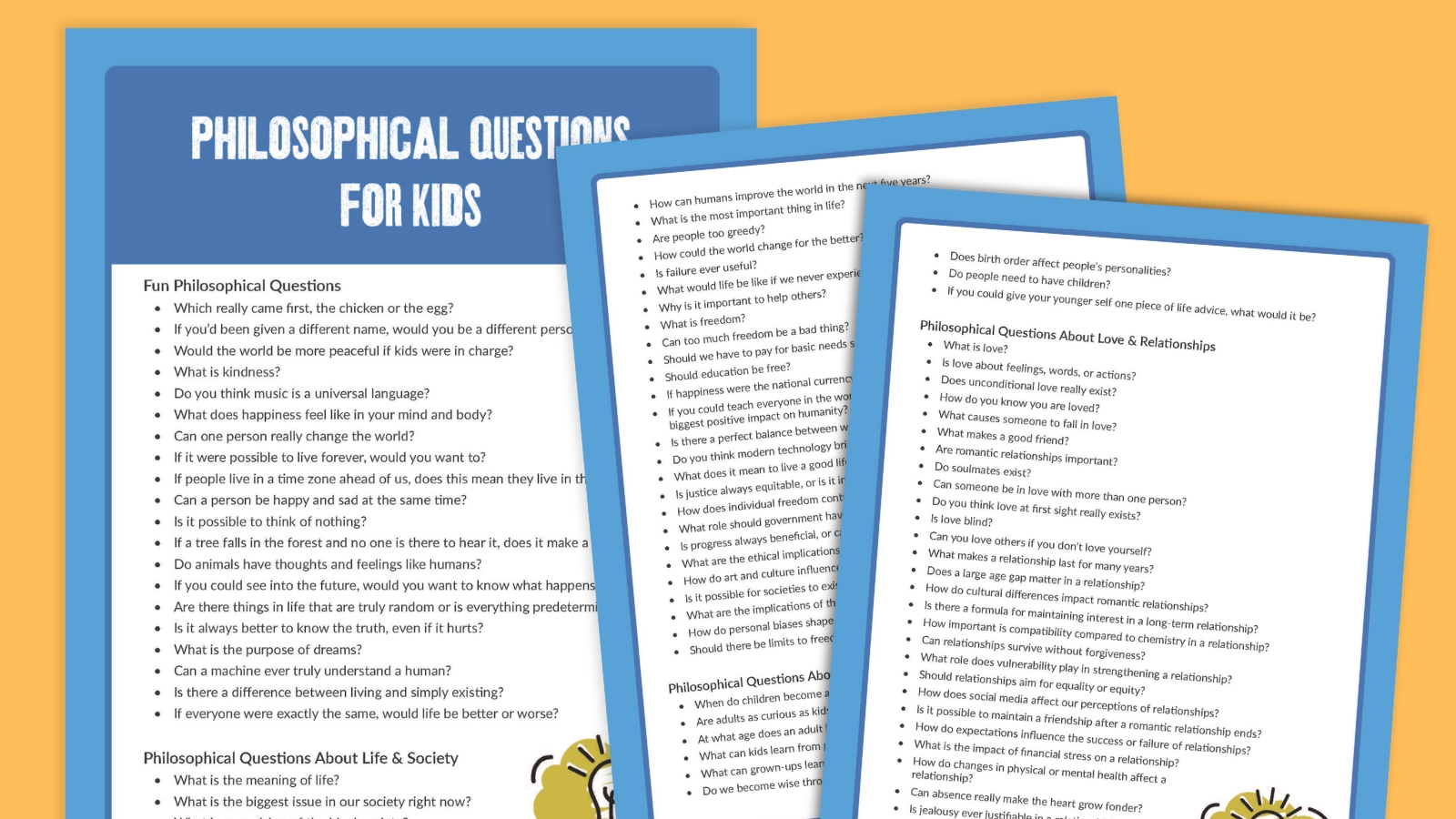
Get your free printable list of philosophical questions!
Grab a copy of our free printable list of philosophical questions for kids to use with your students. Just click the button below and fill out the form to get it.
What are your favorite philosophical questions? Come share in the We Are Teachers HELPLINE group on Facebook!
Plus, check out Fun Icebreaker Questions for Kids and Teens.
175 Funniest Knock-Knock Jokes for Kids
They say that laughter is the best medicine. Since everyone loves a good laugh, you can try one of our favorite knock-knock jokes for kids to break the tension caused by tests or social anxiety—or anytime! Your students may roll their eyes, but you know they secretly love some cringey humor!
Jump to:
- Classic Knock-Knock Jokes for Kids
- Food Knock-Knock Jokes
- Knock-Knock Jokes With Names
- Animal Knock-Knock Jokes for Kids
- Knock-Knock Jokes About Nature and Places
- Inanimate Bbjects Knock-Knock Jokes
- Holiday Knock-Knock Jokes for Kids
- School Knock-Knock Jokes for Kids
- More Knock-Knock Jokes
Classic Knock-Knock Jokes for Kids
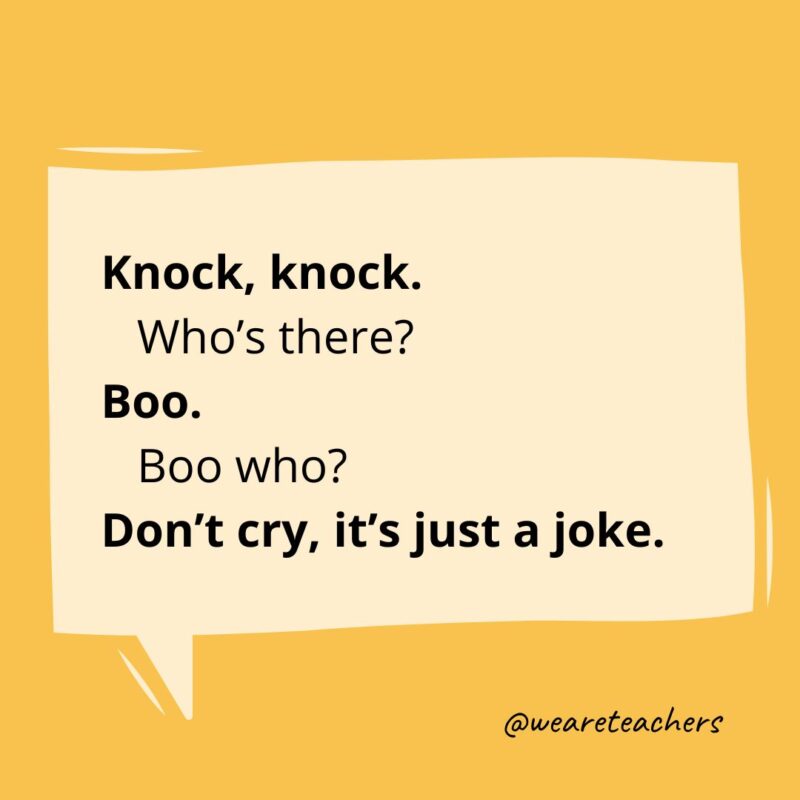
1. Knock, knock.
Who’s there?
Boo.
Boo who?
Don’t cry, it’s just a joke.
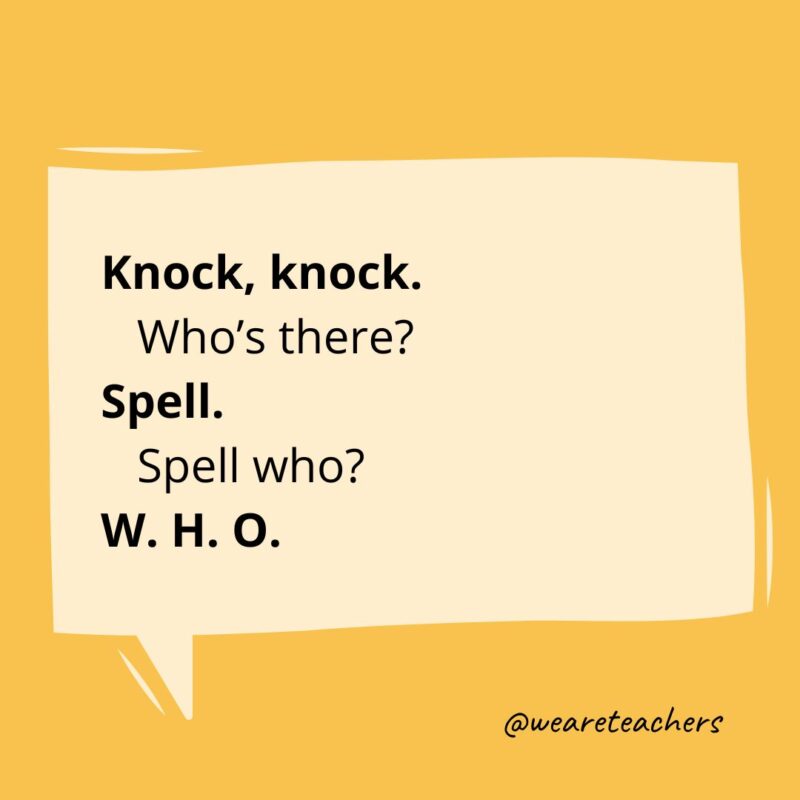
2. Knock, knock.
Who’s there?
Spell.
Spell who?
W. H. O.
3. Knock, knock.
Who’s there?
Hatch.
Hatch who?
Bless you!
4. Knock, knock.
Who’s there?
Little old lady.
Little old lady who?
Hey, I didn’t know you could yodel!
5. Knock, knock.
Who’s there?
Weekend.
Weekend who?
Weekend do anything we want!
6. Knock, knock.
Who’s there?
You.
You who?
Yoo-hoo! Anybody home?
7. Knock, knock.
Who’s there?
Mustache.
Mustache who?
I mustache you a question.
8. Knock, knock.
Who’s there?
Adore.
Adore who?
Adore is between you and me, so please open up!
9. Knock, knock.
Who’s there?
Dishes.
Dishes who?
Dishes the police, open up!

Food Knock-Knock Jokes for Kids
10. Knock, knock.
Who’s there?
Beets.
Beets who?
Beets me!
11. Knock, knock.
Who’s there?
Lettuce.
Lettuce who?
Lettuce in, it’s cold out here!
12. Knock, knock.
Who’s there?
Ice cream.
Ice cream who?
ICE CREAM SO YOU CAN HEAR ME!
13. Knock, knock.
Who’s there?
Olive.
Olive who?
Olive you sooooo much!
14. Knock, knock.
Who’s there?
Cereal.
Cereal who?
Cereal pleasure to meet you!
15. Knock, knock.
Who’s there?
Cash.
Cash who?
No thanks, but I’d love some peanuts.
16. Knock, knock.
Who’s there?
Honeydew.
Honeydew who?
Honeydew you wanna dance?
17. Knock, knock.
Who’s there?
Meringue.
Meringue who?
Meringue the bell but nobody answered!
18. Knock, knock.
Who’s there?
Figs.
Figs who?
Figs the doorbell. I’ve been knocking forever!
19. Knock, knock.
Who’s there?
Ketchup.
Ketchup who?
Ketchup with me and I’ll tell you!
20. Knock, knock
Who’s there?
Butter.
Butter who?
Butter let me in or I’ll freeze!
21. Knock, knock.
Who’s there?
Banana.
Banana who?
Knock, knock.
Who’s there?
Banana.
Banana who?
Knock, knock.
Who’s there?
Orange.
Orange who?
Orange you glad I didn’t say banana?
22. Knock, knock.
Who’s there?
Peas.
Peas who?
Peas open the door for me!
23. Knock, knock.
Who’s there?
Bacon.
Bacon who?
Bacon some cookies in there? Smells delicious!
Knock-Knock Jokes With Names
24. Knock, knock.
Who’s there?
Juno.
Juno who?
Juno I love you, right?
25. Knock, knock.
Who’s there?
Iona.
Iona who?
Iona new car!
26. Knock, knock.
Who’s there?
Norma Lee.
Norma Lee who?
Norma Lee I don’t just show up out of the blue like this!
27. Knock, knock.
Who’s there?
Ray D.
Ray D. who?
Ray D or not, here I come!
28. Knock, knock.
Who’s there?
Alec.
Alec who?
Alectricity. BUZZ!
29. Knock, knock.
Who’s there?
Ben.
Ben who?
Ben knocking for 10 minutes!

30. Knock, knock.
Who’s there?
Yukon.
Yukon who?
Yukon say that again!
31. Knock, knock.
Who’s there?
Lena.
Lena who?
Lena a little closer, and I’ll tell you another joke!
32. Knock, knock.
Who’s there?
Abby.
Abby who?
Abby birthday to you!
33. Knock, knock.
Who’s there?
Candice.
Candice who?
Candice joke get any worse?
34. Knock, knock.
Who’s there?
Watts.
Watts who?
Watts for dinner? I’m hungry.
35. Knock, knock.
Who’s there?
Cher.
Cher who?
Cher would be nice if you opened the door!
36. Knock, knock.
Who’s there?
Theodore.
Theodore who?
Theodore wasn’t open so I knocked.
37. Knock, knock.
Who’s there?
Sue.
Sue who?
Sue-prize! Happy birthday!
38. Knock, knock.
Who’s there?
Anita.
Anita who?
Anita use the bathroom, please open the door!
39. Knock, knock.
Who’s there?
Noah.
Noah who?
Noah place I can spend the night?
40. Knock, knock.
Who’s there?
Mary.
Mary who?
Mary Christmas!
41. Knock, knock.
Who’s there?
Venice.
Venice who?
Venice your dad coming home?
42. Knock, knock.
Who’s there?
Wendy.
Wendy who?
Wendy bell gonna start working again?

43. Knock, knock.
Who’s there?
Adam.
Adam who?
Adam my way, I’m coming in!

44. Knock, knock.
Who’s there?
Euripides.
Euripides who?
Euripides clothes, you pay for them!
45. Knock, knock.
Who’s there?
Amos.
Amos who?
A mosquito. Look, right there!
46. Knock, knock.
Who’s there?
Dwayne.
Dwayne who?
Dwayne the sink. I need to use it!
47. Knock, knock.
Who’s there?
Luke.
Luke who?
Luke through the peephole and find out.
48. Knock, knock.
Who’s there?
Nana.
Nana who?
Nana your business!
49. Knock, knock.
Who’s there?
Isabel.
Isabel who?
Isabel not working?
50. Knock, knock.
Who’s there?
Alice.
Alice who?
Alice fair in love and war.
51. Knock, knock.
Who’s there?
Annie.
Annie who?
Annie thing you can do, I can do better!
52. Knock, knock.
Who’s there?
Mikey.
Mikey who?
Mikey doesn’t work, can you let me in?
53. Knock, knock.
Who’s there?
Alex.
Alex who?
Alex-plain later, just open up!
54. Knock, knock.
Who’s there?
Colleen.
Colleen who?
Colleen up your room, it’s a mess!
55. Knock, knock.
Who’s there?
Goliath.
Goliath who?
Goliath thee down, thou looks tired!
56. Knock, knock.
Who’s there?
Gus.
Gus who?
Gus whose birthday is today?!
57. Knock, knock.
Who’s there?
Claire.
Claire who?
Claire a path, I’m coming through!
58. Knock, knock.
Who’s there?
Justin.
Justin who?
Justin time for dinner!
59. Knock, knock.
Who’s there?
Sarah.
Sarah who?
Is Sarah phone I could use?
Animal Knock-Knock Jokes for Kids
60. Knock, knock.
Who’s there?
Alpaca.
Alpaca who?
Alpaca the trunk, you pack the suitcase.
61. Knock, knock.
Who’s there?
Who.
Who who?
I didn’t know you were an owl!
62. Knock, knock.
Who’s there?
Lion.
Lion who?
Lion on your doorstep, open up!
63. Knock, knock.
Who’s there?
Dragon.
Dragon who?
Dragon your feet again!
64. Knock, knock.
Who’s there?
Kanga.
Kanga who?
Actually, it’s kangaroo!
65. Knock, knock.
Who’s there?
Interrupting sloth.
Interrupting sloth who?
(20 seconds of silence)
Sloooooooooth.
66. Knock, knock.
Who’s there?
Cow says.
Cow says who?
No, a cow says mooooo!
67. Knock, knock.
Who’s there?
Honey bee.
Honey bee who?
Honey bee a dear and get the door for me.

68. Knock, knock.
Who’s there?
Goat.
Goat who?
Goat to the door and find out!
69. Knock, knock.
Who’s there?
Roach.
Roach who?
Roach you a letter, and I’m putting it in your mailbox!
70. Knock, knock.
Who’s there?
Moose.
Moose who?
Moose you be so nosy?
71. Knock, knock.
Who’s there?
Aardvark.
Aardvark who?
Aardvark a million miles for one of your smiles.
72. Knock, knock.
Who’s there?
Poodle.
Poodle who?
Poodle little mustard on my hot dog, please.
73. Knock, knock.
Who’s there?
Iguana.
Iguana who?
Iguana hold your hand.
74. Knock, knock.
Who’s there?
A herd.
A herd who?
A herd you were home, so I came over!
75. Knock, knock.
Who’s there?
Frog.
Frog who?
Frog-et about it!
76. Knock, knock.
Who’s there?
Owl.
Owl who?
Owl always love you!
77. Knock, knock.
Who’s there?
Howl.
Howl who?
Howl you know unless you open the door?
78. Knock, knock.
Who’s there?
An interrupting cow.
An interrupt—
MOO!
79. Knock, knock.
Who’s there?
Gorilla.
Gorilla who?
Gorilla me a hamburger, I’m starving!
Nature and Place Knock-Knock Jokes for Kids
80. Knock, knock.
Who’s there?
Amarillo.
Amarillo who?
Amarillo nice person.

81. Knock, knock.
Who’s there?
Iran.
Iran who?
Iran all the way here!
82. Knock, knock.
Who’s there?
Utah.
Utah who?
U-tahking to me?
83. Knock, knock.
Who’s there?
Kenya.
Kenya who?
Kenya open the door?
84. Knock, knock.
Who’s there?
Freeze.
Freeze who?
Freeze a jolly good fellow!
85. Knock, knock.
Who’s there?
Hike.
Hike who?
I didn’t know you like Japanese poetry!
86. Knock, knock.
Who’s there?
Leaf.
Leaf who?
Leaf me alone, I’m reading!
87. Knock, knock.
Who’s there?
Snow.
Snow who?
It’s snow use—this joke will never be funny.
88. Knock, knock.
Who’s there?
Icy.
Icy who?
Icy you in there!
89. Knock, knock.
Who’s there?
Shore.
Shore who?
Shore hope you like bad jokes!
90. Knock, knock.
Who’s there?
Hawaii.
Hawaii who?
I’m good. Hawaii you?
91. Knock, knock.
Who’s there?
Water.
Water who?
Water you asking so many questions for, just open up!
92. Knock, knock.
Who’s there?
Tree.
Tree who?
It’s tree-mendous to see you again!
93. Knock, knock.
Who’s there?
Roses.
Roses who?
Roses smell so sweet!
94. Knock, knock.
Who’s there?
Tibet.
Tibet who?
Early Tibet and early to rise!
95. Knock, knock.
Who’s there?
Uruguay.
Uruguay who?
You go Uruguay and I’ll go mine.
Inanimate Object Knock-Knock Jokes for Kids
96. Knock, knock.
Who’s there?
Coal.
Coal who?
Coal me when Santa’s on his way.
97. Knock, knock.
Who’s there?
Bed.
Bed who?
Bed you can’t guess who I am!
98. Knock, knock.
Who’s there?
Wooden shoe.
Wooden shoe who?
Wooden shoe like to hear another joke?
99. Knock, knock.
Who’s there?
Razor.
Razor who?
Razor hands, this is a stickup!

100. Knock, knock.
Who’s there?
Needle.
Needle who?
Needle little help opening the door!
101. Knock, knock.
Who’s there?
Stopwatch.
Stopwatch who?
Stopwatch you’re doing and let me in!

102. Knock, knock.
Who’s there?
CD.
CD who?
CD person knocking on the door?

103. Knock, knock.
Who’s there?
Leash.
Leash who?
Leash you could do is answer the door!
104. Knock, knock.
Who’s there?
Radio.
Radio who?
Radio not, here I come!

105. Knock, knock.
Who’s there?
Thermos.
Thermos who?
Thermos be a better way to get to you.
106. Knock, knock.
Who’s there?
Canoe.
Canoe who?
Canoe come out now?
107. Knock, knock.
Who’s there?
Tank.
Tank who?
You’re welcome.

Holiday Knock-Knock Jokes for Kids
108. Knock, knock.
Who’s there?
Witches.
Witches who?
Witches the best way out of this neighborhood?

109. Knock, knock.
Who’s there?
Pumpkin.
Pumpkin who?
Pump-kin up the volume, it’s Halloween!
110. Knock, knock.
Who’s there?
Boo.
Boo who?
Don’t cry—it’s just Halloween!

111. Knock, knock.
Who’s there?
Lettuce.
Lettuce who?
Lettuce give thanks!
112. Knock, knock.
Who’s there?
Turkey.
Turkey who?
Turkey your time—Thanksgiving only comes once a year!
113. Knock, knock.
Who’s there?
Harry.
Harry who?
Harry up, I’m hungry for turkey!
114. Knock, knock.
Who’s there?
Ho ho.
Ho ho who?
You know, your Santa impression could use a little work!
115. Knock, knock.
Who’s there?
Noel.
Noel who?
Noel, Noel, merry Christmas to you!
116. Knock, knock.
Who’s there?
Mary.
Mary who?
Mary Christmas and a Happy New Year!
117. Knock, knock.
Who’s there?
Elf.
Elf who?
Elf-abet you want to open this present!
118. Knock, knock.
Who’s there?
Holly.
Holly who?
Holly-day cheer to you!

119. Knock, knock.
Who’s there?
Cheer.
Cheer who?
Cheer-ing in the New Year!

120. Knock, knock.
Who’s there?
Champ.
Champ who?
Champagne wishes for the New Year!
121. Knock, knock.
Who’s there?
Howard.
Howard who?
Howard you like to be my valentine?
122. Knock, knock.
Who’s there?
Olive.
Olive who?
Olive you and want you to be my valentine!

123. Knock, knock.
Who’s there?
Bee.
Bee who?
Bee my valentine!

124. Knock, knock.
Who’s there?
Irish.
Irish who?
Irish you a lucky St. Patrick’s Day!

125. Knock, knock.
Who’s there?
Patty.
Patty who?
Patty yourself on the back—it’s St. Patrick’s Day!

126. Knock, knock.
Who’s there?
Leigh.
Leigh who?
Leigh-prechaun at your door!
127. Knock, knock.
Who’s there?
Bunny.
Bunny who?
Bunny one home? It’s Easter!

128. Knock, knock.
Who’s there?
Egg.
Egg who?
Egg-cited for Easter!

129. Knock, knock.
Who’s there?
Some bunny.
Some bunny who?
Some bunny loves you!
130. Knock, knock.
Who’s there?
Yankee.
Yankee who?
Yankee doodle went to town to celebrate the 4th of July!
131. Knock, knock.
Who’s there?
Fire.
Fire who?
Fire up the grill—it’s the 4th of July!
132. Knock, knock.
Who’s there?
Hawaii.
Hawaii who?
Hawaii you doing on summer break?
133. Knock, knock.
Who’s there?
Justice.
Justice who?
Justice here to remind you it’s finally summer vacation—time to relax!
School Knock-Knock Jokes
134. Knock, knock.
Who’s there?
Broken pencil.
Broken pencil who?
Never mind. It’s pointless.

135. Knock, knock.
Who’s there?
Donut.
Donut who?
Donut forget to do your best today!
136. Knock, knock.
Who’s there?
Teacher.
Teacher who?
Teacher kids some manners, please.
137. Knock, knock.
Who’s there?
Art.
Art who?
Art you ready for art class?
138. Knock, knock.
Who’s there?
Read.
Read who?
Read-y or not, here comes a quiz!
139. Knock, knock.
Who’s there?
Science.
Science who?
Science you asked, I’ve got an experiment to show you.
140. Knock, knock.
Who’s there?
Homework.
Homework who?
Home-work your way through that math problem.
141. Knock, knock.
Who’s there?
Chalk.
Chalk who?
Chalk it up to another learning moment.
142. Knock, knock.
Who’s there?
Note.
Note who?
Note-ing beats a good day at school.
Sports Knock-Knock Jokes for Kids
143. Knock, knock.
Who’s there?
Soccer.
Soccer who?
Soccer to me, I can take it.
144. Knock, knock.
Who’s there?
Goal.
Goal who?
He could go-all the way!
145. Knock, knock.
Who’s there?
Homer.
Homer who?
Homer run! This one’s out of the park!

146. Knock, knock.
Who’s there?
Swim.
Swim who?
Swim-body turn up the pool heater, it’s chilly.
More Knock-Knock Jokes for Kids
147. Knock, knock.
Who’s there?
Chair.
Chair who?
Chair up, it’s just a joke.
148. Knock, knock.
Who’s there?
Mitt.
Mitt who?
Mitt you at the mall later.
149. Knock, knock.
Who’s there?
Coach.
Coach who?
Coach me if you can—I’m fast.
150. Knock, knock.
Who’s there?
Score.
Score who?
Score-y to bother you, but please pass the salt.
151. Knock, knock.
Who’s there?
Yoda.
Yoda who?
Yoda best friend ever.
152. Knock, knock.
Who’s there?
Butter bean.
Butter bean who?
Butter bean nice or Santa might not come.
153. Knock, knock.
Who’s there?
Scold.
Scold who?
Scold enough in here to go ice-skating.
154. Knock, knock.
Who’s there?
Sherwood.
Sherwood who?
Sherwood like to be your friend.

155. Knock, knock.
Who’s there?
Blue.
Blue who?
Blue me away with your kindness!
156. Knock, knock.
Who’s there?
Gray.
Gray who?
Gray-t to see you.
157. Knock, knock.
Who’s there?
Howard.
Howard who?
Howard you like to be knocking on doors all day?
158. Knock, knock.
Who’s there?
Ale.
Ale who?
Ale have what she’s having.
159. Knock, knock.
Who’s there?
Double.
Double who?
W!
160. Knock, knock.
Who’s there?
To.
To who?
No, it’s to whom!
161. Knock, knock.
Who’s there?
Interrupting pirate.
Interrupting pira-
ARGHHHHHHHH!
162. Knock, knock.
Who’s there?
Says.
Says who?
Says me!
163. Knock, knock.
Who’s there?
Woo.
Woo who?
Glad you’re excited, too!
164. Knock, knock.
Who’s there?
Tennis.
Tennis who?
Tennis five plus five.
165. Knock, knock.
Who’s there?
Dozen.
Dozen who?
Dozen anybody want to let me in?
166. Knock, knock.
Who’s there?
Zoom.
Zoom who?
Zoom did you think it was?
167. Knock, knock.
Who’s there?
Bless.
Bless who?
But I didn’t sneeze!
168. Knock, knock.
Who’s there?
Nobel.
Nobel who?
Nobel … that’s why I knocked!
169. Knock, knock.
Who’s there?
Weirdo.
Weirdo who?
Weirdo you think you’re going?
170. Knock, knock.
Who’s there?
Ears.
Ears who?
’Ears another knock-knock joke for ya!
171. Knock, knock.
Who’s there?
Cook.
Cook who?
Yeah, you do sound cuckoo!
172. Knock, knock.
Who’s there?
Ya.
Ya who?
Yippee!
173. Knock, knock.
Who’s there?
Scold.
Scold who?
Scold outside, let me in!
174. Knock, knock.
Who’s there?
Cargo.
Cargo who?
Car go “Toot toot, vroom, vroom!”
175. Knock, knock.
Who’s there?
Voodoo.
Voodoo who?
Voodoo you think you are?
Get your knock-knock jokes slideshow!
Just click the button below and fill out the form to receive a Google Slideshow of these knock-knock jokes to share with your class.
If you liked these knock-knock jokes for kids, we’ve got jokes on other topics including math jokes, history jokes and science jokes.
And be sure to subscribe to our newsletters to be the first to see more humor posts!
Winter Bulletin Boards: Free Printable Kits To Celebrate the Season
Transform your classroom into a creative wonderland this season with winter bulletin boards that do double duty as winter classroom door decor. From magical castles to K-pop stages to cozy kindness villages, these ready-to-use kits bring color and excitement to your space. Whether you’re celebrating kindness, goal-setting, or friendship, you’ll find everything you need: title banners, borders, student craftivities, and eye-catching elements that will get your students excited this winter!
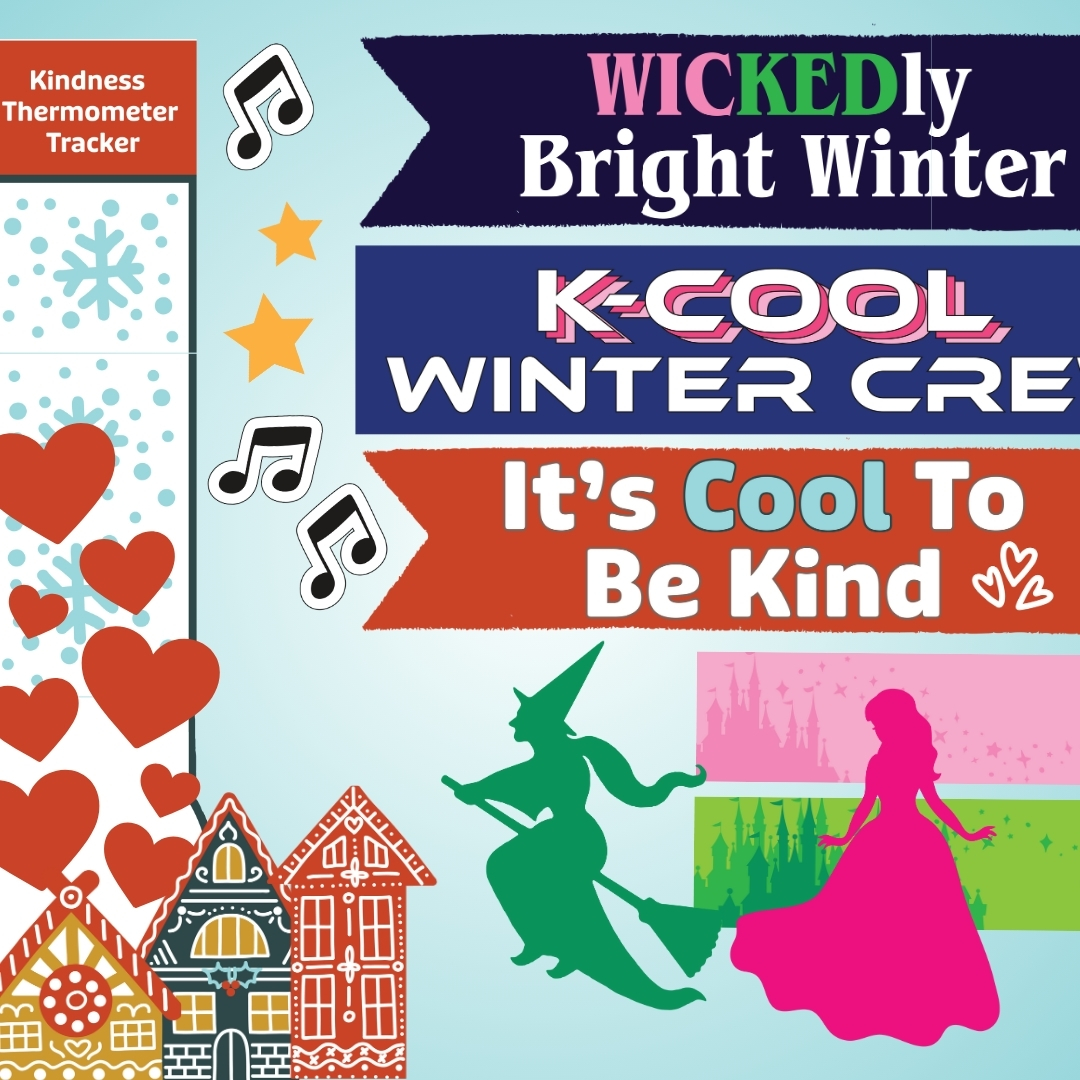
Winter Bulletin Boards
Why Teachers Love Them
Winter can feel long, but a fun and engaging bulletin board can completely change the classroom mood. These bulletin board kits (or winter door decor) keep your space vibrant while reinforcing social-emotional learning themes like empathy, kindness, and personal growth.
Why Students Love Them
Each kit includes interactive components that invite students to create, write, and reflect. They’ll love seeing their own work, whether it’s a “kindness wand,” a microphone for New Year’s goals, or a heart that warms the room.
How To Use Them
Incorporate these boards into morning meetings, SEL lessons, or goal-setting activities. Each craftivity encourages reflection and sharing, helping students practice empathy and celebrate one another’s wins throughout the winter season.
Wickedly Bright Winter Bulletin Board
This fun “Wicked”-inspired bulletin board will bring a little sparkle to your classroom!
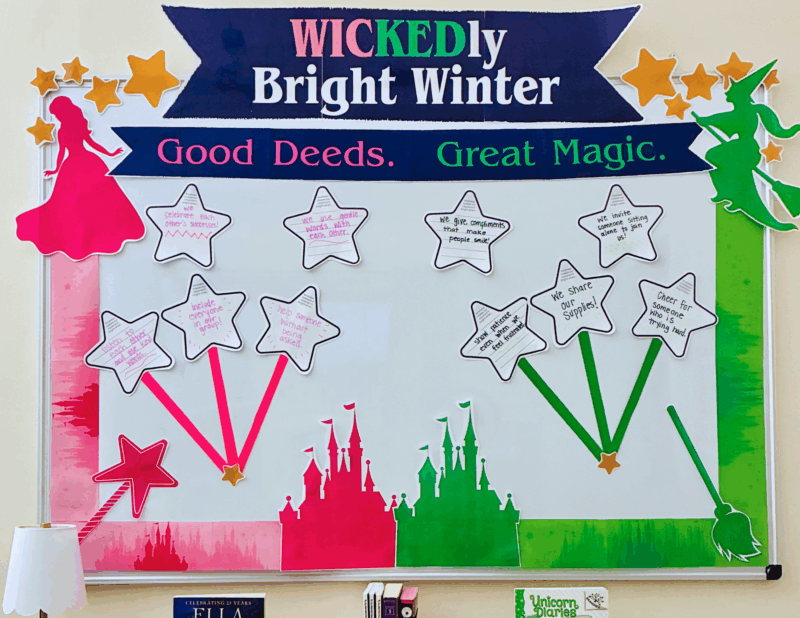
What’s Included
- Title lettering: WICKEDly Bright Winter
- Subtitle lettering: Good Deeds. Great Magic.
- Magic Wand craftivity: Kindness makes our classroom bright when …” (with and without lines)
- Two borders: Two designs
- Decorative elements: Stars, wand handles, broomsticks, princesses, witches, castles (various colors and designs)
How To Set Up
Start with your choice of green or pink castle pieces, matching borders, and star accents. Add the broom or wand corners to tie the theme together, then hang the pre-made banner “WICKEDly Bright Winter” with the subtitle “Good Deeds. Great Magic.”
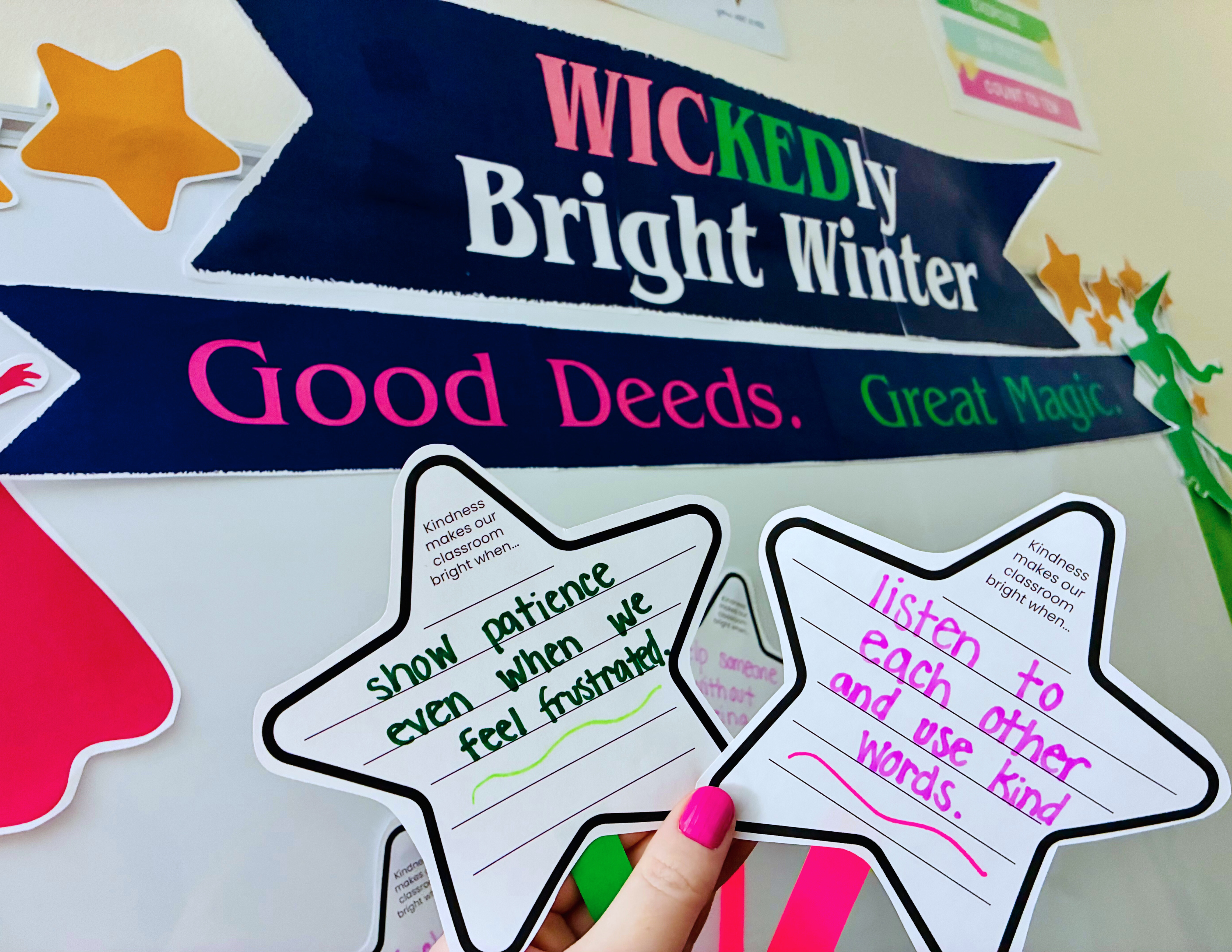
Student Interactive Component
Students create their own kindness wands and complete the prompt “Kindness makes our classroom bright when …” Display their finished wands in the center castle or scatter them like stars around the board.

FREE PRINTABLE
The snowflake printable bundle is a great winter activity and can be used long after the last snowflake melts.
K-Cool Winter Crew Bulletin Board
The K-pop–inspired bulletin board is bursting with color, positivity, and student voice.
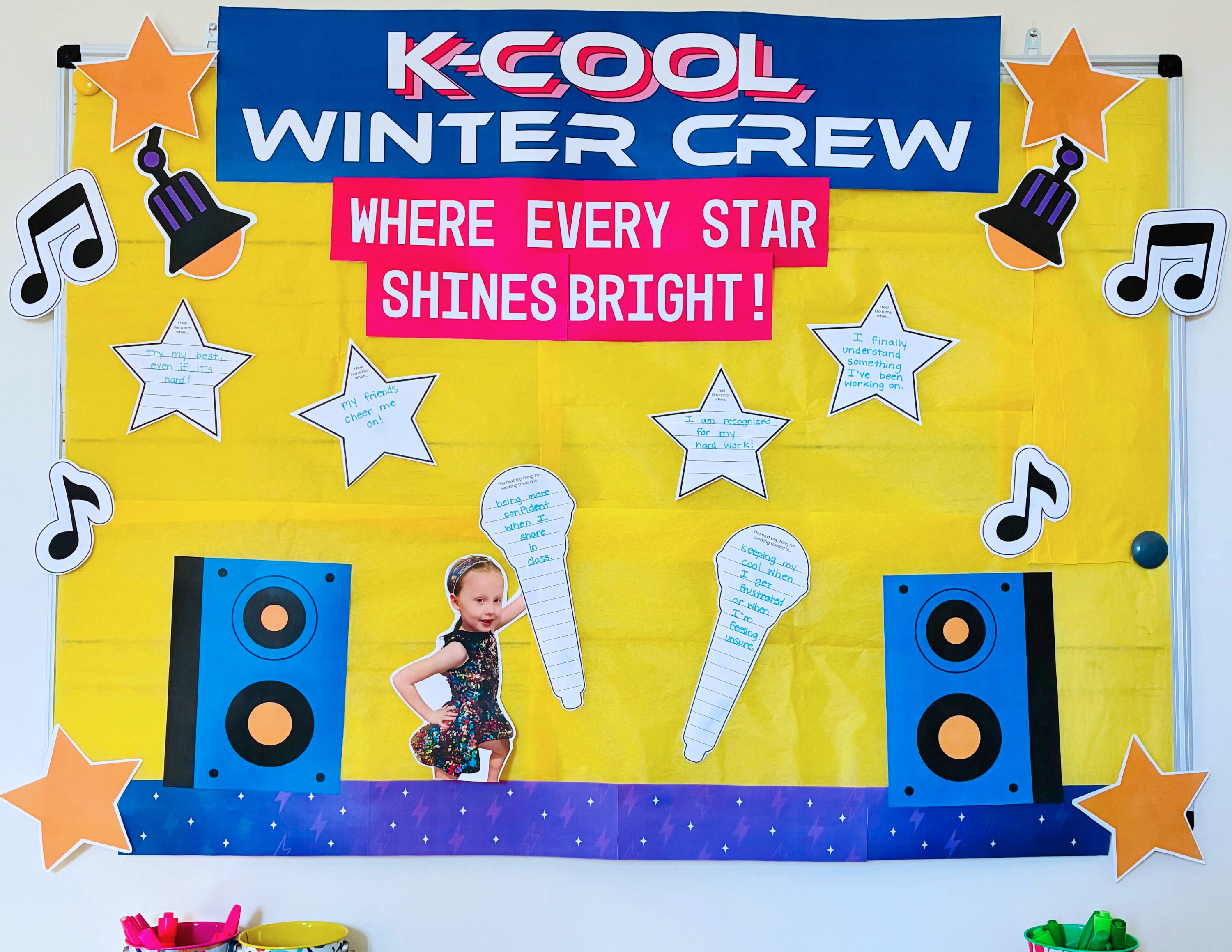
What’s Included
- Title lettering: K-Cool Winter Crew
- Subtitle lettering: Where Every Star Shines Bright!
- Star craftivity: “I feel like a star when …” (with and without lines)
- Microphone craftivity: “The next big thing I’m working toward is …” (with and without lines)
- Two borders: Two designs
- Decorative elements: Speakers, stars, spotlights, musical notes, snowflakes (various colors and designs)
How To Set Up
Create your own stage scene with the pink, purple, and blue gradient border, stars, music notes, and stereo cutouts. Hang the title banner “K-Cool Winter Crew” with the subtitle “Where Every Star Shines Bright!”
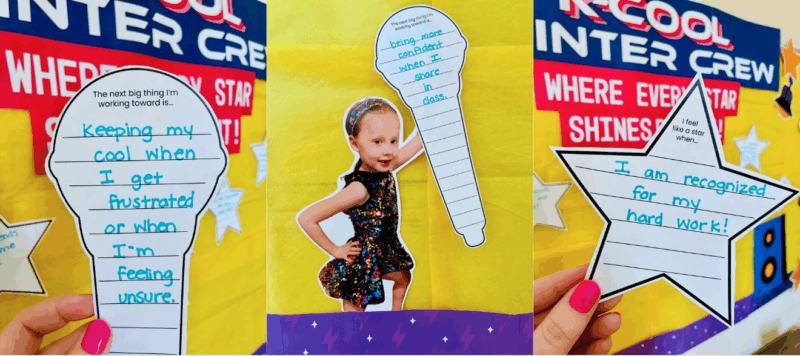
Student Interactive Components
- Microphone craftivity: Students write “The next big thing I’m working toward is …”—perfect for New Year’s resolutions or goal-setting activities. A great way to personalize this activity is to have your students dress up as pop stars, snap a photo, and attach it to their writing. Students will love seeing their work and photo on display!
- Star craftivity: Students complete the prompt “I feel like a star when …”
It’s Cool To Be Kind Bulletin Board
Fill your classroom with warmth and compassion with this cozy gingerbread village–inspired winter bulletin board.
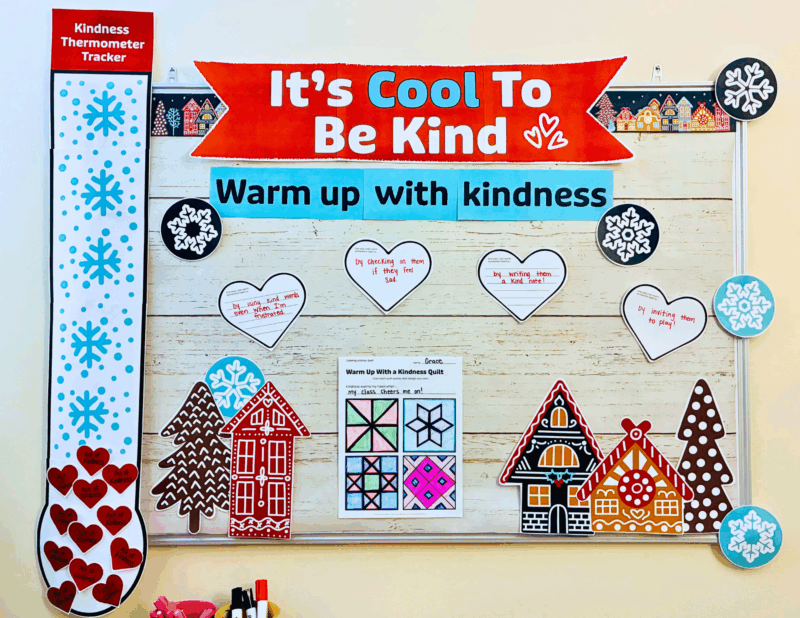
What’s Included
- Title lettering: It’s Cool To Be Kind
- Subtitle lettering: Warm up with kindness.
- Heart craftivity: “One way I can warm someone’s heart is …” (with and without lines)
- Kindness quilt craftivity: “Kindness warms my heart when …”
- Kindness Thermometer Tracker activity
- Two borders: Two designs
- Decorative elements: Winter trees, houses, hearts, snowflakes (various colors and designs)
How To Set Up
Layer the gingerbread village houses and trees along the bottom of your board, add the snowy village border to the top or bottom, and add the title “It’s Cool To Be Kind” and subtitle “Warm up with kindness.” Don’t forget to include your kindness thermometer tracker to keep track of your students’ acts of kindness this season!
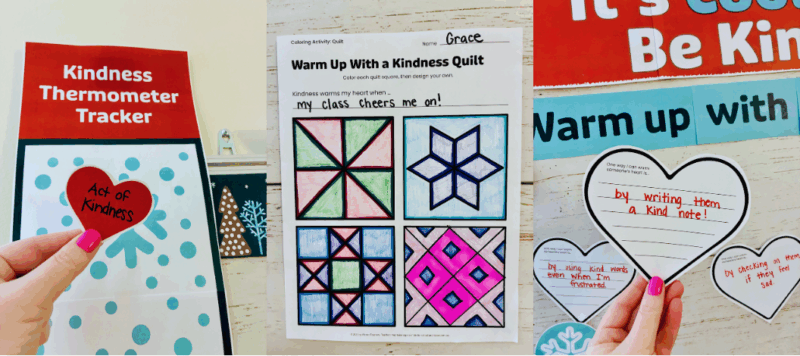
Student Interactive Components
- Heart craftivity: Students complete the prompt “One way I can warm someone’s heart is …”
- Kindness quilt worksheet: Students color quilt squares and design their own, finishing the sentence “Kindness warms my heart when …”
- Kindness thermometer: Track classroom acts of kindness using small printable hearts.
FREE PRINTABLE
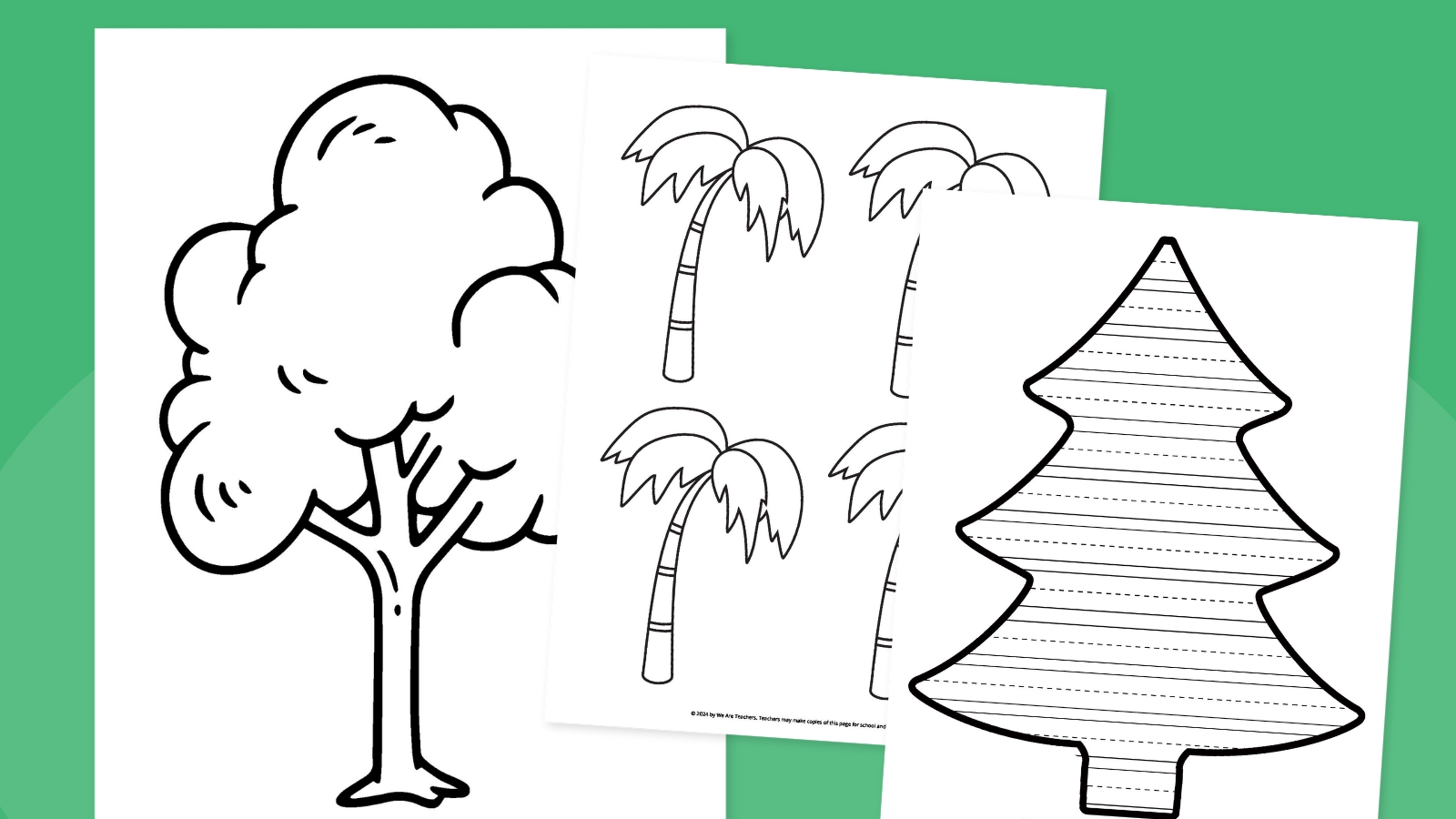
Want to add a few more trees to your winter bulletin boards? Check out our free tree template printable bundle!
Get your free winter bulletin board kits!
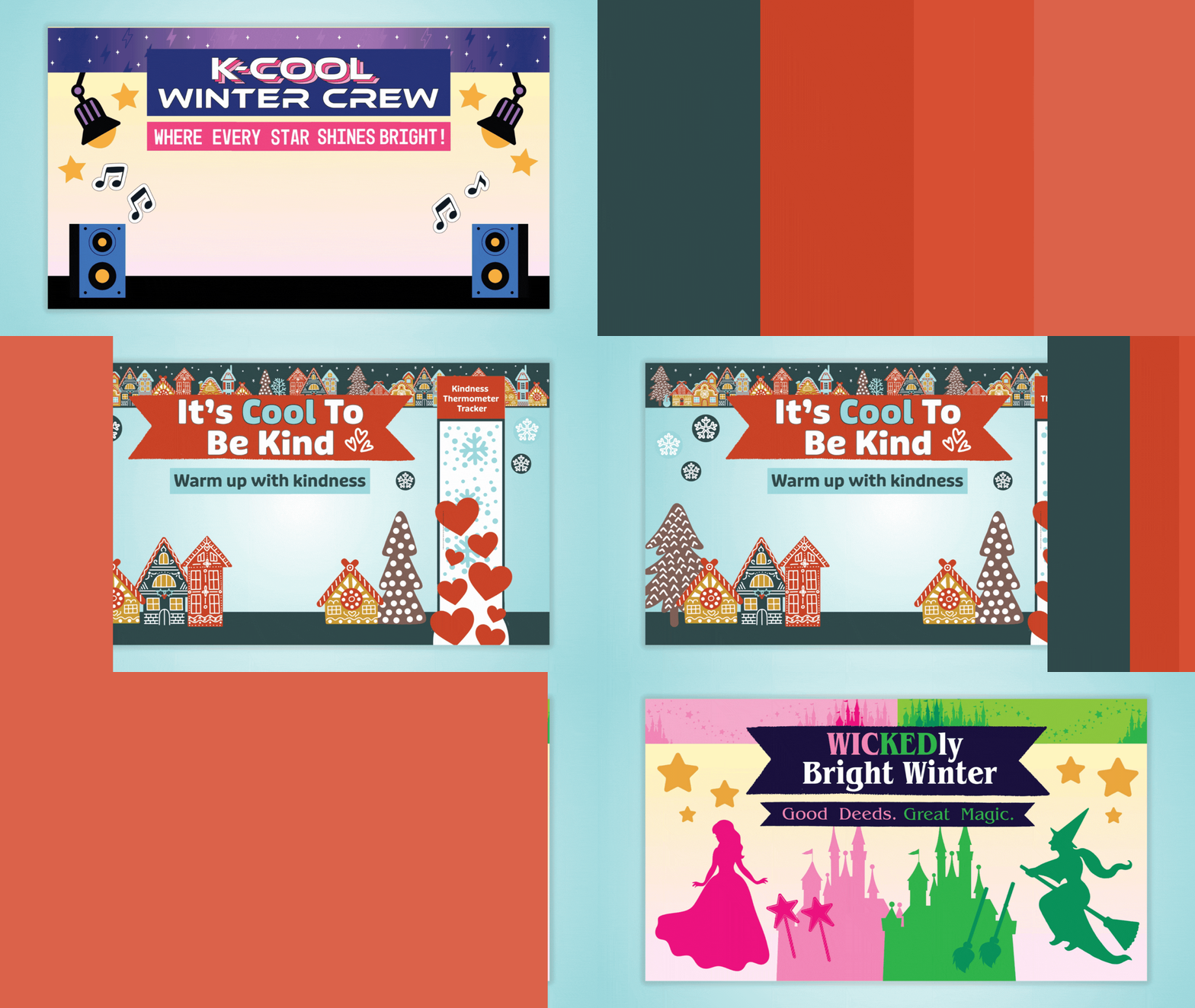
Each of these winter bulletin boards is a low-prep, high-impact way to bring reflection and engagement into your classroom. Just fill out the form on this page to get your winter bulletin boards kits and let your students help bring the magic to life—on your wall, your door, or anywhere that could use a little winter sparkle!
Looking for more free bulletin board inspiration? Check out our inventor bulletin board kit!
Plus, for more articles like this, be sure to subscribe to our newsletters!
Deal of the Day: Save 15% on Whirlpool
If you love a good deal on major appliances as much as you love a well-organized classroom (so, a lot), you’ll love this: Whirlpool offers teachers a well-deserved discount to help make home life a little easier. After all, you’re juggling lessons, laundry plans, and more—you might as well make something a little easier, right?
Educators can save 15% on Whirlpool products
Whether you’re eyeing a quieter dishwasher after a noisy day, a dependable washer for all the classroom craft days, or just a good ol’ upgrade that doesn’t break the bank, Whirlpool has you covered. With its educator-exclusive 15% discount, you’ll be able to gift yourself a new appliance that makes life smoother and more affordable this holiday season.
The best part? You don’t have to jump through hoops to get this deal. Just sign up and verify your status as a teacher through SheerID and you’re good to go!
We’re curious—what else can we help you save on this month?
Email us at editors@weareteachers.com and we’ll try to include your suggestions in our deal roundups. Happy shopping!
60 Math Brain Teasers (With Answers) for Every Age
There’s no better way to encourage outside-the-box thinking than math brain teasers. They’re usually much more about using logic than being a math whiz, so everyone will need to think creatively. Here are some of our favorite math brain teasers for students of all ages. They’re perfect for bell ringers, extra credit, or to fill the last few minutes at the end of class.
Math Brain Teasers

ALSO RECOMMENDED
Prodigy
Kids can play brain-teaser games on Prodigy. Motivate them to have fun as they practice curriculum-aligned math skills. With Prodigy, kids practice math skills as they play fun, adaptive learning games. All with teacher and parent tools to support their learning in class and at home.
1. Using only addition, add eight 8s to get the number 1,000.
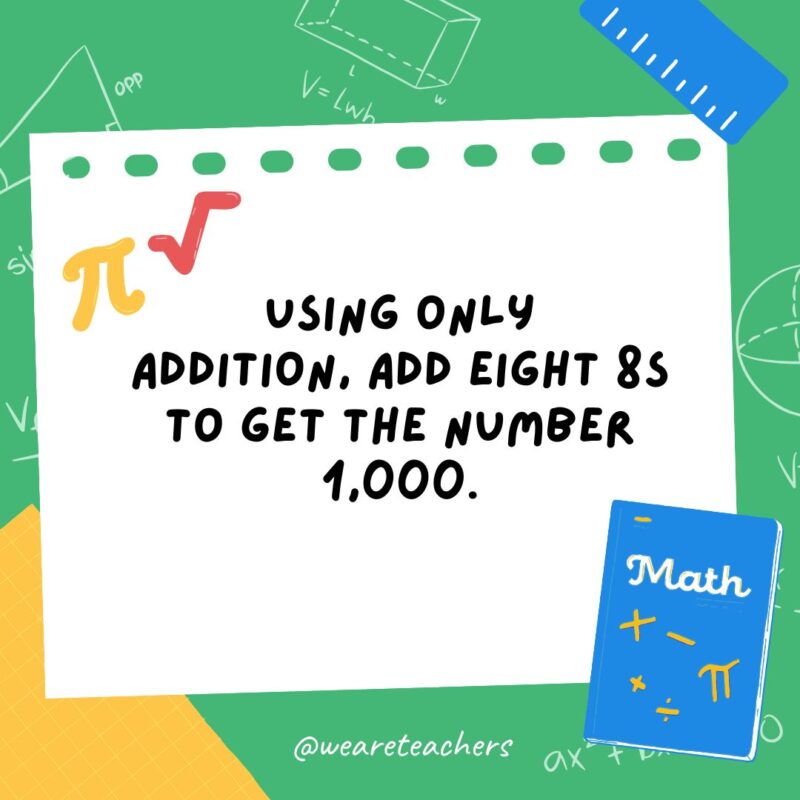
Answer: 888 + 88 + 8 + 8 + 8 = 1,000.
2. Two years ago, I was three times as old as my brother was. In three years, I will be twice as old as my brother. How old is each of us now?
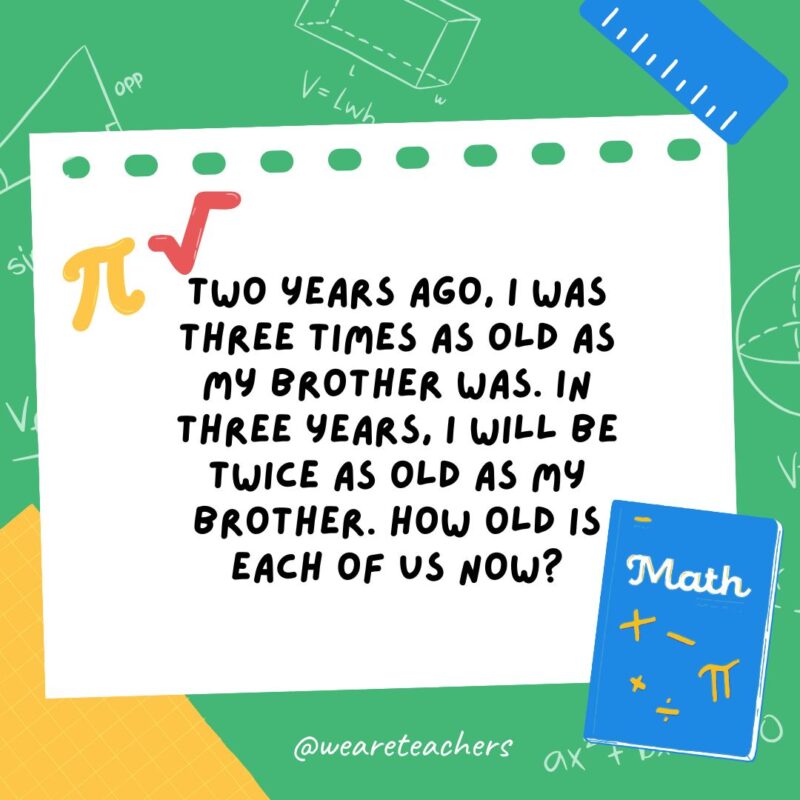
Answer: The older brother is 17, and the younger brother is 7.

Here’s another fun way to teach mathematical reasoning: Snakebird Math from our friends at PlayMath.org! Kids solve progressively harder puzzles using logic and math skills in this fun game.
3. If a hen and a half lays an egg and a half in a day and a half, how many eggs will half a dozen hens lay in half a dozen days?
Answer: 2 dozen, or 24 eggs.
4. When does 9 + 5 = 2?
Answer: When you’re telling time. 9:00 + 5 hours = 2:00.
5. A farmer had 17 sheep. All but 9 of them ran away. How many sheep does she have left?

Answer: 9.
6. A boy is 2 years old. His brother is half as old as him. When the first boy is 100, how old will his brother be?
Answer: 99.
7. Use the numbers 2, 3, 4, and 5 and the symbols + and = to make a true math equation.
Answer: 2 + 5 = 3 + 4.
8. If 3 cats can catch 3 bunnies in 3 minutes, how long will it take 100 cats to catch 100 bunnies?
Answer: 3 minutes.
9. Mr. Lee has 4 daughters. Each of his daughters has 1 brother. How many children does Mr. Lee have?
Answer: 5 (All of the daughters have the same brother.)
10. What single digit appears most frequently between and including the numbers 1 and 1,000?
Answer: 1.
11. Which weighs more: 16 ounces of feathers or a pound of solid gold?
Answer: They weigh the same. 16 ounces = 1 pound, no matter what material is being weighed.
12. Jake bought a pair of shoes and a shirt, which cost a total of $150. The shoes cost $100 more than the shirt. How much was each item?
Answer: The shoes cost $125, the shirt $25.
13. You have two coins that total 30 cents. One of them is not a nickel. What are the two coins?
Answer: A quarter and a nickel. (Only ONE of the coins is not a nickel!)
14. A + B + C = D, and A x B x C = D. What numbers make these two equations true?
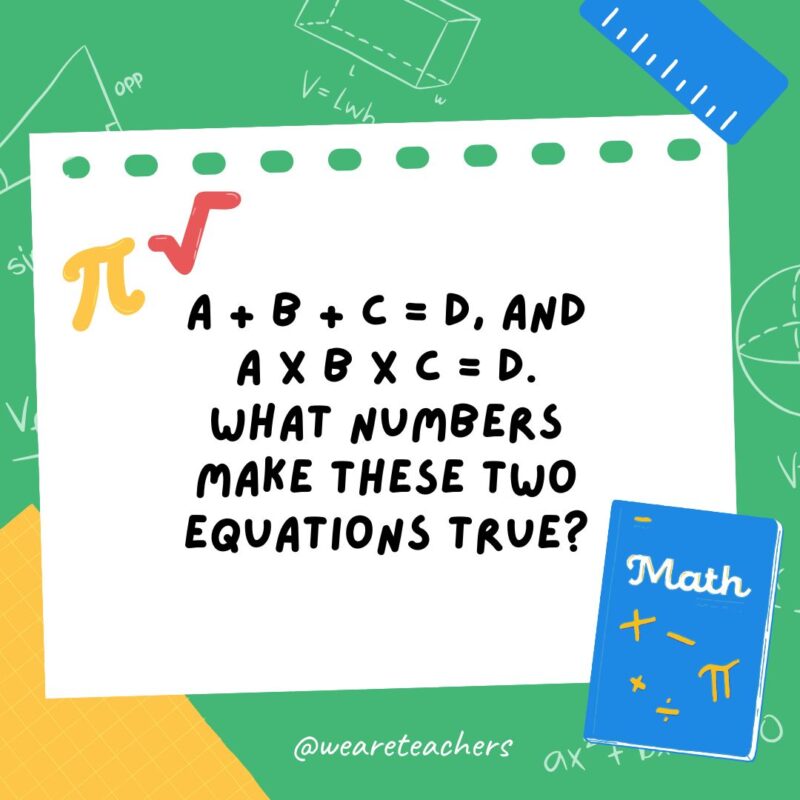
Answer: A = 1, B = 2, C = 3, and D = 6.
15. Solve this in your head (no writing it down!). Take 1,000 and add 40 to it. Add another 1,000. Now add 30. Add another 1,000. Now add 20. Add another 1,000. Now add 10. What is the total?
Answer: 4,100.
16. Grandmother died and left half her money to her granddaughter and half of that amount to her grandson. She left a sixth to her brother, and the remainder, $1,000, to the animal shelter. How much did she leave altogether?
Answer: $12,000.
17. Your sock drawer contains 18 white socks and 18 blue socks. Without looking, what is the smallest number of socks you should take out to guarantee a matching pair?
Answer: 3.
18. You planted sunflower seeds in your garden. Every day, the number of flowers doubles. If it takes 52 days for the flowers to fill the garden, how many days would it take for them to fill half the garden?
Answer: 51.
19. There are 100 houses in the neighborhood where Alex and Dev live. Alex’s house number is the reverse of Dev’s house number. The difference between their house numbers ends with 2. What are their house numbers?
Answer: 19 and 91.

20. What can you place between 8 and 9 to make the outcome greater than 8 but less than 9?
Answer: A decimal (8.9 is greater than 8 but less than 9).
21. Multiply this number with any other number and you will get the same answer every time. What is the number?
Answer: Zero.
22. If there are 6 oranges in a basket and you take out 4, how many oranges do you have?
Answer: 4 (You took 4 oranges, so you have 4 oranges!)
23. There are 8 apples in a basket. Eight people each take 1 apple, but there is still 1 apple in the basket. How can this be?
Answer: The 8th person took the basket with 1 apple still in it.
24. Multiply all the numbers on the number pad of a phone. What is the total?
Answer: Zero (Phone number pads include the numbers 0-9.)
25. There are 7 kids in the Garcia family, each born 2 years apart. If the eldest Garcia child is 19, how old is the youngest Garcia child?
Answer: 7.
26. Two mothers and 2 daughters each had 1 egg for breakfast, but they only ate 3 eggs all together. How can this be?
Answer: There were only 3 people—a grandmother, her daughter, and her granddaughter.
27. A 300-foot train traveling 300 feet per minute must travel through a 300-foot-long tunnel. How long will it take the train to travel through the tunnel?

Answer: 2 minutes. (It takes the front of the train 1 minute, and the rest of the train will take 1 more minute to clear the tunnel.)
28. I am a three-digit number. My second digit is four times greater than the third digit. My first digit is three less than my second digit. What number am I?
Answer: 141.
29. Tom was asked to paint numbers outside 100 apartments, which means he will have to paint numbers 1 through 100. How many times will he have to paint the number 8?
Answer: 20 times (8, 18, 28, 38, 48, 58, 68, 78, 80, 81, 82, 83, 84, 85, 86, 87, 88 [two 8s], 89, 98).
30. Ellie works at the aquarium. When she tries to put each turtle in its own tank, she has one turtle too many. But if she puts two turtles per tank, she has one tank too many. How many turtles and how many tanks does Ellie have?
Answer: Ellie has 3 tanks and 4 turtles.
31. If eggs cost 12 cents a dozen, how many eggs can you get for $1?
Answer: 100 eggs (The eggs cost 1 penny each.)
32. If you toss a coin 100 times and it lands heads up every time, what is the chance it will land heads up on your next throw?

Answer: 50/50 (The previous tosses don’t make any difference; you always have an equal chance of heads or tails.)
33. You’re visiting a clothing store that has a strange way of pricing items. A vest costs $20, socks cost $25, a tie costs $15, and a blouse costs $30. You want to buy some underwear. How much will it cost?
Answer: $45. Items cost $5 for each letter used to spell the word.
34. How can you make this equation correct: 81 x 9 = 801?
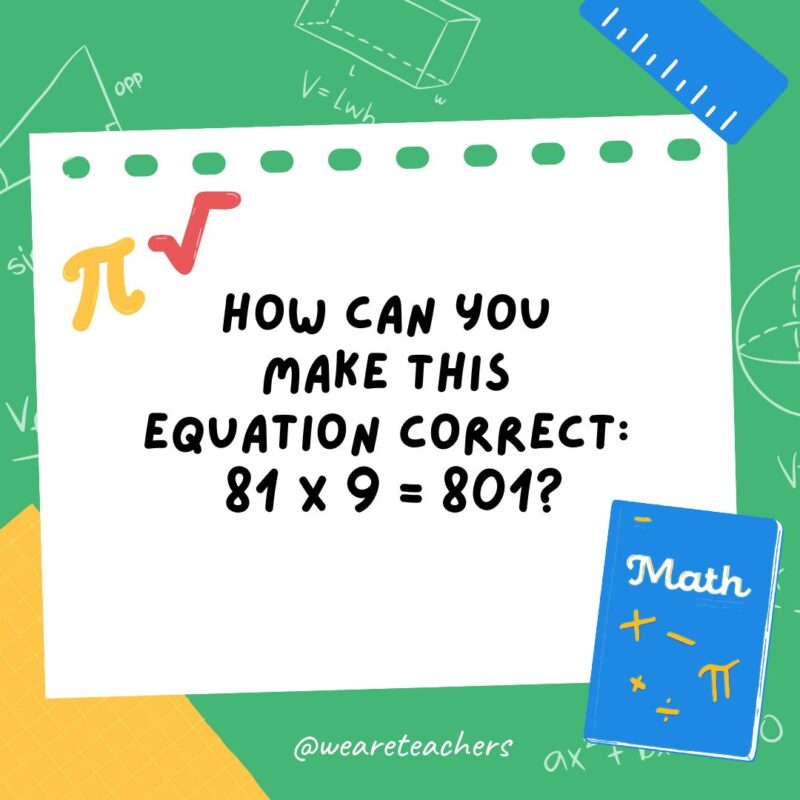
Answer: Turn it upside down: 108 = 6 x 18.
35. You’re planning to spend your birthday money taking some friends to the movies. Is it cheaper to take 1 friend to the movies twice or 2 friends to the movies at the same time?
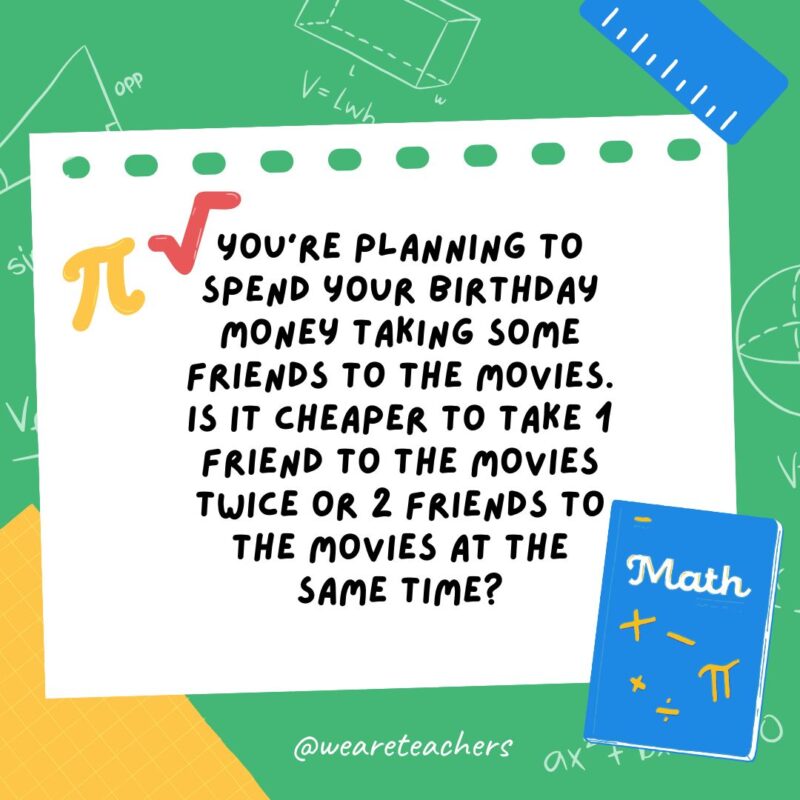
Answer: Take 2 friends at the same time, so you’ll only buy 3 tickets total. If you take 1 friend twice, you’ll need to buy yourself a ticket each time, for a total of 4 tickets.
36. Each day, a snail climbs 3 feet up a wall, but each night it slips 2 feet back down while it sleeps. If the wall is 30 feet high, how many days will it take for the snail to reach the top?
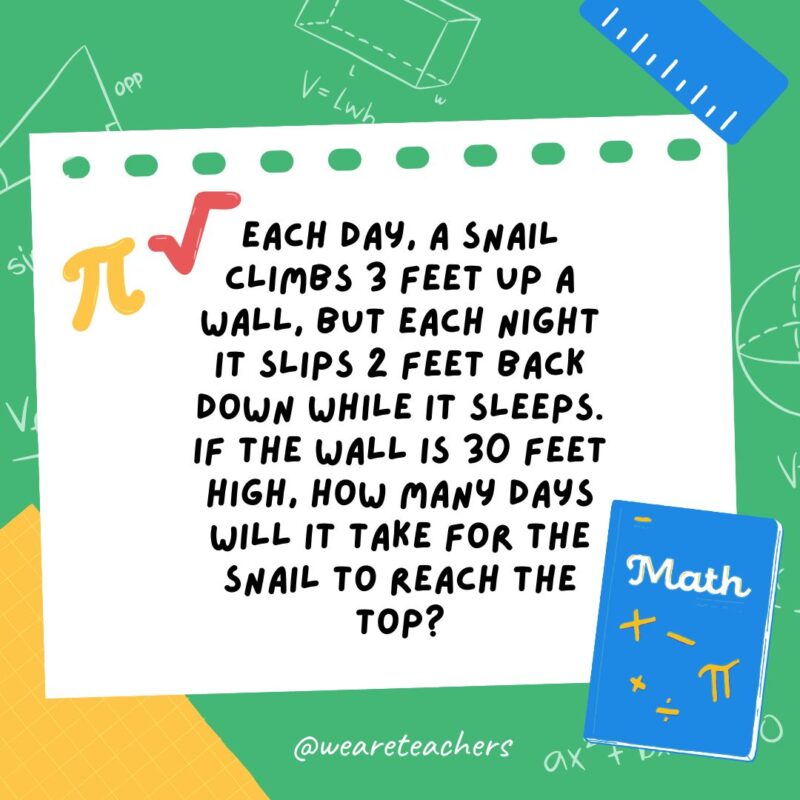
Answer: 28 days. Each day, the snail makes a 1 foot gain, bringing it to 27 feet by the 27th day. On the 28th day, it will climb the last 3 feet and reach the top.
37. Divide 40 by half and add 10. What’s the result?
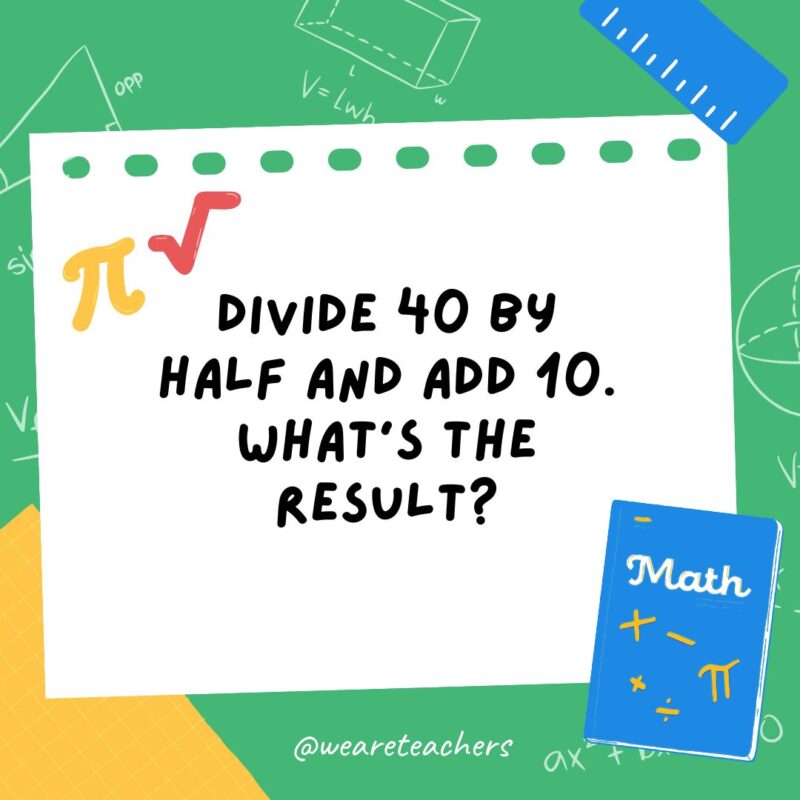
Answer: 90. The instruction says to divide by half, not to divide in half. In other words, the equation is 40 ÷ .5 = 80 + 10 = 90.
38. Add me to myself and multiply by 4. Divide me by 8 and you will have me once more. What number am I?

Answer: This works for any number!
39. Lin is four times as old as her daughter Rosa. In 20 years, Lin will be twice as old as her daughter. How old are Lin and Rosa now?
Answer: Lin is 40, and Rosa is 10.
40. A box holds 13 blue marbles, 13 red marbles, and 13 green marbles. If you’re unable to see into the box, what is the minimum number of marbles you need to take out to ensure you have one of every color?
Answer: 27. You might need to take out every one of two colors of marbles (26) before pulling one of the third color (+1).
41. A store is offering a bat and ball for a total of $1.10. The bat costs $1 more than the ball. How much does each item cost separately?
Answer: The ball costs 5 cents, and the bat costs $1.05.
42. Find two numbers whose squares add up to 100. (Neither number is zero.)
Answer: 8 and 6 (64 + 36 = 100).
43. Miguel, Sara, and Olive share a box of 120 M&Ms. Miguel eats half the candy, Sara eats one-third, and Olive eats one-tenth. How many M&Ms are left?

Answer: 8. Miguel eats 60, Sara eats 40, and Olive eats 12. This leaves 8 pieces of candy uneaten.
44. What is unique about this number: 8,549,176,320?
Answer: When spelled out as words, it contains the numbers 0 to 10 in alphabetical order. (Eight, five, four, etc.)
45. Arrange the numbers 1 to 9 in a 3 x 3 grid such that the sum of each row, column, and diagonal is the same.
Answer: Row One: 8 3 4, Row Two: 1 5 9, Row Three: 6 7 2.
46. A rectangle has a perimeter of 24 inches. If the length is twice the width, what are the dimensions of the rectangle?
Answer: Width = 4 inches, length = 8 inches.
47. I am a four-digit number (ABCD). When you multiply me by 4, the answer is the same four-digit number in reverse (DCBA). What number am I?
Answer: 2,178.
48. What is the next number in this series? 7,645 5,764 4,576 _______.
Answer: 6,457 (Move the final digit to the beginning each time.)
49. A triangle has three angles that are all square numbers. What are the angles of this triangle?
Answer: 16 degrees, 64 degrees, and 100 degrees.
50. What is the smallest whole number that, when written out in words, uses all the vowels exactly once?
Answer: Five thousand.
51. An old woman dies on her 24th birthday. How can that be?

She was born on February 29, in a leap year, which occurs once every four years. Consequently, 24 x 4 = 96.
52. Lorenzo was born in 1988. In 1968, he was 20 years old. How could that be?
Lorenzo was born in 1988 B.C.E. So, we count the time backward. 1968 B.C.E. is 20 years later than 1988 B.C.E.
53. It’s the longest side of the triangle, starting with H and ending with E. What is it?
Hypotenuse.
54. Figures with sides have it, but a circle doesn’t. What is it?
An angle.
55. I am an odd number. If you subtract 10 from me, you get 15. What number am I?

25 (25 – 10 = 15).
56. I am thinking of a number. If you add 5 to it and then multiply the result by 3, you get 24. What number am I thinking of?

3 (3 + 5 = 8, 8 x 3 = 24).
57. How can you make 45 using only 4?
Use fractions: 44 + 4/4 = 45 because 4/4 = 1.
58. I put three matches on a table. I ask you to add two matches to get 8. How can you do this?

You can make the Roman numeral eight: VIII.
59. William takes two from five and gets four. How does he do that?
He takes the letters F and E from FIVE and gets IV, which is Roman numeral four.
60. A farmer bought a rooster to sell eggs for 1 cent each. The rooster lays five eggs daily. How much will the farmer earn in a week?

Nothing because roosters don’t lay eggs.
Get my math brain teasers Google Slides!
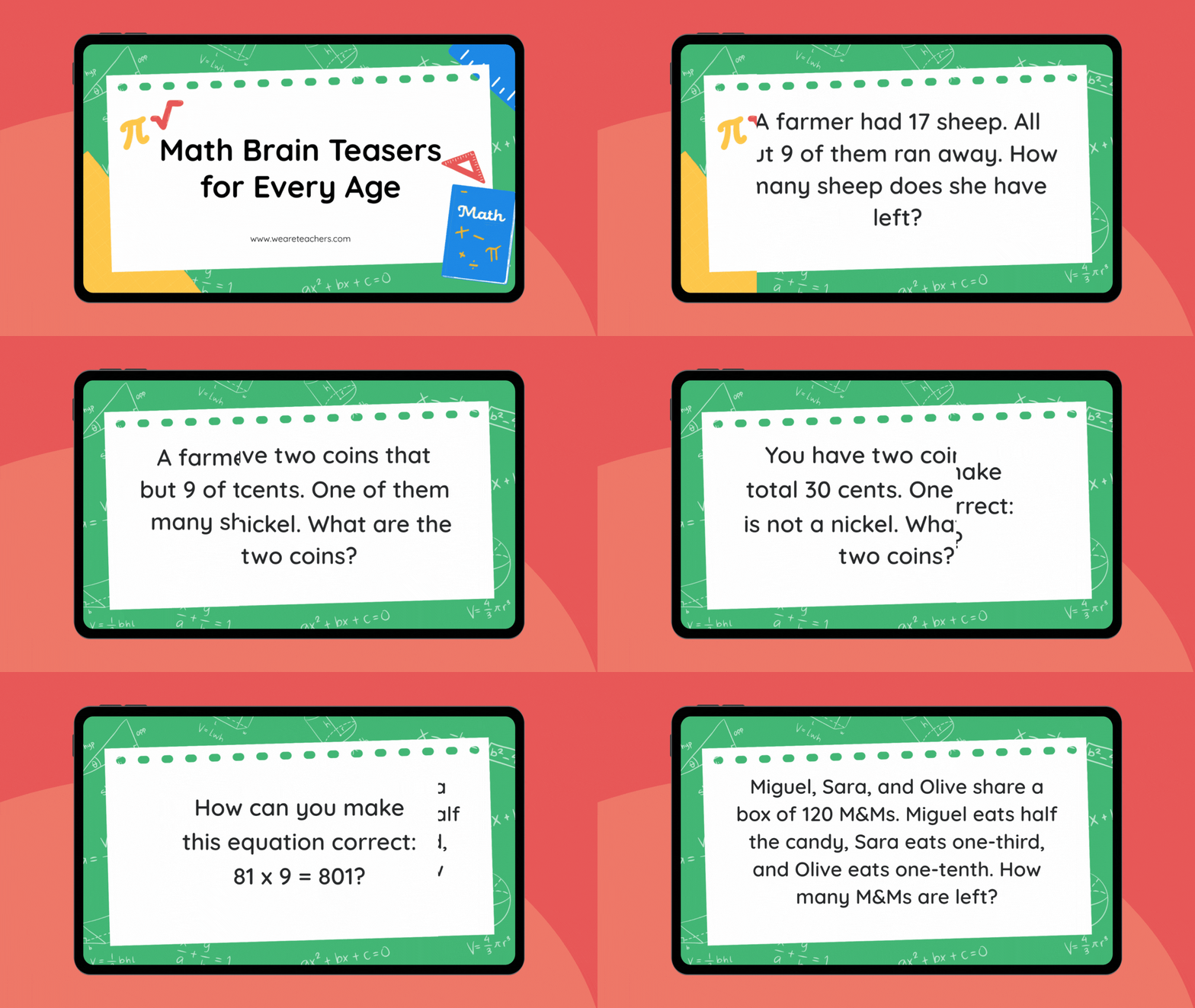
If you loved our math brain teasers, click the button below and fill out the form to receive your own copy. The brain teasers are formatted to easily share with your classroom. Just fill out the form on this page!
Did we miss one of your favorite math brain teasers? Come share your favorite math conundrums in the We Are Teachers HELPLINE group on Facebook.
If you love these math brain teasers, don’t miss these Math Puzzles and Number Tricks To Wow Your Students.
110 History Jokes We Dare You Not To Laugh At
History is usually no laughing matter, but sometimes we can’t help but LOL at modern interpretations of the past. Here are 110 irreverent history jokes to share with your students.
Jump to:
American History Jokes
What kind of music did the Pilgrims like?

Plymouth rock.
Why did George Washington have trouble sleeping?
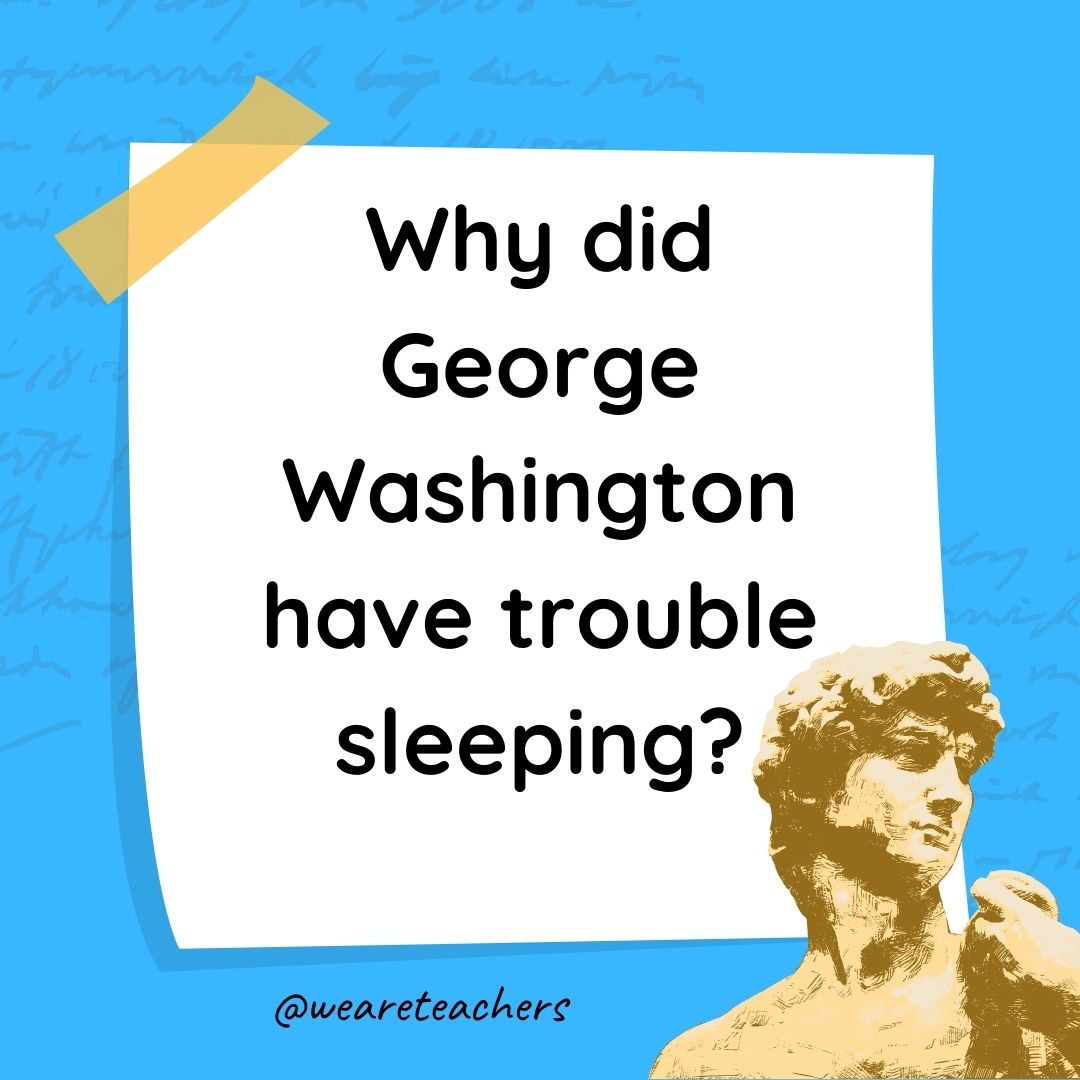
Because he couldn’t lie.
What did Mason say to Dixon?
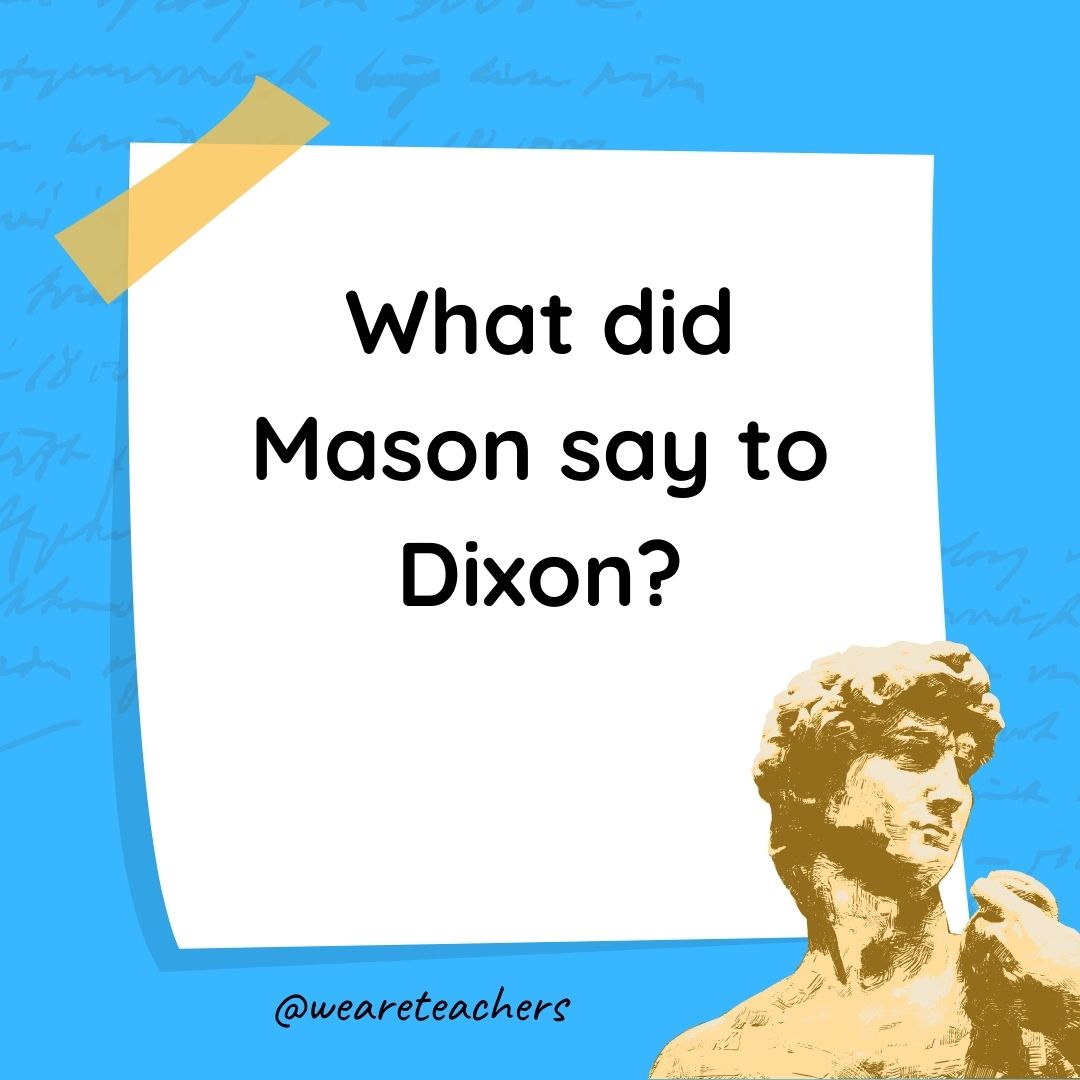
This is where we draw the line!
Where was the Declaration of Independence signed?
At the bottom.
Two wrongs don’t make a right.
But two Wrights did make an airplane!
What did King George think of the American colonies?

He thought they were revolting.
Did you hear the one about the Liberty Bell?
Yeah, it cracked me up!
How were the first Americans like ants?
They lived in colonies.
How did Benjamin Franklin feel when he discovered electricity?
Shocked.
Why did the Pilgrims’ pants always fall down?
Because they wore their belt buckles on their hats!
Why did the American colonists dump tea into the harbor?
Because they wanted to throw a tea-rrific party.
What kind of music did the Founding Fathers listen to?
Rock and scroll.
Why did the history book get grounded?
It had too many dates.
How did everyone know Paul Revere was good at his job?
Word got around.
How did the Pilgrims bring cows to America?
On the Moo-flower.
What kind of tea was the colonists’ favorite?
Liber-tea.
Who can jump higher than the Statue of Liberty?
Anyone. Statues can’t jump.
Why is the Declaration of Independence so dramatic?
It has so many acts.
Why did the colonists wear red coats?
Because they didn’t want to be spotted by the British.
What do you get when you cross George Washington with a cow?
Moo-tiny on the Potomac.
Who was the biggest jokester in George Washington’s army?

Laugh-ayette.
Why did George Washington chop down the cherry tree?
He wanted to branch out.
Why did Ben Franklin fly a kite in a storm?
He wanted to spark a new idea.
What was the American army’s favorite food during the Revolutionary War?

Chicken catch-a-Tory.
Which Americans tell the most dad jokes?
Punn-sylvanians.
What do you call the first turkeys in America?
The Founding Feathers.
What’s Betsy Ross’s favorite sport?

Flag football.
What do you get when you cross a fancy, patriotic American with a curly-haired dog?
A Yankee Poodle Dandy.
Why did the early settlers build their homes near rivers?
They liked current events.
What did the colonists wear to the Boston Tea Party?

Tea-shirts.
Why did the Confederate soldier bring a broom to the battlefield?

He wanted to sweep the victory.
Why did the Union soldier always carry a map?

He didn’t want to lose his direction.
Why did Civil War soldiers wear suspenders?
To keep their pants up.
When was the last time Abraham Lincoln cried?
Four score and seven tears ago.
Why was Teddy Roosevelt always invited to parties?
He was bear-y fun to be around.
What is President Obama’s favorite vegetable?

Barack-oli.
Why did President Lincoln wear a tall hat?
So he’d be head and shoulders above the rest.
What did the patriot say when he stormed the bakery?
Give me liberty or give me bread.
World History Jokes
Why were the early days of history called the Dark Ages?

Because there were so many knights.
How was the Roman Empire cut in half?
With a pair of Caesars.
How did Louis XIV feel after completing the Palace of Versailles?
Baroque.
How did the Vikings send secret messages?
By Norse code.
What’s the most popular kids’ movie in Ancient Greece?

Troy Story.
Why did the knight always carry a pencil and paper?
He wanted to draw his sword.
Why did the ancient pharaoh go to jail?
He wouldn’t stop running his pyramid schemes.
Why did the ancient Egyptians need a doctor?
They had sar-cough-aguses.
Why did Alexander the Great have to study geometry?
He wanted to conquer all the angles.
How did the Roman emperor cut his hair?
With a pair of Caesars.
How did the Egyptian pharaoh get around?

In his mummy’s car.
How did the pharaoh feel after a long day of ruling?
Tut-erly exhausted!
Did you hear about the Viking who was reincarnated?
He was Bjorn again.

Why did the Roman Empire cut costs on roads?

Because all roads led to Rome.
Why was the king only 12 inches tall?
Because he was a ruler.
Why did the Greeks start telling myths?
They didn’t want history to be boring.
What did the medieval knight say to the queen?
“You rule!“
Who made King Arthur’s round table?
Sir Cumference.
Why did the baker go to the Renaissance faire?

He heard there was a knead for speed.
Why did soldiers in the Middle Ages have such low energy?
Because there were too many sleepless knights.
Why did Christopher Columbus always carry a map?
He didn’t want to be lost in history.
Why did the explorer bring a ladder?

To reach new heights in discovery.
What did explorer Marco say when he got home?
“I Polo’d the wrong continent!”
Why did the ship cross the ocean?
To get to the other continent.
What’s a revolutionary’s favorite movie?
“Rebel Without a Cause.”
Why was World War I so quick?

Because it was Rushin’.
Why was World War II so slow?

Because it was Stalin.
Why was the guillotine so polite?

It was trying to cut people some slack.
Why did Henry VIII cross the road?
To get to the other bride.
Why is England the wettest country?
Because the queen reigned there for years.
Why did the soldier bring string to battle?
To tie up loose ends.
What did the pharaoh say when he saw the pyramid?

“Mummy’s home!”
Why did the airplane go to school in World War I?

To improve its plane geometry skills.
Where did General George Patton keep his armies?
In his sleevies.
Why was the map always calm during war?
It stayed on the level.
Why did the general bring a pencil to the battlefield?
In case he needed to draw his troops.
What did one army say to the other?
“I’m drawn to your tactics.”
Why did people invent the telephone?
To let history ring.
What did the Cold War spy say to the other spy?
“I’ve got a chilling secret.”
Why did the Berlin Wall fall?
Because it couldn’t handle the pressure.
In a democracy, it’s your vote that counts.

In feudalism, it’s your count that votes.
More History Jokes
Who invented fractions?
Henry the 1/8th.
Why did Columbus cross the ocean?
To get to the other tide.
What do Alexander the Great and Kermit the Frog have in common?
The same middle name.
Why is history like a fruit cake?
It’s full of dates.
What is a snake’s favorite subject in school?
Hissssstory.
Why was the math book sad about history class?

It knew it couldn’t count on the past.
Why did the archaeologist become a comedian?
Because he loved digging up old jokes.
How did the cavemen feel about studying history?
They thought it was a pre-hysterical subject.
What did one flag say to the other flag?

Nothing, it just waved.
Why shouldn’t you major in history in college?

There’s no future in it.
What did the history book say to the philosophy book?

I’ve got the facts—you just think you do.
Why did the historian take a nap?

He wanted to dream of the past.
Why are Americans allowed to wear short sleeves to work?

Because the Second Amendment gives them the right to bare arms.
Why do history buffs make terrible thieves?

They always leave evidence.
What did the students say to one another before their history test?
“Let’s make this test historic!”
How do you comfort a sad historian?
You say, “Don’t worry, this too shall pass!”
Why are elephants good historians?
Because they never forget.
Why did the king go to the dentist?
To get his crown checked.
Why did the history book go to the psychiatrist?

It had a troubled past.
Why was the broom late to the Renaissance?
It over-swept.
How do archaeologists feel about parties?

They dig them!
What did Caesar say to Cleopatra?

Toga-ther we can rule the world!
Which monument always gossips about the other monuments?
The Statue of Liber-tea.
What’s a mummy’s favorite type of music?
Wrap music.
Why did Columbus sail to America?
It was too far to swim.
Why did the pioneers cross the country in covered wagons?

Because they didn’t want to wait 40 years for a train.
Why did the sword get a promotion?
It had a cutting-edge attitude.
Why did the pirate go to school?

To improve his arrrrrt skills.
Why was the Viking so hungry?

He couldn’t a-fjord any food.
When a knight was killed in battle, what sign did they put on his grave?

Rust in peace.
Did you watch “Dancing With the Tsars” last night?

Peter and Catherine were great, but Ivan was terrible.
Get your free history jokes Google Slides!

Just click the button below and fill out the form to access your free Google Slides will all the history jokes on this list.
What are some of your favorite history jokes and memes? Come share them in our We Are Teachers HELPLINE on Facebook.
Plus, if you liked these history jokes, check out our favorite math jokes and science jokes.
65 Best Jobs for Former Teachers, In and Out of Education
Teachers are among the most dedicated people in today’s workforce, but the job is getting harder every day. The sad reality is that more teachers than ever are opting out of the traditional classroom for the sake of their mental health, physical health, life balance, or other reasons. Yet most who leave still want to remain connected to teaching and learning. After all, that is where their passion and experience lie. So what are the best jobs for former teachers who are ready to leave the traditional classroom? The number of options may surprise you!
Finding Jobs for Teachers Outside the Traditional Classroom
Are there jobs for former teachers that use your skills but don’t take place in the classroom? You bet! Teachers are smart and skilled workers who often easily qualify for a wide variety of jobs in a variety of industries. Many former classroom teachers choose to stay in some form of education, working as instructional designers, corporate trainers, or private tutors—just to name a few.
If you’re ready to leave the education industry behind altogether, that’s OK too! Consider a career that takes advantage of your subject-area expertise instead. Former math teachers may become accountants or insurance actuaries. Chem teachers could work in lab settings, while ELA educators may transition to publishing or become freelance writers. The opportunities are incredible once you start looking!
Jobs for Former Teachers FAQs
Can teachers work from home?
Yes! The opportunities for teachers to work from home are growing every day. Become a virtual classroom teacher or ESL tutor for students in other countries. You can also tutor students online or in your own home, or work as a remote corporate trainer in a variety of industries.
What jobs can former teachers do without going back to school?
Teachers have a lot of transferable skills, plus they already have the four-year degree required by many positions. Many former teachers find success as tutors, educational consultants, project managers, content writers, or customer relations specialists. And that’s just the start!
How do I transition from teaching to another field?
In order to make a successful transition, you’ll need to present your experience differently. Think about how your skills and accomplishments in the classroom correspond to new industries. To help get you started, check out Leaving Teaching? How To Make Your Resume Stand Out in the Corporate World.
What are the highest-paying jobs for former teachers?
Salaries vary by industry, but teachers often find they can earn more in business, tech, or corporate learning roles. Look for positions like corporate trainer, instructional designer, education consultant, human resources specialist, and project manager.
What are the best alternative careers for teachers who want to leave the classroom but not education?
Many former classroom teachers transition to new careers in corporate training, instructional design, education consulting, education advocacy, or nonprofit educational groups. If you love working with students, consider becoming a literacy specialist, private tutor, or childcare worker. Want to work with grown-ups instead? Try a career as an instructional coach, adult educator, or technical instructor.
Once you dive in, you’ll find many jobs for teachers that don’t involve a traditional classroom. We rounded up dozens to consider, many suggested by the community of teachers in our We Are Teachers HELPLINE group on Facebook. We’ve even provided average salaries* and links to some typical listings* to get you started!
Jump to:
- Teaching Jobs Outside the Traditional Classroom
- Jobs for Former Teachers Who Love To Read and Write
- Best Jobs for Former Teachers Who Love Math
- STEM Teacher Jobs Outside of Education
- Best Jobs for Former Humanities and World Language Teachers
- Jobs for Former Teachers Who Excel at Communication
- Best Jobs for Former Teachers Who Love Kids
- Jobs for Former Teachers With Strong Organizational Skills
*Note: Job listings are continually being updated so please check websites for real-time listings. All salary average estimates provided by Glassdoor.
Teaching Jobs Outside the Traditional Classroom
Your teaching skills are most directly transferable to other jobs in the education industry. If you still love teaching but don’t want to deal with some of the problems associated with traditional schools and classrooms, these career paths may appeal to you.
1. Online Educator
Red tape and pressure still apply, but one of the best jobs for former teachers is an online educator. It’s been a game changer for many people, especially now that we’ve all done it during quarantine. The pay, even when salaried, is less, but so is the stress. Kellie T. agrees: “I’m still teaching but virtually on a virtual platform. I’ve been working for a couple of years. I enjoy it because I teach what I want and how I want.” Average salary: $56,773. Sample job listings.
2. Corporate Trainer
Corporate trainers are like teachers that work in corporate or other professional settings to promote employee growth and development. They may train teams in person to develop their skills or create entire training programs used to teach and train employees. According to WGU, the career path of a corporate trainer can be rewarding for those with a passion for teaching. Anyone who is outgoing, loves being around people, and likes to teach would be an excellent fit for this position and can take simple steps to get started. Average salary: $67,431. Sample job listings.
3. Prison Educator
Many people shy away from this because they fear for their safety. Teacher Melissa E. says otherwise: “It’s a great gig! You get the best, most motivated students. They will go out of their way to keep you safe because they value you so much. Go for it!” Average salary: $80,162. Sample job listings.
4. Private Tutor
Use your expertise as an instructor to start your own tutoring business. Yes, tutoring jobs are some of the most obvious jobs for former teachers. However, if you build up your own clientele, you can make serious money, with experienced tutors charging anywhere from $35 to $50 per hour. Tap into those good relationships you’ve built over the years and make the transition to working at your own pace and on your own terms. Michele T. shares, “I resigned after 20 years of teaching, and I’ve never been happier! My school families started reaching out to me almost immediately to ask if I’d be interested in becoming a personal tutor for their children. I designed individual plans based on their needs.” Average salary: $50,546. Find a tutoring job.
5. Technical Instructor
Technical instructors provide a variety of training in fields such as auto repair, healthcare, culinary science, and others. They design curricula, encourage class discussion, and teach technical skills to students (for example, auto repair tech instructors might teach how to fix a damaged car frame or replace a tire). Average salary: $100,401. Sample job listings.
6. Adult Education Teacher
This job is perfect for the educator who wants to work in a different environment and with nontraditional students. These teachers work with adults who have not yet finished high school and are ready to get the skills to advance in their careers. It is an opportunity to work with students who are usually highly motivated and appreciative of the chance to learn to read or to qualify for their general equivalency diploma (GED). Average salary: $55,882. Sample job listings.
7. Post-Secondary Educator
Post-secondary teachers work in colleges, including community colleges, and universities. They may provide instruction or conduct and publish research. A master’s degree is often sufficient to work at the community college level, but a doctoral degree is necessary to have a future at the university level. Average salary (community college) $53,988. Sample job listings.
Jobs for Former Teachers Who Love To Read and Write
Former ELA teachers, this section is for you! Make good use of your knowledge of composition, grammar, and other key writing skills with jobs like these.
8. Curriculum Writer/Creator
Want to improve the quality of what students learn? Interested in working with teachers? Informing curriculum is a great way to directly impact what goes on in the classroom without actually being in it! Whether that means going with one of the big education curriculum companies or producing your own content on paid teacher sites, it’s a great opportunity to share your knowledge with other teachers. Average salary: $81,037. Sample job listings.
9. Freelance Writer
If you love to write and are a hard worker who will do the detective work to land writing gigs, then freelancing is an awesome option for you. There are lots of education-related publishers looking for contributors. You can work from home, write when it fits your schedule, and make decent money. Susan G. says, “I became a copywriter when I retired after 32 years because I love to write and it combined my English and journalism major.” Average salary: $55,515. Sample job listings.
10. Editor
If you don’t feel much like writing but still want to facilitate the distribution of content, you may want to look at becoming an editor. An editor typically works with writers to develop content that fits within the editorial guidelines of an online or print publication. Writing and management skills are a must! And if you worked within a particular subject, you may find your knowledge is even more in demand for editorial work. Average salary: $72,362. Sample job listings.
11. User Experience Designer
A User Experience (UX) Designer’s role is to make a product or service usable, enjoyable, and accessible—skills that teachers work on every day. After all, good teachers create lessons with their students’ experience in mind. This role is particularly suited for teachers with strong tech skills. While many companies design user experiences, the term is most often associated with digital design for websites and apps. Average salary: $94,472. Sample job listings.
12. Librarian
For those who love books and/or encouraging research or a love of reading, this position might be for you. Librarians select books and educational material for schools as well as business, law, and public libraries. Generally, you’ll need a master’s degree in library science (MLS). China R. says, “Now I work in the children’s department of the local library, and I have never been happier.” Average salary: $53,599. Sample job listings.
13. Digital Content Creator
Want to write about education, your subject area, or any other topic that interests you? Websites are always looking for new content creators to help expand their offerings (including We Are Teachers!). Content creators write informative web articles on specified topics, using skills like SEO to maximize their content’s reach. You can find full-time, part-time, or contract work in this area, and you can often work remotely. Average salary: $58,000. Sample job listings.
14. Copy Editor
Put all those years spent grading spelling tests and teaching grammar to good use. Copy editors review text for accuracy, spelling, grammar, clarity, and more, ensuring that published work meets high standards. They use style manuals to ensure consistency, and fact-check to catch any potential errors. This is the perfect job for someone with obsessive attention to detail. Average salary: $57,000. Sample job listings. Sample job listings.
15. Journalist
While print newspapers and magazines aren’t as prevalent as they used to be, online versions are flourishing. This job is ideal for those who love to research, ask questions, and be right in the middle of current events. Some jobs require a degree in journalism, but others may consider you if you have a strong history in writing already. Average salary: $81,000. Sample job listings.
16. Grant Writer
Nonprofit organizations depend on grant writers to craft the proposals that will win the funding they need. Grant writers need strong persuasive skills, as well as the ability to write clearly and collaboratively. Many academic and other large nonprofit institutions hire people specifically to research and write grant proposals, either full-time or freelance. Average salary: $56,800. Sample job listings.
17. Social Media Manager
Organizations rely more and more on social media to reach people these days, meaning you can make a career out of posting on behalf of a company on Instagram, Facebook, TikTok, and more. This job requires creative flair along with a good understanding of the algorithms that govern social media sites behind the scenes. Average salary: $61,000. Sample job listings.
Best Jobs for Former Teachers Who Love Math
If numbers are your game, check out these potential career paths. Former math teachers tend to have terrific attention to detail and a flair for logic, making jobs like these easy to transition to.
18. Data Scientist
Love analyzing numbers and other information? Data scientists use technology and scientific methods to help businesses understand trends and patterns. They analyze and visualize raw data so companies can better use it to meet their goals and optimize their strategies. Average salary: $109,000. Sample job listings.
19. Statistician
These mathematicians also look closely at data, but they’re more focused on learning the causes behind the raw information. For example, they may work in healthcare exploring epidemiology or for the government analyzing census statistics. Average salary: $124,000. Sample job listings.
20. Actuary
This career is all about performing risk assessments for insurance companies and other businesses. An actuary uses mathematical models to determine the statistical likelihood of specific events and advises companies on ways to mitigate risk. Average salary: $217,000. Sample job listings.
21. Bookkeeper
If you enjoy keeping meticulous records, especially of financial transactions, you’d probably make a terrific bookkeeper. These workers manage accounts, handle payroll and invoices, prepare financial reports, and otherwise handle money concerns for small businesses and nonprofit organizations. Average salary: $64,000. Sample job listings.
22. Accountant
As an accountant, you take bookkeeping to the next level by interpreting a company’s financial data and providing strategic advice. These employees also often prepare tax returns, helping institutions maximize their deductions and ensuring legal compliance. They may also perform internal audits and prepare companies for external audits. Average salary: $86,000. Sample job listings.
23. Financial Planner
Savvy with money? Put your skills to use advising others on investments, budgeting, retirement and estate planning, and tax strategies. Many financial planners set up their own businesses, building a client base of individuals and small businesses. Average salary: $173,000. Sample job listings.
24. Market Research Analyst
Companies perform market research to learn more about consumer preferences and buying trends. A market research analyst collects data through primary and secondary research, then analyzes it to provide strategic advice to an organization. Average salary: $96,000. Sample job listings.
25. Logistics Coordinator
A logistics coordinator oversees a company’s goods and materials, managing their movement, storage, and usage. They coordinate with suppliers, warehouses, and shipping companies to ensure everything is where it needs to be, safely and on time. Average salary: $64,000. Sample job listings.
26. Tax Consultant
With a keen eye for detail and thorough understanding of the law, tax consultants help people and organizations ensure compliance while minimizing their tax liability. In addition to filing tax returns, they advise clients on ways to maximize their deductions and help them plan for the future. They may also represent clients during IRS audits or other tax disputes. Average salary: $122,000. Sample job listings.
STEM Teacher Jobs Outside of Education
Whether your favorite subject is biology, physics, chemistry, engineering, health and nutrition, or any other topic, these jobs make good use of your STEM subject knowledge.
27. Educational Technology Consultant
There are several different ways in which an educational technology consultant helps schools and businesses. Kela L. says, “Lots of ed-tech and consulting jobs out there need a teacher’s experience. Think about all the software we used to transition to distance learning. All those companies are booming and may be hiring.” Average salary: $93,827. Sample job listings.
28. Nutritionist
Dietitians and nutritionists counsel clients on nutrition issues and healthy eating habits. They are experts in the use of food and nutrition to promote health and manage disease. These are perfect jobs for former teachers because you can put your lesson planning and instruction skills to use by planning and conducting food service or nutritional programs to help people lead healthy lives. Average salary: $67,391. Sample job listings.
29. Health Coach/Personal Trainer
A health coach works to be a mentor and wellness authority to assist individuals in making food and lifestyle changes. Wendy A. shares, “I left teaching because I replaced my income within six months’ health coaching, and I am impacting so many lives. Most rewarding career I have ever had and freedom to work from anywhere.” Average salary: $60,599. Sample job listings.
30. Software Developer
Software developers design, create, and maintain software applications and systems. They work on everything from mobile apps to large-scale software solutions for businesses. Though some jobs require a degree in software development, others may be open to years of experience instead. You can also consider a coding boot camp to get your skills up to snuff. Average salary: $132,000. Sample job listings.
31. Lab Technician
Love to tinker with beakers? Lab technicians assist scientists, researchers, and healthcare professionals by preparing samples and conducting tests. They keep careful track of data and prepare reports, analyzing and interpreting information. Average salary: $50,000. Sample job listings.
32. Research Assistant
A research assistant expands on the duties of a lab tech, overseeing scientific research studies for academic institutions, medical facilities, or business organizations. In addition to collecting lab data, they may perform fieldwork, conduct experiments, prepare reports, and provide administrative support. Average salary: $52,000. Sample job listings.
33. Environmental Scientist
Governments and organizations rely on environmental scientists to help them make smarter choices related to their environmental impact. Environmental scientists gather and analyze data, advise on best practices, and ensure compliance with environmental laws. They often get to work in the field, surveying conditions and overseeing projects. Average salary: $96,000. Sample job listings.
34. Ed-Tech Specialist
The ed-tech field is constantly expanding, with new job opportunities on the rise. As a former STEM teacher, you might find work managing educational technology for schools and districts. Or you could work for an ed-tech company, helping to develop new products or as part of the sales force. Average salary: $69,000. Sample job listings.
35. IT Coordinator
Are you the one who gets called when the printer breaks or a computer won’t work? Your new career might be in information technology! You could work for a school or district, managing and maintaining their tech equipment. Or branch out into the corporate world and work in person or remotely helping companies keep their tech running smoothly. Average salary: $81,000. Sample job listings.
36. Public Health Educator
Former health teachers can use their skills to educate the public on a wider scale. You might work for government programs, doing community outreach, or for private healthcare organizations who need help educating their clients. Average salary: $81,000. Sample job listings.
Best Jobs for Former Humanities and World Language Teachers
Whether you love history, government, and civics or speak multiple languages fluently, you’ll find your skills transfer well with these jobs for teachers outside of education.
37. Foreign Language Interpreter/Translator
Did you teach a foreign language? Why not pivot those skills to being an interpreter or translator? You’ll be working on converting the spoken or written word in at least two languages, so your fluency level must be high. Average salary: $58,210. Sample job listings.
38. Interpreter for the Deaf
Look within your school district for job opportunities for former teachers. If you have the skills, serving as an interpreter for the deaf is a great way to work one-on-one with students in a classroom setting. Average salary: $70,508. Sample job listings.
39. Adult ESL Teacher
Maybe you’ve got the skills to teach English language learners but are tired of working in the public school system or with children. Adult ESL (English as a second language) teachers instruct adults in fundamental skills such as reading, writing, and speaking English. In addition, they may help newcomers to our country with customs and everyday life questions. Average salary: $56,863. Sample job listings.
40. Archivist
Archives provide valuable primary sources of material for research and exploration through the years. An archivist helps to choose, catalog, preserve, and store important materials, such as papers, photographs, recordings, maps, and more. They literally ensure that history continues to live on. Average salary: $65,000. Sample job listings.
41. Genealogist
Fascinated by family trees? Help others trace their family history by becoming a professional genealogist. Use your research skills to dig into historical records, archives, and even DNA data to help your clients better understand their background. Average salary: $67,000. Sample job listings.
42. Public or Private Historian
Historians combine jobs like genealogist and archivist with research and analysis to form a complete picture of society, area, culture, or person. Many governments and academic institutions employ historians to research and preserve local history, as well as educate the public about important findings. Average salary: $94,000. Sample job listings.
Jobs for Former Teachers Who Excel at Communication
Really, don’t all teachers excel at communication? If you truly enjoy that part of the job, consider using your communication skills for a teacher job outside of education like these.
43. Educational Policy Expert
If you’re considering leaving the classroom, there’s a chance it’s because you don’t agree with a mandated policy … or 30. Be the change by becoming a policy expert, a person who has hands-on administrative experience with a desire to review and adjust policies within educational institutions. Average salary: $90,089. Sample job listings.
44. Instructional Coach/Mentor
Many districts promote senior teachers to positions where they mentor and coach new and struggling teachers. Some coaches work at only one school, and some travel throughout the district. In these jobs for former teachers, you’ll get to spend time in classrooms but not be responsible for your own kiddos. Meghann R. reveals, “I’m a literacy coach for ELA educators. I coach teachers who are new to the profession or immensely struggling with their instructional strategies.” She started her coaching business after seeing how desperate fellow educators had become to simply keep their heads above water. “As someone who personally experienced those same struggles in my earlier years of education, I felt I could make a tremendous impact on others by offering my expertise where some are really struggling.” Contact your local school districts for sample job listings. Average salary: $58,773.
45. Homeschool Education Consultant
Many homeschool families seek advice for educational experts to ensure they’re offering their children a high-quality education in a nontraditional setting. Homeschool consultants help families comply with local homeschool laws, plus advise on curriculum programs, lesson plans, and other educational subjects. They may provide academic evaluations of homeschool students and help families find other homeschoolers in their area. Average salary: $83,000.
46. Addiction Counselor
Addiction counselors provide support, counseling, and treatment for people with substance use and co-occurring mental health disorders. Many of the skills required to be a good teacher—empathy, listening, being able to develop a personalized plan—apply nicely. Average salary: $60,486. Sample job listings.
47. Career Coach
A career coach is a development professional who helps people adjust and improve their career paths through one-on-one guidance and advising. You may consider a career coach for several reasons, including to find a new job, to change careers, or to work toward a promotion. Average salary: $67,752. Sample job listings.
48. Life Coach
Life coaching is similar to teaching in that you’ll be helping someone find their strengths and work to meet the goals they create. The big difference is you’ll be working with adults outside of a classroom setting. Average salary: $63,828. Sample job listings.
49. College Academic Advisor
As a teacher, you’re well versed at looking at the big picture when it comes to helping students succeed—both academically and personally. Being an academic advisor is often a good match for people who’ve left the teaching profession but don’t want to leave the education sector altogether. Note: Most universities prefer candidates with master’s degrees and relevant higher-education experience. Average salary: $58,738. Sample job listings.
50. Parenting Coach
Sometimes parenting can be a challenge. A parent needs to not just care for their child but to understand their emotions, behavior, and psychological state of mind. Parents are not experts in every subject and often need a little help along the way. As a parenting coach, you can work hours that suit your schedule while you put your leadership and mentoring skills to good use. In order to work with young children, you will require a background in early childhood education. Average salary: $77,038. Sample job listings.
51. Curriculum Service Rep
Publishing companies that create curriculum for school districts often employ former teachers as service representatives. Your job is to connect with and train educators on using the company’s products. The advantages of this position are that you get to use the knowledge you’ve gained as a classroom teacher (which makes it easier to connect with clients), you can usually work part-time, you control your schedule, and you make a lot more money. Average salary: $76,321. Sample job listings.
52. Dog Trainer
Love animals and want to use your teaching skills in a setting where students don’t talk back? Dog trainers work with dogs to teach them basic obedience and, in some cases, advanced performance activities. Dogs are often used for emotional support following school crises. Some dog trainers may work primarily with dogs to correct behavior, and others may work with dogs to prepare them for shows or competitions. Average salary: $56,255. Sample job listings.
Best Jobs for Former Teachers Who Love Kids
Many educators got into teaching for the kids and hate the thought of leaving them behind. Fortunately, there are lots of jobs for former teachers outside of education that still keep kids front and center in your life. Some of them are jobs that involve teaching without the heavy responsibilities. Others take you beyond the classroom into other fields instead.
53. School Counselor
School counselors are in a unique position to help students and make improvements to the school. While still working within a school district, counselors serve as personal advocates for students in need and are responsible for organizing programs to help the student body. It may take further education, but the investment is worth it. Contact your local school districts for job listings. Average salary: $47,338.
54. Paraeducator
Still want to work one-on-one or in small groups with children? Being a para gives you the opportunity to teach and connect with kids, without all the additional stressful responsibilities like staff meetings, parent-teacher conferences, etc. The downside, of course, is the move comes with a significant pay cut. Contact your local school districts for job listings. Average salary: $48.771.
55. Driving Instructor
If you love working with teens looking to build valuable life skills, this might be a good position for you. It’s the instructor’s job to analyze a student’s current ability and tailor driving lessons in a way that leads to success and minimizes the seriousness that potential mistakes could lead to. Average salary: $54,719. Sample job listings.
56. College Admission Coach
Choosing a post-secondary destination is often an overwhelming process. The options seem endless, and there are many factors to take into consideration. College coaches provide students with college admissions services like help with college essays, applications, and SAT/ACT prep. College admission coaches can also help with financial aid, scholarships, and grants. Average salary: $59,914. Sample job listings.
57. Nanny/Home Childcare Expert
Former preschool and elementary teachers can transfer their skills directly to caring for children at home. They may provide care while parents are at work, after-school care for older students, or even work around-the-clock as a live-in nanny. Average salary: $51,000. Sample job listings.
58. Daycare/Childcare
Here’s another ideal career for former preschool teachers who love working with kids, especially infants and toddlers. Daycare workers provide supervision and activities for little ones while their parents are at work. You might work for an existing daycare organization or take the leap and start your own home-based daycare. Average salary: $40,000. Sample job listings.
59. Museum Educator
If you enjoy the hands-on aspect of education, you might love being a museum educator. They interact with museum guests, especially kids, to inform and entertain. Some museums have set museum education programs they’ll train you on, while others may be looking for someone to help develop new activities and ideas. Average salary: $63,000. Sample job listings.
60. Youth Sports Coach
Turn your love of athletics into a career. You might work with local youth, coaching school or community teams. No leagues of your favorite sport in your area? Consider starting and running your own! Average salary: $52,000. Sample job listings.
Jobs for Former Teachers With Strong Organizational Skills
If you love planning, organizing, and overseeing, you might be ideally suited for an administrative or project manager job. You’ll find plenty of jobs for teachers outside of education that still put your stellar classroom management skills to good use.
61. Community Director
Think of your local YMCA or youth center—anyplace kids go for extracurricular enrichment. Who better than a former teacher to organize and facilitate educational and athletic programs and events? In addition, this position allows you to impact your community on a larger scale. Average salary: $68,714. Sample job listings.
62. Corporate Education Manager
Big corporations are a great place to look for jobs for former teachers. An education manager typically works within a company to facilitate teaching and learning activities. They may have administrative duties like organizing educational programs, obtaining funding, instructing, and more. Karen L. says, “I’m an education manager for a nonprofit farm-to-school organization. I create and edit/revise lessons and teach young adults how to teach garden lessons to students.” Average salary: $59,462. Sample job listings.
63. Educational Curator for the Public
Do you have a passion for culture? This role helps create and implement educational events and programs at places like museums and zoos. You still get to work with curriculum and learning and, best of all, kids. Average salary: $53,809. Sample job listings.
64. Disability Services Coordinator
This type of job helps support individuals with disabilities to live independently in the community. Melissa M. shares, “If you have any medium- to large-size companies that employ people with disabilities, maybe start there. City and county offices and child protective services need SPED-educated folks all the time.” Average salary: $52,311. Sample job listings.
65. Event Planner
Were you the teacher who liked to plan all the events and functions at your school? If so, extend that passion to the event-planning space. You’ll still get to interact with others and plan and lead projects through to fruition. Average salary: $55,830. Sample job listings.
Get your free teacher resignation letter template!
Writing a resignation letter is fairly straightforward—make it even easier by grabbing our free template. Just edit it to fit your needs and you’re ready to go! Click the button below to get it.
Plus, check out Flexible Side Hustles and Second Jobs for Teachers Who Need Extra Money.
Science Fair Certificates for Kids (Free Printables)
Recognize your students’ hard work with these free printable science fair certificates—perfect for classroom showcases, school-wide science fairs, or homeschool-learning projects. With more than 40 unique award titles and a customizable blank version, it’s easy to celebrate every student’s effort, creativity, and discovery.
Inside the Free Science Fair Award Bundle
Download our science fair certificates to make your classroom or school event extra special. Each certificate highlights a different aspect of scientific exploration, ensuring every student feels seen and celebrated.
Here are just a few examples of the over 40 awards included in this set:
- Best Hypothesis: Perfect for students who made strong predictions backed by thoughtful reasoning. A great way to celebrate scientific thinking in action!
- Most Creative Display: Reward the projects that truly wowed the crowd. From colorful visuals to clever setups, this award celebrates design and presentation.
- Catchiest Title: Some titles just stick! Use this award to honor those creative wordsmiths who captured attention with their clever project names.
- Planet Protector: Perfect for students who focused on sustainability, conservation, or eco-friendly solutions. This award celebrates the care and protection of our planet through scientific research.
- Grossest Experiment: Science can get messy—and that’s part of the fun! Celebrate those unforgettable, squeamish, and totally fascinating experiments that made everyone say “Ew!” and “Wow!” at the same time.
You’ll also get a blank customizable certificate so you can create your own science fair certificates to fit your students and event perfectly.
How To Use the Certificates
Print, personalize, and present! These science fair certificates are ideal for:
- Classroom science fairs and school-wide STEM events
- Homeschool science showcases
- Project-based learning celebrations
- End-of-unit recognition for hands-on investigations
Whether your science fair fills the gym or happens right in your classroom, these colorful awards make every student feel proud of their efforts.
Why Celebrate Every Participant?
Recognizing every student’s effort helps build confidence and a lifelong love of science. These science fair certificates remind kids that science isn’t only about results—it’s about curiosity, creativity, and persistence.
Use the certificates to celebrate growth, teamwork, and innovation, and watch your young scientists’ confidence soar!
Get your free Science Fair Award certificates!
Get your own customizable Science Fair Award certificates! Just fill out the form on this page to download your free certificates.
Plus, check out 75 Easy Science Experiments Using Materials You Already Have On Hand.
Deal of the Day: Save 15% on Hello Bello
By the time you come home from a day with your classroom kids to an evening with your own little one, your checklist is probably overflowing. Making one more decision for the day? No, thank you. Thankfully, when it comes to premium baby products, you don’t have to put your mind to work—Hello Bello is there to make the choice easy.
Teachers save 15% on Hello Bello Subscriptions
You spend enough time looking for classroom supplies, and when you add baby supplies, you add a world of options. Hello Bello aims simplify it all for parents and by offering diapers, wipes, training pants, and other essentials that are high-quality, hypo-allergenic, and sustainable.
Better yet, teachers are among the community heroes Hello Bello gives a 15% subscription discount to. When you fill out the verification form through Sheer.ID, you’ll get your unique code to apply at checkout.
We’re curious—what else can we help you save on this month?
Email us at editors@weareteachers.com and we’ll try to include your suggestions in our deal roundups. Happy shopping!
100 Funny School Jokes for Kids
Sometimes you just need a good laugh, and your students do too! Whether it’s a chuckle about classrooms, students, supplies, or teachers, these school jokes for kids are the perfect way to give students the giggles. Tip: Try sharing a joke of the day for kids to kick off each class!
Jump to:
- Funny School Jokes for Kids
- Jokes for Kids About School Supplies
- Teacher Jokes for Kids
- Math and Numbers Jokes
- School Jokes About Music
- Science and Technology Jokes
- School Jokes About Animals
- Spelling and Grammar Jokes for ESL Classes
- School Jokes for Teens
Funny School Jokes for Kids
Make kids laugh with these chuckle-worthy witticisms. They’re perfect for Joke of the Day lists!
1. Why did the egg get thrown out of class?
Because it kept telling yolks.
2. What do you need to go to high school?
A ladder.
3. What’s as big as a school building but doesn’t weigh anything?
The school building’s shadow.
4. Who is everyone’s best friend at school?
The princiPAL.
5. What kind of school do surfers go to?
Boarding school.
6. Why did the student throw her watch out of the school window?
She wanted to see time fly.
7. What’s the best place to grow flowers in school?
In kinder-garden.
8. What school does an ice cream man go to?
Sundae school.
9. Why was the broom late for school?
He over-swept.
10. Why do magicians do so well in school?

They’re good at trick questions.
11. Why didn’t the teddy bear eat his school lunch?

He was already stuffed.
12. Why did the kid eat his homework?
Because his teacher said it was a piece of cake.
13. What time would it be if Godzilla came to school?
Time to run!
14. Why couldn’t the skeleton go to school?
His heart just wasn’t in it.
15. Why did the girl do her homework on an airplane?
To get a higher education.
Classroom and School Supplies Jokes
Pens, pencils, notebooks, highlighters … what kid doesn’t secretly (or not so secretly) love school supplies? These jokes are sure to give you the giggles.
16. What did one pencil say to the other on the first day of school?
Looking sharp!
17. Why did the stapler break up with the paper?
It felt it was just too attached.
18. What did the highlighter say to the textbook?
“I’ll bring out the best in you.”
19. Why did the glue get in trouble at school?
It couldn’t stick to the rules.
20. What did the paper say to the pen?
You have a good point.
21. What’s the most tired school supply?
A nap-sack.
22. Which state is called the land of pencils?
Pennsylvania.
23. What did the paper say to the pencil?
Write on!
24. What did the pencil say to the sharpener?
“Stop going around in circles with me!”
25. Which school supply is king of the classroom?
A ruler.
26. What is the blackboard’s favorite drink?

Hot CHALKolate.
27. What’s the eraser’s life motto?
“Everybody makes mistakes!”
28. Why was the notebook so popular?
It had all the right lines.
Teacher Jokes for Kids
Kids will crack up at these hilarious school jokes about teachers of all kinds. Get even more teacher jokes in our big roundup here!
29. Why did the teacher wear sunglasses to school?

Because her students were so bright.
30. Why did the teacher jump into the pool?
He wanted to test the water.
31. Why did the teacher start a gardening club?
To help students grow.
32. What do you do if a teacher rolls her eyes at you?

Pick them up and roll them back!
33. Why did the teacher draw on the window?
Because he wanted his lesson to be very clear.
34. Why did the teacher wear a helmet to class?
She was teaching “crash” courses.
School Jokes for Kids About Math
If you love numbers, these school jokes are for you! Find even more math jokes and puns here.
35. Why is 2 + 2 = 5 like your left foot?
It’s not right.
36. How do you make seven an even number?

By removing the S.
37. What makes a circle overqualified?
It has 360 degrees.
38. Why is the obtuse angle always upset?

Because it can never be right.
39. Why was the equal sign so humble?
Because it knew it wasn’t less than or greater than anyone else.
40. Are monsters good at math?
Not unless you Count Dracula.
41. Why don’t parallel lines ever get together?
Because they never meet.
42. What did the triangle say to the circle?
“You’re pointless.”
43. Why do plants hate math?
Because it gives them square roots.
44. Why did the student do multiplication problems on the floor?
Because the teacher said not to use tables.
45. Why did the cafeteria serve math books for lunch?

Because they wanted to add more to the menu.
46. Why do calculators make great friends?
You can always count on them.
47. What are the 10 things teachers can always count on?
Their fingers.
48. Why does the math class make students sad?
Because it is full of problems.
49. Which tree is the math teacher’s favorite?
GeomeTREE.
50. Which U.S. state has the most math teachers?
Mathachusetts!
51. Why did the square and triangle go to the gym?
To stay in shape.
School Jokes About Music
Music teachers will be singing the praises of these jokes! Plus, we’ve got even more music jokes for kids here.
52. Why do music teachers need a ladder?
To reach the high notes.
53. Why are music teachers good baseball players?
Because they have a perfect pitch.
54. What did the music teacher say to her class?
“Let’s find harmony in learning!”
55. How did the music teacher get locked out of her classroom?
Her keys were on the piano.
Science and Technology Jokes
These science jokes are just the formula you need for a few good laughs! Love science humor? Get a whole collection of science jokes here.
56. How do you know that Saturn was married more than once?
Because it has so many rings!
57. Why didn’t the sun go to college?
Because it already has many degrees.
58. When do student astronauts eat?
During launch time.
59. How do astronauts organize a party?
They planet.
60. What do you call a bunch of iron atoms at a carnival?
A ferrous wheel.
61. Why can you never trust atoms?
They make up everything.
62. Who’s the superhero in computer class?
The Screen Saver!
63. How much do rainbows weigh?
Not much—they’re actually pretty light.
64. What does your computer do for lunch?
It has a byte.
65. What should you grow in a school garden?
Human beans.
66. What’s so fresh in the chemistry class?
The experiMINTS.
67. Why are chemistry teachers great at solving problems?
They have all the solutions.
68. Why did the science teacher remove her doorbell?
She wanted to win the no-bell prize.
Grammar and Spelling School Jokes for Kids
Looking for a collection of punny quips to share with students? Get started with these jokes, then check out our whole roundup here.
69. What is a witch’s favorite subject in school?
Spelling.
70. What do you call a classmate with a dictionary in their pocket?
Smarty-pants.
71. What does a thesaurus eat for breakfast?
A synonym roll.
72. What does a book do in the winter?
Puts on a jacket.
73. Why isn’t there a clock in the library?
Because it tocks too much.
74. How many letters are in the alphabet?
11: T-H-E A-L-P-H-A-B-E-T.
75. What are the coolest letters of the alphabet?
AC.
76. What do elves learn in school?
The elf-a-bet.
77. Which are the smartest letters of the alphabet?
The Ys (wise).
78. Which letter of the alphabet has the most water?
The “C.”
79. Why can’t pirates learn the alphabet?

Because they keep getting lost at C.
School Jokes About Animals
Humor about animals is always a hit with kids. These are perfect for a list of school jokes. If you want more, grab our whole list of animal jokes here.
80. Why do we measure a snake in inches?
Because it doesn’t have feet.
81. What is a snake’s favorite subject in school?
Hisssssstory.
82. What’s a butterfly’s favorite subject?
MOTHematics.
83. Why do fireflies get bad grades at school?
Because they are not bright enough.
84. Why did the dog do so well in school?
Because he was the teacher’s pet.
85. Why are fish so smart?
Because they live in schools.
86. How do fish get to school?
The octo-bus.
87. What does a spider do on the internet?
Create a WEBsite.
88. What dinosaur had the best vocabulary?
The thesaurus.
89. What did the buffalo say at drop-off?
Bi-son.
90. What contest do skunks win at school?
The smelling bee!
91. What’s a frog’s favorite year?
A leap year.
92. Which animal cheats on exams?
A cheetah.
93. How do bees get to school?
On the school buzz.
Jokes About School for Teens
Yes, you really can make teens giggle! Try these to get started, then check out our big roundup of jokes for teens here.
94. Why didn’t the pencil do its homework?
It seemed a bit pointless.
95. Why did the student bring scissors to school?
So they could cut class.
96. What do you call U.S. college students when they go for a hike?
The Walking Debt.
97. Why don’t students trust math teachers?
They’re always plotting something.
98. What do they call prom at a school for hamburgers?

The Meat Ball.
99. What school requires you to drop out in order to graduate?
Skydiving school.
100. How do you know history class is popular?
It has so many dates.
Download our school jokes for kids Google Slides!
Just click the button below to fill out the simple form on this page, and grab a Google Slides version of all the school jokes for kids here to share with your students.
Looking for Joke of the Day idea for kids, or just love to laugh? Check out all our humor articles here!
For more articles like this one, be sure to subscribe to our newsletters!
150 Best High School Debate Topics
Debate is one of the best ways to build high school students’ communication and critical thinking skills. High school debate topics can vary from lighthearted fun (Is a hot dog a sandwich?) to downright controversial (Should we abolish the death penalty?), but they all give students a chance to build real-world experience in thinking critically, speaking clearly, and disagreeing with respect.
Our wide-ranging list of debate topics for high school students ranges from lighthearted and fun (perfect for new debaters) to complex and ethical (ideal for students with experience). The subjects cover ideas that really appeal to students this age, from school and education issues to pop culture and technology. You’ll also find tips for choosing topics, prepping students for debate, and more, plus free graphic organizers!
Jump to:
- School and Education Debate Topics
- Government and Civics Debate Topics
- Science and Technology Debate Topics
- Health and Lifestyle Debate Topics
- Social Justice and Ethics Debate Topics
- Entertainment and Pop Culture Debate Topics
- Fun and Easy Debate Topics
- High School Debate Topics FAQs
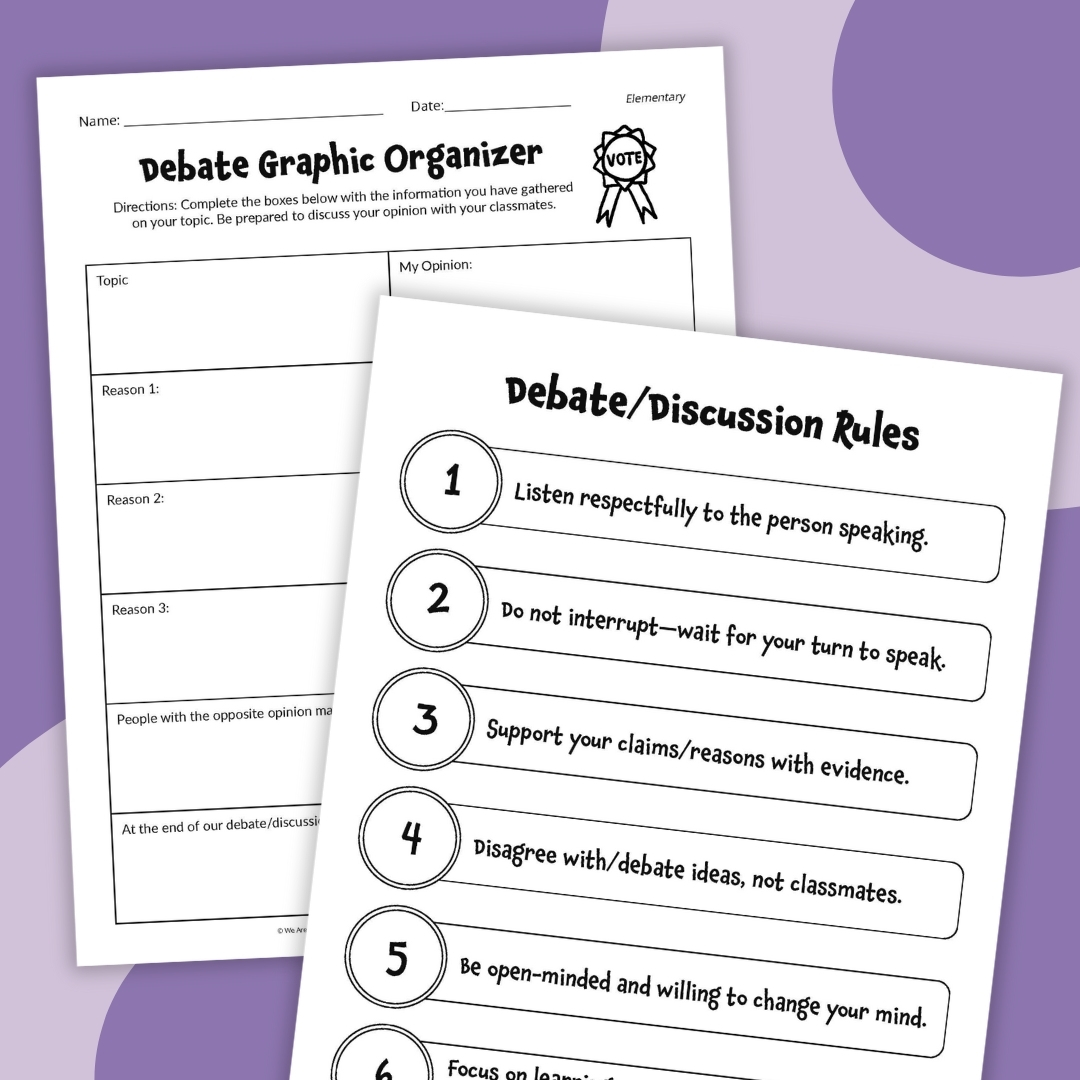
Teacher Tip: Use our links to give students a jump-start!
Each one of our debate topics for high school students includes a link to a trusted, reliable source that provides pros and/or cons on the topic, plus evidence and information for students to consider. This will help even reluctant students make a good start, especially when paired with our free printables!
School and Education Debate Topics

- It’s better to be good at academics than to be good at sports.
- Final exams should be abolished.
- Students should be required to wear school uniforms.
- Private schools are better than public schools.
- Year-round school is better for students.
- Standardized tests are effective.
- Every student should have to participate in athletics.
- Single-gender schools are better for students.
- Schools should be allowed to teach critical race theory.
- Math is the most important school subject.
- Schools should teach sex ed instead of abstinence only.
- Letter grades should be abolished.
- Teachers should be replaced by computers.
- People who get better grades in school will be more successful in life.
- Sometimes it’s OK to cheat on homework or a test.
- Students who fail a test should be given the chance to take it again.
- Outdoor recess is important at every grade level.
- Students should be allowed to grade teachers.
- Everyone should be able to bring their pets to school.
- Shorter school days are better for students.
- Schools should eliminate dress codes.
- Everyone should be required to go to college.
- College should be free for everyone who wants to attend.
- Schools should install safe rooms in case of mass shootings or natural disasters.
- Schools should be allowed to ban some books from their libraries.
- Book smarts are better than street smarts.
- Schools should teach life skills like cooking and personal finance.
- School vouchers benefit students and schools.
- Religion has no place in schools.
- In-person school is better than online school.
- Traditional school is better than homeschooling.
- Charter schools should receive public school funds.
Government and Civics Debate Topics
- The voting age should be lowered to 16.
- Democracy is the best form of government.
- All Americans should be required to vote.
- The driving age should be raised to 18.
- The drinking age should be lowered to 18.
- Supreme Court judges should be appointed for fixed terms.
- Parents should be punished for their children’s crimes.
- A progressive income tax is better than a flat tax.
- All students should be required to volunteer in their community.
- The United States isn’t ready to accept a woman president yet.
- Police funding should be redirected to social services.
- The United States should implement a universal basic income.
- We should require people of all genders to register for the draft.
- Gun safety laws infringe on the Second Amendment.
- Anyone over 12 should be tried as an adult in court.
- We should require people to take drug tests before receiving government aid like welfare.
- The government should provide funding for public art programs.
- There are reasonable limits to freedom of speech.
Science and Technology Debate Topics
- Plastic bottles should be banned.
- It’s important to spend money exploring space.
- Developing countries have to meet the same environmental standards as more developed nations.
- GMOs are more helpful than harmful.
- Human cloning should be legal.
- We should ban fossil fuels.
- Nuclear weapons should be banned worldwide.
- Testing on animals should be illegal.
- Macs are better than PCs.
- Androids are better than iPhones.
- We should replace all paper documents with electronic versions.
- Parents should use their kids’ cell phones to track them.
- There is intelligent life on other planets.
- We should use stem cells from human embryos for scientific research.
- People rely too much on technology.
- Net neutrality should be mandatory for internet service providers.
- Expanded use of artificial intelligence will be good for humanity.
- Technology is creating more jobs than it eliminates.
- Schools should have surveillance cameras in classrooms and hallways.
- The United States should provide free internet access for everyone.
- Cryptocurrencies should replace cash.
- Scientists should try to develop a way for everyone to live forever.
- Pluto should still be considered a planet.
- Governments should subsidize technologies like electric cars and solar panels for houses.
Health and Lifestyle Debate Topics
- Humans should not eat animals.
- Cigarette smoking and vaping should be banned entirely.
- Drug addicts should receive help instead of punishment.
- Euthanasia should be legal.
- Vaccines should be mandatory.
- White-collar jobs are better than blue-collar jobs.
- Abortion rights and other reproductive rights should be protected under the law.
- Marijuana should be legal everywhere.
- Junk food should be banned in school cafeterias.
- Schools should provide free mental health services to students and teachers.
- All drugs should be legalized, regulated, and taxed, like alcohol.
- Healthcare should be universal.
- Beauty pageants are sexist.
- People should have to take a parenting class before having a child.
- Doctors should not be allowed to prescribe psychiatric drugs like Ritalin or SSRIs to children.
- Organ donation should be mandatory after death.
Social Justice and Ethics Debate Topics
- Girls face more peer pressure than boys.
- Giving is better than receiving.
- Animals should not be kept in zoos.
- Happiness is more important than success.
- If you find money on the ground, it’s automatically yours to keep.
- It is better to be kind than to be truthful.
- We should do away with gender-specific public bathrooms.
- Learning about history can stop us from repeating past mistakes.
- Ethical hunting and fishing is possible.
- Men should not be allowed to make laws that affect women’s bodies.
- The death penalty should be abolished.
- Security is more important than freedom.
- The government should pay reparations to descendants of enslaved people.
- Religion does more harm than good.
- We will never achieve world peace.
- We should make the path to American citizenship easier.
- A strong middle class is vital to the economy.
- Transgender athletes should be allowed to compete in sports according to their gender identity.
- Criminal profiling is inherently racist.
- We should return control of ancestral lands to Indigenous communities.
- The American justice system is inherently racist.
- Ageism is a major problem in our society.
- Felons should be allowed to vote after serving their time in prison.
- The UN should require all member countries to accept a minimum number of refugees each year.
Entertainment and Technology Debate Topics

- Reality television depicts real life.
- Schools should allow students to use phones in class.
- Social media is making us less social.
- Social media does more harm than good.
- Video games are better than board games.
- Video gaming is a sport.
- Reading books is better than watching TV.
- The book is always better than the movie.
- Playing video games makes you smarter.
- Paper books are better than e-books.
- All museums and zoos should be free to everyone.
- Everyone should play on the same sports teams, regardless of gender.
Fun and Easy Debate Topics

- Dogs are better pets than cats.
- A taco is a sandwich.
- Summer is better than winter.
- Coke is better than Pepsi.
- Pepperoni is the best pizza topping.
- Fruit counts as dessert.
- The number 13 is not unlucky.
- People should eat to live, not live to eat.
- Monday is the worst day of the week.
- Clowns are more scary than funny.
- Modern music is better than classical music.
- Aliens live among us here on Earth.
- It’s OK to put ketchup on a hot dog.
- Was Robin Hood a thief or a rebel hero?
- It would be better to be able to fly than to be able to turn invisible.
- It’s better to be too hot than too cold.
- We should allow people to go barefoot anywhere if they want to.
- Fiction is better than non-fiction.
- Using profanity is good for your mental health.
- Leftover pizza is better cold than reheated.
- It’s OK to wear socks with sandals.
- Being famous is actually not all that great.
- GIF should be pronounced “JIFF,” not “GIFF.”
- People shouldn’t have to go to school or work on their birthdays.
High School Debate Topics FAQs
What academic skills do high school students learn from debating?
Debates teach students to research their topic, make informed choices, and argue effectively using facts instead of emotion. Participating in formal debate activities like groups or clubs has been shown to have real academic benefits. Students who join debate teams are 12% more likely to graduate high school. One study also showed that debate improved language arts achievement nearly three times more effectively than traditional reading interventions.
How can debate teach students to disagree respectfully?
Some teachers shy away from debate in the classroom, afraid it will become too adversarial. But debates teach respectful communication, showing students how to disagree with ideas—not people. They practice using critical thinking to support their viewpoints with facts and evidence, and build listening skills that encourage empathy and tolerance. Constructive debate helps us exchange ideas and points of view rationally, moving discussions forward into progress.
How do I choose the right high school debate topic for my class?
Consider your students’ interests, background knowledge, and skill level. For new debaters, start out with easy topics that will engage them right off the bat—try silly but controversial questions like “Does pineapple belong on a pizza?” As kids gain confidence, dig into topics relevant to their own lives, such as “Should schools eliminate dress codes?” Experienced debaters are ready for advanced topics like “Should we make the path to American citizenship easier?”
What can teachers do to support students who are nervous about public speaking?
Start small, and build confidence gradually. Begin with team debates, where students work together to prepare and defend their point of view. Pair kids with a partner for a debate-style private discussion, rather than asking them to perform in front of the entire class. Show them how to prepare and rehearse their opening statements and key points, using notes to stay focused. Congratulate them for their efforts, and remind them that everything (even public speaking) gets easier with practice.
How can teachers help prepare students to debate successfully?
Successful debaters rely heavily on critical thinking skills. Start by teaching students to think critically, learning to sort fact from opinion. Help them understand reliable primary sources and how to recognize bias and misinformation. Then, guide them as they build opening and closing statements, prepare to rebut counterarguments, and find the right rhetorical language to sway their audience. If it seems like a lot, don’t worry! Our debate graphic organizers will guide students and teachers along the way.
Grab your free Debate Graphic Organizer printables today!
These free organizers are the perfect way to support students as they build debate skills! You’ll also get a handy list of rules to remind debaters of the best ways to argue an idea and disagree with respect.
Did we miss one of your favorite high school debate topics? Come share your ideas and ask for advice in the We Are Teachers HELPLINE group on Facebook.
Plus, check out these additional high school debate resources!
- How To Have a Silent Classroom Discussion
- Use Fishbowl Discussions To Engage Every Student
- Argumentative Essay Topics and Free Essay Planner
- 101 Funny Debate Topics for All Ages
- 125+ Controversial Debate Topics for Students
This Counselor Offers Hikes Instead of Detention, and the Results Are Beautiful
Anyone who’s ever spent an afternoon in detention knows the drill: a silent classroom, a packet of work, and a teacher who would probably rather be anywhere else. At Morse High School in Bath, Maine, school counselor and Outing Club advisor Leslie Trundy wondered if there was a better way.
What if, instead of sitting at a desk for three hours for detention, students could spend two hours walking through the woods with a trusted adult—still serving a consequence but also getting fresh air, reflection time, and connection?
That question led to Morse High School’s detention hikes—a weekly option where many students now choose a 3.5-mile hike on a nearby trail over traditional detention. The idea has since been featured on Maine Public, NPR, and other outlets, sparking conversations among educators about discipline, mental health, and the power of nature.
We spoke with school counselor Leslie Trundy about how the program started, what it looks like in practice, and what advice she has for teachers who might want to try something similar at their own schools. Take a look at our Q&A with her. Plus get advice for ways to start your own similar program.

Q: What inspired you to start offering hikes as an alternative to traditional detention?
Trundy: In the fall of 2024, I was in my fourth year as our school’s Outing Club advisor, and I attended a leadership conference for advisors at Camp Mechuwana in Winthrop, Maine. My goal going in was pretty simple: I wanted to broaden my reach and invite students who might never see themselves as “outdoorsy” or join a club like mine.
The conference happened to fall on what would have been my mom’s 88th birthday. She was a special education teacher who loved the natural world. When I was a kid, she’d flip over logs so we could see what lived underneath and taught me how to pick up a garter snake. That curiosity stayed with me.
In my 20s, I thru-hiked the Appalachian Trail from Georgia to Maine. It took six and a half months, and it was there that I decided to become a school counselor. Walking has always been where I find headspace. I’ve seen it work for my own kids and for the students I take on outings. So I started wondering: Could we take the concept of detention and move it outdoors? Could a walk in the woods be a consequence that also heals? I knew it was worth a try.

Q: How did you pitch the idea to your school administration, and what was their reaction?
Trundy: I brought it to our admin team during a regular meeting. I explained what I wanted to try and why—how I hoped time in nature might help students reflect, connect, and still “pay back” their time to the school.
Their response was immediate: “Do you want to start this Thursday?”
By October 2024, the first detention hike was scheduled. At Morse, students who receive a one-, two-, or three-hour detention can choose a two-hour hike instead. Most who opt in are serving a three-hour consequence—often for having their phone outside of its YONDR pouch, failing to serve a previous detention, or being disrespectful to staff, property, or peers.

Q: What did those first hikes look like, and how has the routine evolved?
Trundy: The first few hikes were wonderful—and a little shorter than I anticipated. We had three to five students, and I had to quickly learn how to gauge the group’s pace and use different trail loops to lengthen or shorten the route.
We leave the high school on foot, walk down to the ball fields, and enter the Whiskeag Trail. The route crosses a road, passes through a cemetery, and then reenters the woods before looping back to campus. I always carry a first aid kit, snacks, and water, and I explain the plan, the rules, and where we’re headed.
As we walk, students often start talking—about why they’re there, what’s going on in their lives, or just regular teenager stuff. Early on, one student came on a second hike even though he didn’t have detention. That’s when I knew something was happening here.
Q: How do students respond before, during, and after the hikes?
Trundy: Before the hike, it really depends on their comfort level with me and with being outdoors. Sometimes an administrator will introduce us first, and I walk them through what to wear and bring so it feels less intimidating.
During the hike, I’m constantly scanning—Are they warm enough? Who’s hanging back? Who’s ready to lead? I vary the pace, separate the group briefly for quiet reflection when it makes sense, and check in with kids who seem withdrawn or upset. I always let them know I have first aid, snacks, and water, and that they’re allowed to walk in silence if talking feels like too much.
Afterward, we all know each other differently. We greet each other by name in the hallway. There’s this shared memory—like seeing a bald eagle, slipping on the first snow, or how wet our shoes were that day. I always thank them for walking with me. Kids often thank me back.
Want to start something similar?
Trundy is quick to point out that what works in a wooded corner of Maine might look different in a desert town, a dense city, or a district with different policies. But she believes the core idea—shifting some discipline from punitive to restorative and moving it outdoors when possible—is adaptable.
Here are some of her practical tips for educators:
1. Start with your “who, what, where, when, how.”
- Who: Decide which students are eligible. At Morse High School, any student assigned a one-, two-, or three-hour detention can choose the hike instead, with parent permission.
- What: Clarify the structure. Trundy’s hikes are about two hours long, roughly equivalent to a three-hour detention. Students walk in groups, with clear norms around safety, behavior, and respect for the environment.
- Where: Use what you have. Their primary route is the Whiskeag Trail, but in icy conditions, she sometimes leads a more urban walk that still ends in the woods. If you don’t have a forest nearby, consider a safe loop around campus, a park, or neighborhood streets.
- When: Consistency helps. At Morse, detention hikes happen after school on Thursdays from about 2:05 to 4:00 p.m.
- How: Partner closely with admin. At Trundy’s school, administrators inform families of the option, track who’s attending, and ensure the hike is listed as an approved way to serve detention.
2. Get your safety and logistics in order.
- Permissions: Find out what your district requires for off-campus activities or “walking field trips.” Trundy uses a digital permission slip that covers taking students off campus.
- Training: In Maine, Trundy holds an Educational Trip Leader certification and Wilderness First Aid, in addition to her training as a school counselor. Your context may not require as much, but make sure at least one adult is trained in first aid and familiar with the route.
- Gear: She keeps a first aid kit, snacks, water, ponchos, and spare hats and gloves for kids who come unprepared. Students are encouraged to dress in layers and wear closed-toe shoes, but she also gently offers extra gear if they’re cold on the trail.
- Group size: Talk with the admin about a safe student-to-adult ratio. If detention numbers are high, you may need a second adult or an assistant, or you can cap each hike.
3. Be clear that it’s still a consequence—just a different kind.
Some critics worry that hiking sounds like a reward. Trundy understands the concern but says students rarely experience it that way on a cold, rainy day. Sometimes the hike does feel like a punishment—they’re expending effort, they’re tired, but they still feel seen and supported. She frames the hike as:
- A way to repair (through conversation, reflection, and showing up)
- A way to repay time to the school
- A chance to reset through movement and nature
4. Build in small rituals: snacks, stories, and quiet.
You don’t have to be a poetry expert to borrow Trundy’s idea of reading a short nature-based poem partway through the hike. Keeping it simple matters more than making it perfect. She also recommends:
- A predictable midway break for water and snacks
- A brief, age-appropriate reflection (a poem, quote, or question)
- Occasional short stretches of silent walking
“Because of me, I hope more kids spend more time outside.”
Looking ahead, Trundy plans to continue the program and keep gathering data as the students who’ve hiked with her move through high school.
She’s already seen leadership grow: One sophomore who attended three detention hikes later joined the Outing Club, became a go-to leader on trips, recruited friends, cooked meals, and even made her counselor’s bed at a lake house retreat. Another student, a junior firefighter and avid mountain biker, ended up leading the group on a new local trail he knew well.
“My hope is that because of this program, more students spend more time outdoors—not just in high school, but for the rest of their lives,” Trundy says. “If that grows out of a detention, I’ll take it.”
If you’re an educator wondering whether your students would ever say yes to something like this, Trundy has one last piece of advice:
“Don’t underestimate them. Give them the option—and then see who shows up at the trailhead.”
Looking for more articles like this? Be sure to subscribe to our newsletters!
Best Teacher Deals for Cyber Monday 2025: The Savings Continue!
The We Are Teachers team is on the hunt for the best Black Friday and Cyber Monday deals for teachers! Our favorite stores will host sales throughout November with weekly and daily deals.
Tip: Bookmark this page and check back all week through Black Friday and Cyber Monday, since we’re seeking out the best new deals every day!
Note: Prices listed are current as of this writing.
Top 2025 Cyber Monday Deals for Teachers
Find all the best Cyber Monday deals at Amazon, Target, Walmart and more—the ones that are truly worth getting excited about. We’ll be updating this list as stores release their offers, so be sure to check back often.









2025 Cyber Monday Deals for Teachers by Store
These are our favorite stores for finding Black Friday and Cyber Monday deals for teachers.
Jump to:
- Amazon Cyber Monday Deals
- Walmart Cyber Monday Deals
- Target Cyber Monday Deals
- Michaels Cyber Monday Deals
- JCPenney Cyber Monday Deals
- Best Buy Cyber Monday Deals
- Kohl’s Cyber Monday Deals
- Year-Round Teacher Discounts
Amazon 2025 Cyber Monday Deals for Teachers
With quick delivery and some of the best prices on the market, Amazon is an incredibly convenient shopping choice for busy teachers. Here are some of their top offerings for teachers and classrooms this holiday season.
- PicassoTiles 100-Piece Set Magnet Building Tiles, 40% off
- Flashforge Adventurer 5M 3D Printer, 26% off
- Amazon Smart Plug 2-Pack, 48% off
- Skechers Women’s Go Walk Joy Sneaker, 37% off
- Cell Phone Stand with Wireless Bluetooth Speaker, 47% off
- Shuttle Art 216 Pack Washable Markers, 8 Assorted Colors, 16% off
- HeyDude Wally Men’s Slip-On Loafers, 43% off
- Nextmug Temperature-Controlled, Self-Heating Coffee Mug, 31% off
- Phomemo D30 Label Maker, 44% off
- Keurig K-Express Single Serve K-Cup, 45% off
More Amazon deal tips:
- Download the free Amazon app to easily find the top deals and place watches on items.
- Make an official Amazon list of the items you hope will go on extreme sale for the holidays. If these items go on sale, you will be notified.
- If you miss a lightning deal, click the “Join Waitlist” button, and you will be notified if it goes on sale again.
FEATURED PICK
Rosetta Stone
Save 60% on Rosetta Stone access. Pay only $149 for Rosetta Stone Lifetime Unlimited!
Walmart 2025 Cyber Monday Deals for Teachers
Walmart’s Black Friday deals ran all month long leading up to Black Friday, with new deals kicking in on Cyber Monday. Here are just some of the deals available.
- Dreo HEPA Air Purifier for Large Room, $59.99
- Beranmey Cozy Platform Fuzzy Slippers for Women and Men, $13.29
- Canon PIXMA TS3722 All-in-One Wireless Inkjet Printer, $29.00
- Sharpie Permanent Markers, Fine and Utra-Fine Point, 27-Count, $10.00
- Connect 4 Classic Grid Game, $5.00
- HP 15.6-Inch FHD IPS Touch Windows Laptop, $299.00
- Apple Pencil (USB-C), $49.99
- Keurig K-Duo Essentials, Hot & Iced Single-Serve K-Cup Pod Coffee Maker, $79.00
- Laneige Lip Sleeping Mask Berry, $20.60
- MaxKare Ultra-Soft Heating Pad, $17.99
Target 2025 Cyber Monday Deals for Teachers
Target offers a holiday price-match guarantee, meaning if you purchase something and later notice it on sale for even less before December 24, you’ll be refunded the difference. Check out these incredible Cyber Monday deals for teachers.
- Whirlpool 3.1-cubic-ft. Mini Refrigerator w/Freezer, $149.99
- Keurig K-Mini Go, Multicup Reservoir Single-Serve K-Cup Pod Coffee Maker, $69.99
- HP DeskJet 2855e Wireless All-in-One Color Printer Scanner Copier, $59.99
- Fitbit Inspire 3 Activity Tracker, $69.95
- SodaStream Terra Sparkling Water Maker, $49.99
- Picasso Tiles 101-Piece Magnetic Tiles, $37.59
- Cricut Joy Xtra Cutting Machine Bundle, $145.00
- Our Generation Elliot 18″ Boy Doll & Pet Set, $24.74
- Chuckle & Roar Float-a-Ball Hand Balls – 2-pk., $9.27
Michaels Cyber Monday Deals for Teachers
The craft store’s holiday deals are offering up to 60% off on art supplies, storage solutions, craft machines, decorations, and more! Plus, get 40% off all regular-price purchases with code CYBER40.
- 101-Piece Kid’s Art Set by Creatology, $3.00
- 5-Drawer Modular Mobile Chest, $47.99
- 16-Compartment Rainbow Photo & Craft Keeper, $12.59
- Metro 8-Drawer Rolling Cart, $49.99
- 4-Drawer Mesh Rolling Cart, $49.99
- Crayola® Ultimate Crayon Collection, $14.99
- Crayola Washable Sidewalk Chalk, 48-Ct., $5.99
JCPenney Cyber Monday Deals for Teachers
You can find a huge variety of major Black Friday deals, as well as Cyber Monday deals, at JCPenney all month long. Use code CYBER24 to take an extra 40% off many items!
- Discovery™ Glow Tracing Light-Up Art Tablet, $19.79
- Supreme Silent Sports Basketball, $19.98
- Discovery Kids Glow Easel Dual-Sided Art Station, $49.49
- Liz Claiborne Women’s Long-Sleeve Open-Front Cardigan, $16.99
- a.n.a Women’s Split Crew Neck Long-Sleeve Striped Pullover Sweater, $9.99
- Liz Claiborne Women’s Midweight Peacoat, $74.99
- St. John’s Bay Men’s Long-Sleeve Classic-Fit Flannel Shirt, $11.99
- St. John’s Bay Super-Soft Jersey Men’s Classic-Fit Long-Sleeve Polo Shirt, $9.99
- J. Ferrar Men’s Stanwell Flat-Heel Chelsea Boots, $29.99
- St. John’s Bay Women’s Randa Flat-Heel Booties, $24.99
- St. John’s Bay Harrison Men’s Round Closed-Toe Oxford Shoes, $29.99
Best Buy Cyber Monday Deals for Teachers
Teachers need tech! From the latest laptop to keep your plans and notes organized to gadgets and gizmos that make an educator’s life just a little bit easier, we’ve found the best bargains at Best Buy.
- Dyson Hot+Cool AM09 Tower, Heater and Fan, $299.99
- Skylight 15-Inch Touchscreen Smart Calendar and Chore Chart, $249.99
- Targus Octave III Backpack for 15.6” Laptops, $9.99
- Acer Chromebook 315 – 15.6″ Full HD Laptop, $177.51
- Samsung – Galaxy Tab A9+ 11″, $139.99
- bella PRO 12-Cup Programmable Coffee Maker, $19.99
- Apple 11-inch iPad A16, $274.00
- Lenovo Yoga 7i 2-in-1 16″ 2K Touchscreen Laptop, $629.99
- Energizer 5,000mAh Magnetic Wireless MagSafe PowerBank, $12.99
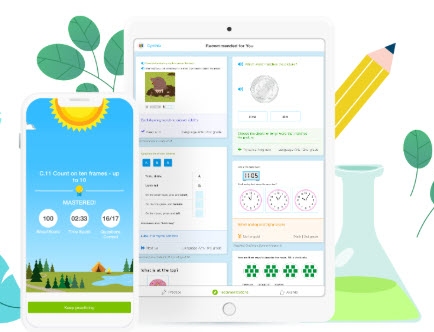
FEATURED PICK
IXL
Save 25% off IXL Family Memberships. Get math, language, arts, social studies, and science support at home for just $119.25 for your first year!
Kohl’s Cyber Monday Deals for Teachers
Don’t forget to use coupon codes and your Kohl’s card to get the best possible prices on all these great Kohl’s Cyber Monday deals for teachers.
- Men’s ZeroXposur Lightweight Packable Puffer Jacket, $25.60
- Sonoma Goods for Life® Mateyo Men’s Memory Foam Lace-Up Boots, $23.99
- Toastmaster Mini Personal Blender, $12.79
- Chefman Fast-Boil 1.8-Liter Infuser Electric Kettle, $22.99
- Women’s Nine West Coatigan Sweater, $23.99
- Sonoma Goods for Life® Wedge Gore Women’s Ankle Boots, $23.99
- Laneige Midnight Minis Lip Glowy Balm and Lip Sleeping Mask Gift Set, $14.70
Year-Round Teacher Discounts To Remember While Shopping
- Apple: Apple has special reduced education pricing for teachers and students. Compare the prices on Apple products in their Education Store to holiday sale prices elsewhere.
- Barnes & Noble: B&N Educators always save 20% off publisher list prices and get 25% off on select Educator Appreciation days.
- Ben Franklin Crafts: Teachers receive 10% off regular-price items.
- Books-a-Million: Registered BAM Educators get 20% off the publisher’s list price on hardcover and paperback books for the classroom.
- Bose: Bose offers up to 15% off for teachers, only available by calling (800) 353-4207 and ordering over the phone.
- HP: Shop online and then ask for your teacher discount via the online chat! Receive 20% off HP products.
Find even more year-round deals on our big list of teacher discounts.
Plus, follow our We Are Teachers Deals and Shopping page for even more shopping tips and advice.
How To Create a Teaching Portfolio (Examples & Free Templates)
Every teacher, from the newly licensed to those with years of experience, should have a teaching portfolio. It summarizes your career and achievements in ways that go far beyond a resume. But this valuable tool isn’t just for those who are actively job-searching. Here’s why and how to create and maintain your own teaching portfolio, plus lots of helpful real-life examples for inspiration.
Jump to:
- What is a teaching portfolio?
- Why create a teaching portfolio?
- What should a strong teaching portfolio include?
- Digital vs. Print Teaching Portfolios
- How To Choose Materials and Organize Your Teaching Portfolio
- Teaching Portfolio Privacy and Permissions
- Real Teaching Portfolio Examples
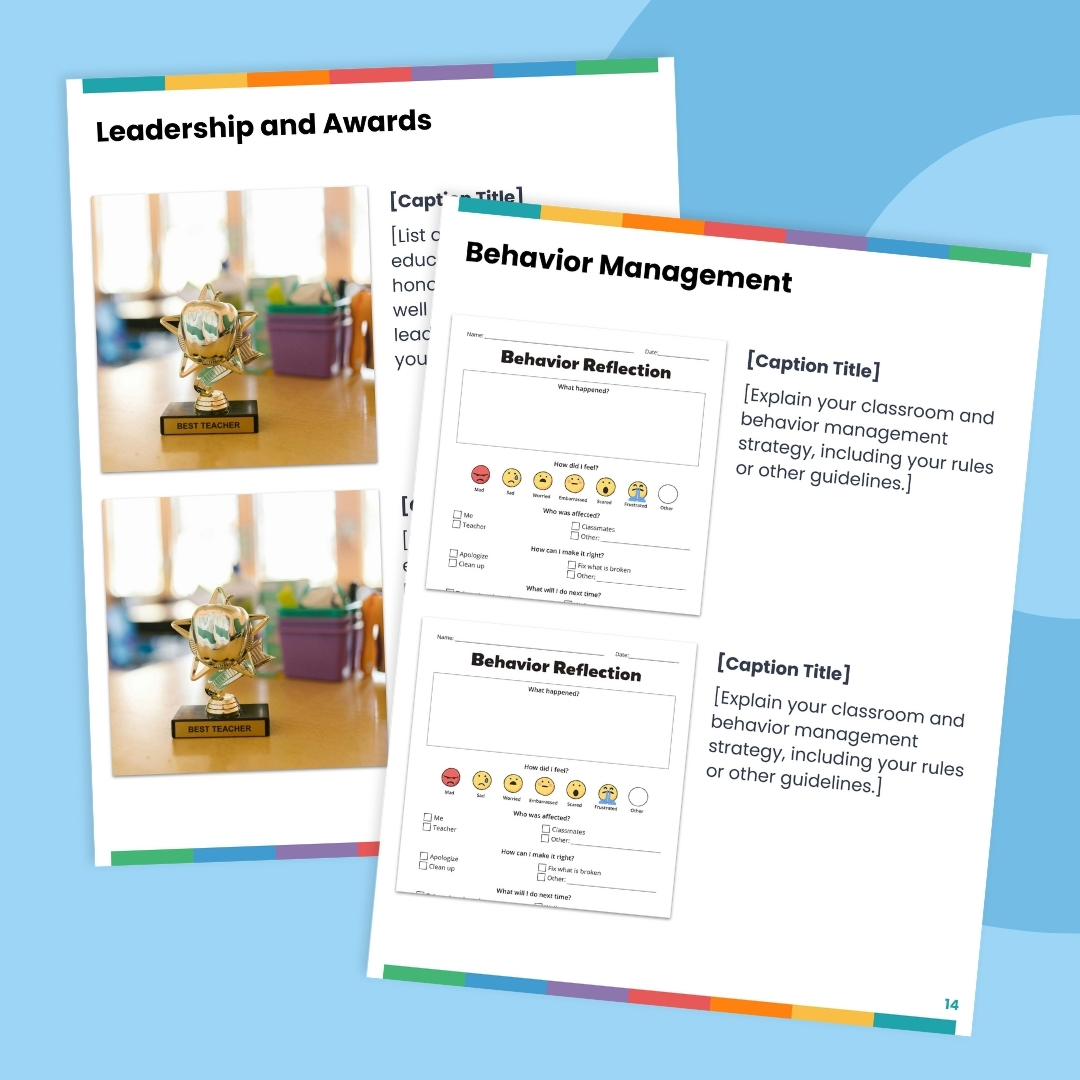
What is a teaching portfolio?
A teaching portfolio is a tool that highlights your strengths as an educational professional. It can be a binder of paper-based materials, neatly organized and presented. Or, as is increasingly more popular these days, it can be digital, including videos and other multimedia elements. Most teachers use portfolios when they’re interviewing for a new position as a way to demonstrate their abilities and achievements.
As with any tool, teaching portfolios work best when you use them properly. When you bring a portfolio to an interview, be prepared to use it to help answer questions by providing examples of your experience and teaching philosophy. Your interviewer probably won’t go through the whole portfolio page by page, but it makes an excellent visual aid to support your candidacy.
Why should you create a teaching portfolio?
If you’re actively searching for a new job, you probably already have a portfolio on hand. You can take it with you to interviews to show real examples of yourself in action—lesson plans, pictures and video, notes from kids and parents, and more. These can all help potential employers get a more thorough picture of you as a candidate.
But even teachers who aren’t currently job-searching should keep their teaching portfolio up-to-date. By documenting your professional development, you can show you’ve met the criteria for a promotion or other opportunity for advancement. Plus, it pays to be prepared. Creating and updating a teaching portfolio takes time, and it’s much easier to add to yours a little bit at a time than to build a brand-new one from scratch if you’re suddenly facing the job market again.
More than that, though, updating a portfolio gives you a chance to reflect on your achievements and identify opportunities for improvement. You get a chance to look over your entire journey as an educational professional and celebrate your successes. This can be a real benefit during those times when being an educator is a little more challenging than you bargained for.
What should a strong teaching portfolio include?
Every teaching portfolio is different. The goal is to show your experience from many angles and highlight your achievements. Try to include quality real-life examples to prove the points you want to make about yourself as an educator. Here are some common elements to consider:
Philosophy of Education
Each teacher should give some thought to the question “What is your teaching philosophy?” Include it at the beginning of your portfolio, and ensure the examples you provide throughout support that philosophy. See 40 Philosophy of Education examples here to get you started.
Career Summary
This is similar to a resume but can provide much more detail. This is the place to show the subjects, grades, and ages you’ve taught, with lists of topics and material you covered. Be sure to highlight any courses you built from scratch, plus any significant professional development you’ve completed.
Teaching Samples and Documentation
This is really the bulk of your teaching portfolio, where you provide the evidence that supports your knowledge and experience. Here’s the place to include a few particularly strong lesson plan examples and samples of materials like worksheets you personally created. For digital portfolios, include a few well-chosen videos of you in action in the classroom too.
You may also want to include your behavior management plan, as well as information about how you support diversity, equity, and inclusion in your classroom. Add pictures of your previous classroom setups, showing how students interact with one another and with you. All of this paints a clearer picture of what principals or colleagues can expect from you as a teacher.
Student Work
While you don’t want to stuff your portfolio full of endless student projects and materials, you should choose some representative samples that you’re particularly proud of. Include some work that shows how you provide feedback to help students improve, such as proposed edits on essay drafts or notes on incorrect answers.
Assessments and Communications
Provide examples of your favorite types of assessment; include any rubrics you’ve personally created or unique methods you use to assess student progress. Interviewers will also want to know how you approach communication with parents and families, so add samples of classroom newsletters, memos, or other methods you’ve used in the past.
Testimonials and Recommendations
This section is the place for positive communications like thank-you notes from parents and students, as well as statements from colleagues or supervisors about your achievements. Include student evaluations, as well as any documentation you have showing student progress under your instruction.
Professional Achievements
Have you published articles in a journal or written a textbook? Do you have a thriving Teachers Pay Teachers store or a blog with thousands of followers? Show off your influence in this section of your portfolio. Plus, list any awards, honors, speaking engagements, committees, and other ways you’ve been recognized for excellence.
Digital vs. Print Teaching Portfolios
In the past, teachers generally kept their portfolios in neatly organized binders. Today, more and more teachers are opting for digital teaching portfolios instead. Both formats are in common use, so the choice is up to you. To decide which is right for you, consider the types of materials you want to include in your portfolio, how you’ll use it, and how frequently you plan to update it. Here’s a comparison of the two.
Print Portfolio
What it is: A binder with printed copies of each section, including photos and samples of student work. You can assemble the binder yourself or work with a print shop to ensure a professional appearance.
Best for: In-person interviews where you can use your portfolio to provide examples as you answer common interview questions.
Advantages:
- Tangible and easy for interviewers to flip through during an interview
- No need to rely on internet access or devices for access any time
- No special tech skills needed to create
- Older principals and other interviewers may expect and/or prefer a print version of your portfolio
Disadvantages:
- Can be time-consuming and costly to assemble and organize
- Harder to update, since you’ll need to print new pages each time
- Limited to text and images as opposed to videos or interactive elements
- Not easily sharable for virtual interviews or hiring teams who want to review materials in advance
Digital Portfolio
What it is: A website, blog, slide deck, or PDF that is easy to share via a link. Has the same sections and information as a print portfolio but can also include multimedia materials like videos. Can be hosted on sites like Google Sites, Wix, or WordPress.
Best for: Virtual interviews and online sharing and those who want to include multimedia videos or other teaching examples.
Advantages:
- Easy to update and reorganize as needed
- Simple to share with interviewers, principals, or families
- Allows you to include videos, photo slideshows, and links to other supporting materials
- Demonstrates comfort with technology and digital communication
Disadvantages:
- Requires some comfort with technology to build and maintain
- Only viewable with a device or internet access, which may not always be available
- If your portfolio is published publicly, you’ll need to adhere strictly to privacy laws
- Can feel less tangible and personal than a print portfolio
How To Choose Materials and Organize Your Teaching Portfolio
When you start putting together your teaching portfolio, keep in mind that the goal is to provide evidence of your teaching experience from a wide range of sources. As you gather and organize material for your portfolio, you’ll get a better sense of what you want to include. Here are some tips to help you get started.
Choosing Materials
- Be selective: Spend time thinking about what’s most important to you as a teacher, and look for examples that demonstrate those skills and values.
- Show variety: Include materials that show the many aspects of your teaching. Include a mix of lesson plans, assessments, student work, reflections, communications, and more.
- Demonstrate impact: The best portfolio materials show the impact you’ve had on student achievement, growth, or engagement.
- Be honest: Don’t exaggerate your experience or qualifications. You don’t need to look perfect! Your portfolio should be an accurate and fair representation of your teaching career. Tell the world all about your successes, but don’t omit the losses. Instead, focus on how you’ve learned from negative experiences.
Organizing Your Portfolio
Your teaching portfolio should have a clear structure that makes it easy for readers to find what they want to review. Use a table of contents page and colored tabs for a printed portfolio, presented in an attractive, professional binder.
Online, use menu options that are easy to navigate, with separate pages for the various sections of your portfolio. Ensure all digital links work properly and images load quickly. If your digital portfolio is a PDF of a printable document, use version numbers and dates in the file names so you always know you’re using the most up-to-date version.
Teaching Portfolio Privacy and Permissions
In the United States, student education records are protected by FERPA (Family Educational Rights and Privacy Act). Students and families have the right to keep students’ information, including test scores, grades, disciplinary records, and other identifying information, private.
That means that when you’re assembling your portfolio, you’ll need to be sure to anonymize any identifying info by blurring or blacking it out. If you’re including photos of students that clearly show their faces, ask for written permission from their parents or guardians. This is especially important if your portfolio is digital and available online to the public.
Teaching Portfolio Examples
Still not sure how to start, or looking for new ideas? Check out these top-notch teaching portfolio examples from real educators. Each has its own style and reflects the personality of its creator. You’re sure to find some inspiration!
Personal Website Portfolio
This digital portfolio has a clean presentation with simple navigation. The professional appearance really helps to sell this person as a potential hire. With strong examples, lesson plan samples, and videos, this teacher presents herself in the best possible light.
Learn more: Gretchen Seibel
Google Sites Portfolio
Digital portfolios should be well organized and make it easy for people to learn more about you. Share the link on your resume or cover letter, and bring a tablet or laptop with you to interviews so you can show it off there too. Primary Paradise has tons of great tips for creating a quality portfolio using Google Sites, a free and easy hosting option.
Learn more: Primary Paradise
Digital Professional Teaching Portfolio
This digital portfolio example includes an array of subjects, helping to show this teacher’s diverse experience. Lots of quality images help illustrate her achievements.
Learn more: Megan Carnaghi
Print Student-Teacher Portfolio
In this video, a teacher who was newly hired into her first role shows off the portfolio that landed her the job. If you’re just finishing up your student-teaching experience, this example is for you.
Learn more: Hello Middle School via YouTube
Digital Student-Teacher Portfolio
Check out this example of a digital portfolio for a student teacher looking for their first job. This example highlights a teaching philosophy, student work, classroom management, reference letters, and more.
Learn more: Cassandra Burke Teaching Portfolio
Substitute Teacher Portfolio
Not looking for a full-time position? Or are you looking to transition from part-time to something more permanent? This teaching portfolio created by Sarah Cheesman might be perfect for you! Not only does it cover substitute teaching work, it highlights other related professional experience as well.
Learn more: Sarah Cheesman
Hybrid Teaching Portfolio
This traditional-style portfolio has been digitized into a PDF, so it can be accessed from anywhere. It’s extremely comprehensive, with lots of valuable information for potential hiring schools to consider.
Learn more: Holly Factora’s Teaching Portfolio
World Language Teacher Portfolio
If you teach a world language or specialty class, this example may be more helpful to you. This Spanish teacher included comments from students and information on engaging class activities.
Learn more: Tyson Hazard, Spanish Instructor
Portfolio Update
In this YouTube video, a third-year teacher reviews what she included in her portfolio when she was searching for her first job. You get tips on revisiting and updating your teaching portfolio throughout the video.
Learn more: Mrs. Katie in Elementary via YouTube
Experienced Teacher Portfolio
In this video, a teacher with several years of experience shows off her detailed portfolio. An awesome feature in this portfolio is the use of a QR code to link to a digital website or portfolio!
Learn more: Busy With Mrs. Barron via YouTube
Get your editable teaching portfolio templates!
Our bundle includes different colors and styles so you can showcase your own personal style. Just click the button and enter your information in the form on this page for immediate access!
Looking for more? Here’s How To Become a Teacher, From Choosing a College to Landing a Job.
40 Philosophy of Education Examples, Plus How To Write Your Own
These days, it’s become common for educators to be asked what their personal teaching philosophy is. Whether it’s for a job interview, a college class, or to share with your principal, crafting a philosophy of education can seem like a daunting task. So set aside some time to consider your own teaching philosophy (we’ll walk you through it), and be sure to look at philosophy of education examples from others (we’ve got those too!).
Jump to:
- Philosophy of Education FAQs
- How To Write a Philosophy of Education, With Examples
- Real Short-Form Philosophy of Education Examples
- Long Teaching Philosophy Examples From Real Educators
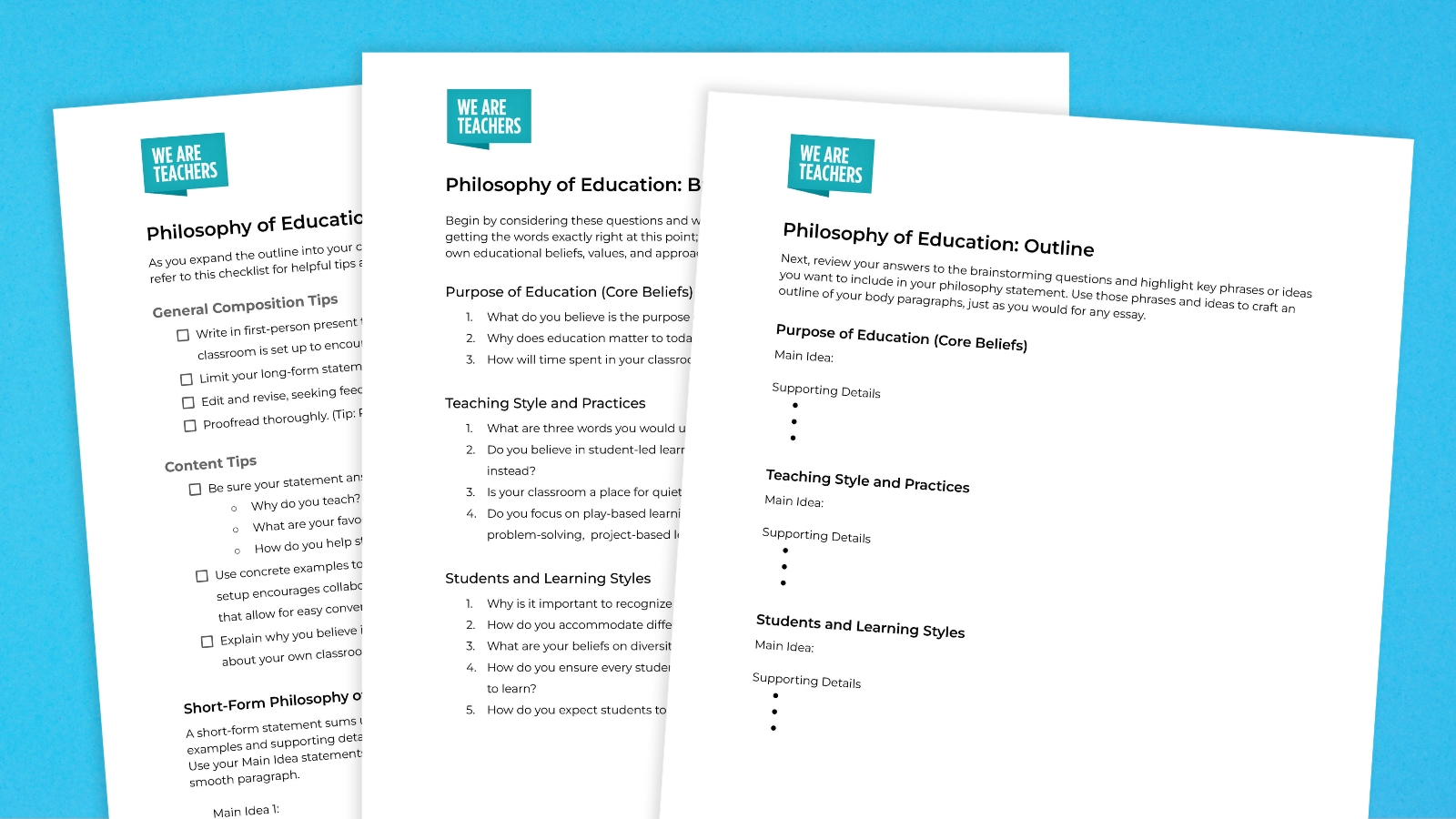
Philosophy of Education FAQs
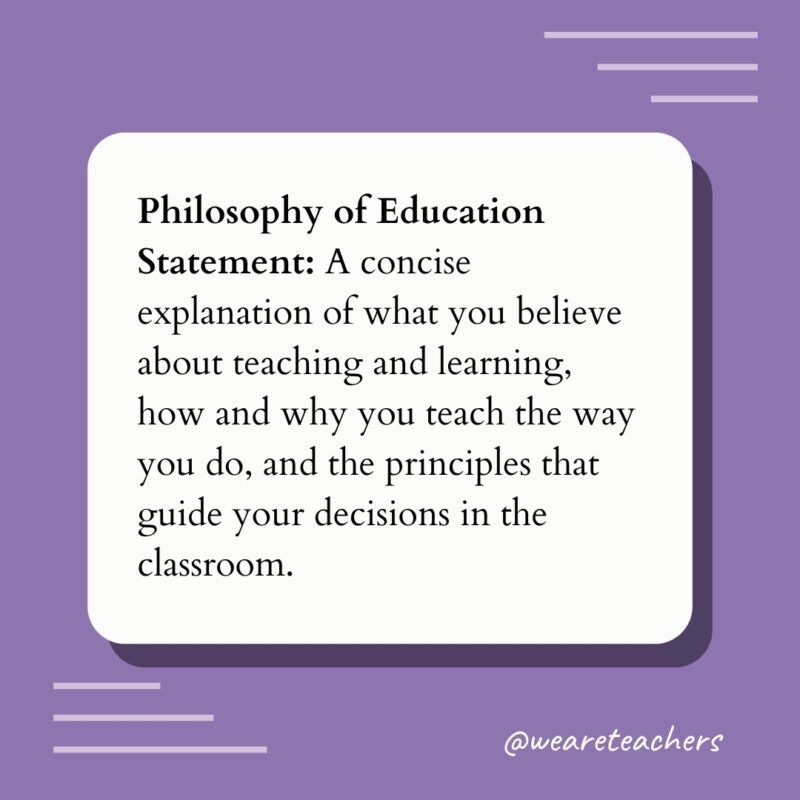
What is a philosophy of education?
A philosophy of education statement provides an explanation of your teaching values and beliefs. Your teaching philosophy is ultimately a combination of the methods you studied in college and any professional experiences you’ve learned from since. It incorporates your own experiences (negative or positive) in education.
Why do teachers need a philosophy of education?
When someone asks for your philosophy of education, what they really want to know is that you’ve given thought to how you prepare lessons and interact with students in and out of the classroom. They’re interested in finding out what you expect from your students and from yourself, and how you’ll apply those expectations. And they want to hear examples of how you put your teaching philosophy into action. You may use your teaching philosophy in interviews or your teaching portfolio, or share it with parents and colleagues.
How long should a philosophy of education be?
Many teachers have two versions of their teaching philosophy: a long form (a page or so of text) and a short form (around a paragraph). The longer form is useful for job application cover letters or to include as part of your teacher portfolio. The short form distills the longer philosophy into a couple of succinct sentences that you can use to answer teacher job interview questions or even share with parents.
Can a teaching philosophy change over time?
Absolutely! A large part of your philosophy of education is influenced by your personal experiences. The philosophy you start off with fresh out of college will almost certainly change and evolve as you put it into practice. In fact, it’s a good idea to revisit your written teaching philosophy every couple of years to see if it still reflects your personal feelings and behavior.
What’s included in a teaching philosophy?
Lead with your core beliefs about teaching and learning. These beliefs should be reflected throughout the rest of your teaching philosophy statement. Then, explain your teaching style and practices, being sure to include concrete examples of how you put those practices into action. Transition into your beliefs about students and learning styles, with more examples. Explain why you believe in these teaching and learning styles, and how you’ve seen them work in your experiences.
From your long-form philosophy, distill the main idea into a few sentences you can memorize and deliver naturally if an interviewer asks, “What is your teaching philosophy?” Keep it conversational and simple, and be sure you can answer any follow-up questions your interviewer may have.
How do I write my philosophy of education?
Start by thinking about your answers to these three key questions:
- Why do you teach?
- What are your favorite tried-and-true methods for teaching and learning?
- How do you help students of all abilities and backgrounds learn?
Then, think back to any essay you’ve ever written and follow a similar format. Write in the present tense; your philosophy isn’t aspirational, it’s something you already live and follow. This is true even if you’re applying for your first teaching job. Your philosophy is informed by your student teaching, internships, and other teaching experiences. Take a look at the next section for step-by-step help in crafting your teaching philosophy.
How To Write a Philosophy of Education, Step-by-Step With Examples

Depending on who you ask, a philosophy of education statement can include a variety of values, beliefs, and information. For each section, start by reflecting on and writing down your answers to our brainstorming questions. Then, take a look at the teaching philosophy example statements, and use them to craft your own, section by section. (Be sure to fill in the form on this page to grab our free downloadable guide to help you write your own teaching philosophy!)
1. Purpose of Education (Core Beliefs)
This opening sentence sums up your beliefs in a few powerful words. To get started, answer these questions:
- What do you believe is the purpose of teaching and learning?
- Why does education matter to today’s children?
- How will time spent in your classroom help prepare students for the future?
Core Beliefs Philosophy of Education Examples
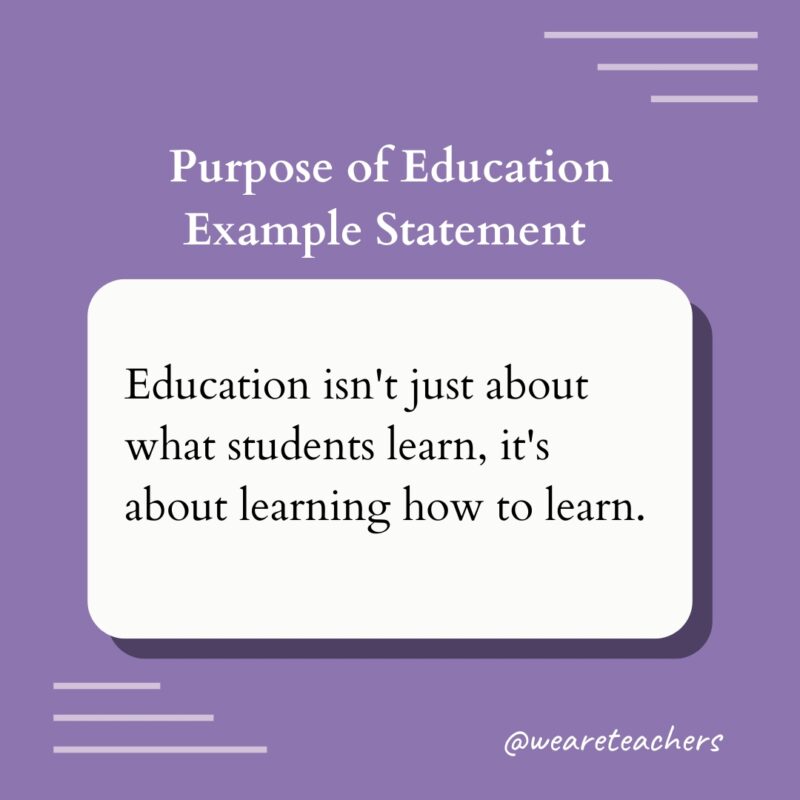
- Education isn’t just about what students learn but about learning how to learn.
- A good education prepares students to be productive and empathetic members of society.
- Teachers help students embrace new information and new ways of seeing the world around them.
- A strong education with a focus on fundamentals ensures students can take on any challenges that come their way.
- I believe education is key to empowering today’s youth, so they’ll feel confident in their future careers, relationships, and duties as members of their community.
- Well-educated students are open-minded, welcoming the opinions of others and knowing how to evaluate information critically and carefully.
2. Teaching Style and Practices
All teachers use a mix of teaching practices and styles, of course, but there are some you’re likely more comfortable with than others. Consider these questions:
- Do you believe in student-led learning, or do you like to use the Socratic method instead?
- Is your classroom a place for quiet concentration or sociable collaboration?
- Do you focus on play-based learning, hands-on practice, debate and discussion, problem-solving, or project-based learning?
Teaching Style and Practices Philosophy Examples
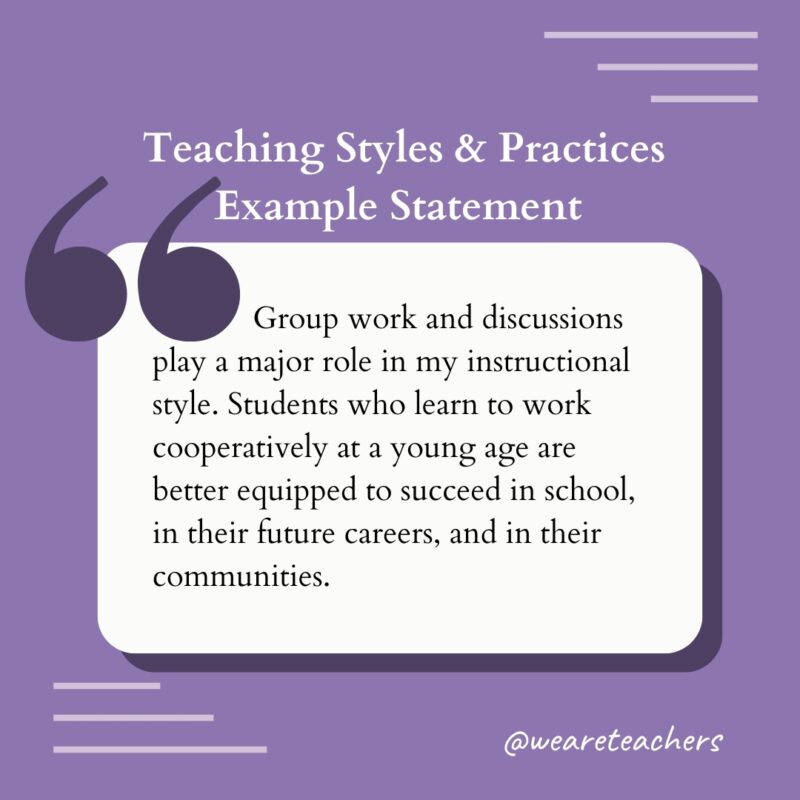
- I frequently use project-based learning in my classrooms because I believe it helps make learning more relevant to my students. When students work together to address real-world problems, they use their [subject] knowledge and skills and develop communication and critical thinking abilities too.
- Play-based learning is a big part of my teaching philosophy. Kids who learn through play have more authentic experiences, exploring and discovering the world naturally in ways that make the process more engaging and likely to make a lasting impact.
- In my classroom, technology is key. I believe in teaching students how to use today’s technology in responsible ways, embracing new possibilities and using technology as a tool, not a crutch.
- While I believe in trying new teaching methods, I also find that traditional learning activities can still be effective. My teaching is mainly a mix of lecture, Socratic seminar, and small-group discussions.
- I’m a big believer in formative assessment, taking every opportunity to measure my students’ understanding and progress. I use tools like exit tickets and Kahoot! quizzes and watch my students closely to see if they’re engaged and on track.
- Group work and discussions play a major role in my instructional style. Students who learn to work cooperatively at a young age are better equipped to succeed in school, in their future careers, and in their communities.
3. Students and Learning Styles
Teachers must be able to speak to how they handle classroom management, incorporate diverse viewpoints, and balance their lessons for all learning styles. Think about your answers to these questions:
- Why is it important to recognize all learning styles?
- How do you accommodate different learning styles in your classroom?
- What are your beliefs on diversity, equity, and inclusion?
- How do you ensure every student in your classroom receives the same opportunities to learn?
- How do you expect students to behave, and how do you measure success?
Students and Learning Styles Sample Teaching Philosophy Statements
- Every student has their own unique talents, skills, challenges, and background. By getting to know my students as individuals, I can help them find the learning styles that work best for them, now and throughout their education.
- I find that motivated students learn best. They’re more engaged in the classroom and more diligent when working alone. I work to motivate students by making learning relevant, meaningful, and enjoyable.
- We must give every student equal opportunities to learn and grow. Not all students have the same support outside the classroom. So as a teacher, I try to help bridge gaps when I see them and give struggling students a chance to succeed academically.
- I believe every student has their own story and deserves a chance to create and share it. I encourage my students to approach learning as individuals, and I know I’m succeeding when they show a real interest in showing up and learning more every day.
- In my classroom, students take responsibility for their own success. I help them craft their own learning goals, then encourage them to evaluate their progress honestly and ask for help when they need it.
- To me, the best classrooms are those that are the most diverse. Students learn to recognize and respect one another’s differences, celebrating what each brings to the community. They also have the opportunity to find common ground, sometimes in ways that surprise them.
Short Philosophy of Education Examples
We asked real educators in the We Are Teachers HELPLINE group on Facebook to share their teaching philosophy examples in a few sentences. Here’s what they had to say:
I am always trying to turn my students into self-sufficient learners who use their resources to figure it out instead of resorting to just asking someone for the answers. —Amy J.
My philosophy is that all students can learn. Good educators meet all students’ differentiated learning needs to help all students meet their maximum learning potential. —Lisa B.
I believe that all students are unique and need a teacher that caters to their individual needs in a safe and stimulating environment. I want to create a classroom where students can flourish and explore to reach their full potential. My goal is also to create a warm, loving environment, so students feel safe to take risks and express themselves. —Valerie T.
In my classroom, I like to focus on the student-teacher relationships/one-on-one interactions. Flexibility is a must, and I’ve learned that you do the best you can with the students you have for however long you have them in your class. —Elizabeth Y
I want to prepare my students to be able to get along without me and take ownership of their learning. I have implemented a growth mindset. —Kirk H.
My teaching philosophy is centered around seeing the whole student and allowing the student to use their whole self to direct their own learning. As a secondary teacher, I also believe strongly in exposing all students to the same core content of my subject so that they have equal opportunities for careers and other experiences dependent upon that content in the future. —Jacky B.
All children learn best when learning is hands-on. This works for the high students and the low students too, even the ones in between. I teach by creating experiences, not giving information. —Jessica R.
As teachers, it’s our job to foster creativity. In order to do that, it’s important for me to embrace the mistakes of my students, create a learning environment that allows them to feel comfortable enough to take chances, and try new methods. —Chelsie L.
I believe that every child can learn and deserves the best, well-trained teacher possible who has high expectations for them. I differentiate all my lessons and include all learning modalities. —Amy S.
All students can learn and want to learn. It is my job to meet them where they are and move them forward. —Holli A.
I believe learning comes from making sense of chaos. My job is to design work that will allow students to process, explore, and discuss concepts to own the learning. I need to be part of the process to guide and challenge perceptions. —Shelly G.
I want my students to know that they are valued members of our classroom community, and I want to teach each of them what they need to continue to grow in my classroom. —Doreen G.
Teach to every child’s passion and encourage a joy for and love of education and school. —Iris B.
I believe in creating a classroom culture of learning through mistakes and overcoming obstacles through teamwork. —Jenn B.
It’s our job to introduce our kids to many, many different things and help them find what they excel in and what they don’t. Then nurture their excellence and help them figure out how to compensate for their problem areas. That way, they will become happy, successful adults. —Haley T.
Long Philosophy of Education Examples
Looking for longer teaching philosophy examples? Check out these selections from experienced teachers of all ages and grades.
- Learning To Wear the Big Shoes: One Step at a Time
- Nellie Edge: My Kindergarten Teaching Philosophy
- Faculty Focus: My Philosophy of Teaching
- Robinson Elementary School: My Teaching Philosophy
- David Orace Kelly: Philosophy of Education
- University of Washington Medical School Faculty Teaching Philosophy Statements
- Laura Ambrose: Teaching Philosophy Statement
Be sure to grab your free philosophy of education writing guide!
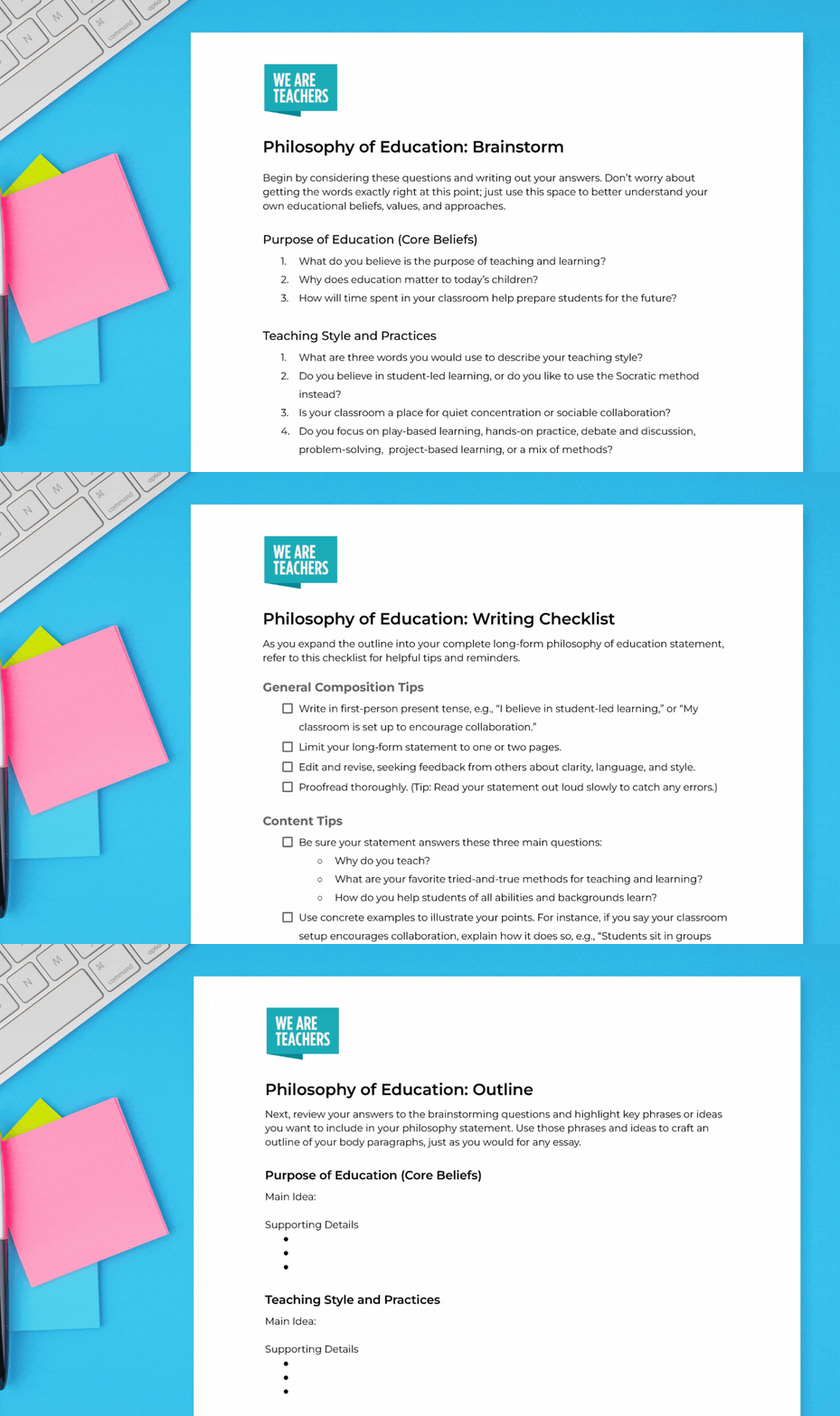
Ready to write your own teaching philosophy? Fill out the form to download our free guide. This Google Doc walks you through the process step-by-step with prompts and tips to help you brainstorm, outline, and write a polished final draft. Just enter your information in the form on this page to get your guide today!
Do you have any philosophy of education examples? Share them in the We Are Teachers HELPLINE Group on Facebook!
For more articles and tips like this, be sure to subscribe to our newsletters to find out when they’re posted.
Teacher Resignation Letter Examples and Free Templates
Nearly one in five teachers say they definitely won’t or may not return to their classroom jobs next year. If you’re one of the many who’ve decided it’s time to move on, you may wonder what’s next. First up: Schedule a conversation with your principal or supervisor. Then, submit your letter of resignation. Fortunately, that part is easy! Find out what to include in your teacher resignation letter, plus see examples and get free templates you can customize in a flash.
Jump to:
- How To Write a Teacher Resignation Letter Tips
- Examples of Teacher Resignation Letters
- Teacher Resignation Letter Templates
- Teacher Resignation Letters FAQs
How To Write a Teacher Resignation Letter Tips
A resignation letter is simply the formal document your employer will add to your file, verifying that you resigned from your job voluntarily. That’s it. It’s short and very easy to write.
IMPORTANT: This is not a multi-page screed describing everything you hate about your job, dashed off in triumph and delivered by storming into your principal’s office. It’s also not a place to write a love letter to your school, although you can include a statement about being grateful to have worked there or something similar. Despite what you’ve seen in movies, a resignation letter is just a piece of paper for your file, nothing more.
Here are the basics:
Use Formal Business Letter Format
Write this official document as a standard business letter. If you’ve forgotten the format, here’s a refresher. You can print out the letter and present it in person or via mail, or attach it to an email, depending on your school district requirements.
Include Only Basic Information
Your letter doesn’t need to say much at all, just these basics:
- Current date: This will help verify that you gave the required amount of notice.
- Decision to resign: Just write one simple sentence stating that you’ve made the decision to resign. There’s no need to include a reason (and in fact, it’s probably better not to).
- Final day of employment: Even if you mention a “two-week notice” in your letter, be sure to include the exact final date that you’ll be working.
- Full legal name: Include your name as it appears on your contract or employment paperwork.
That’s it! We told you it was easy!
Examples of Teacher Resignation Letters
Here are a few examples of teacher resignation letters for different scenarios.
End-of-School-Year Teacher Resignation Letter
April 12, 2026
This letter is to confirm that I am resigning my position as a second grade teacher at Springfield Elementary School at the end of the current school year. My final day will be Wednesday, June 3, 2026. I’ve appreciated the opportunities I had to learn and grow here and wish the school every success in the future.
Sincerely,
Elizabeth Hoover
Midyear Teacher Resignation Letter
January 23, 2026
This letter confirms my decision to resign from my teaching position at John Adams High School, effective two weeks from the date of this letter. My final day will be Friday, February 6, 2024. I will do my best over my final two weeks to ensure a smooth transition of my duties.
Sincerely,
George Hamilton Feeny
Teacher Resignation Letter Templates
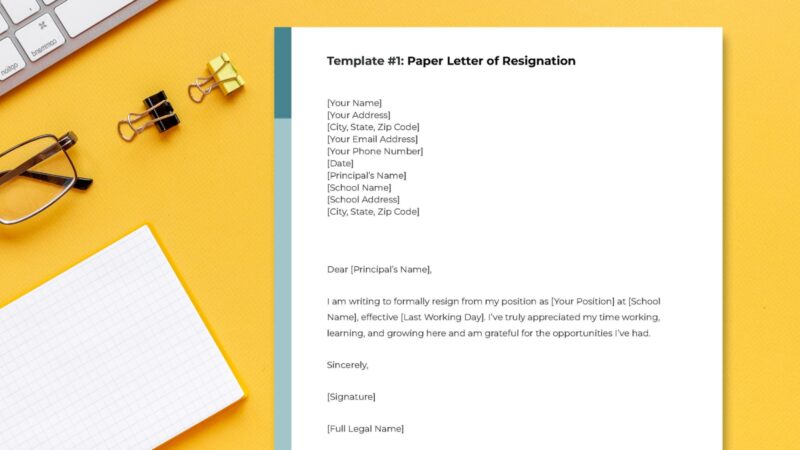
Copy and paste the text from these templates, or fill out the form on this page to get fully editable Google Doc templates. Either way, this is a quick and easy way to take care of this part of your resignation process.
Template #1: Paper Letter of Resignation
[Your Name]
[Your Address]
[City, State, Zip Code]
[Your Email Address]
[Your Phone Number]
[Date]
[Principal’s Name]
[School Name]
[School Address]
[City, State, Zip Code]
Dear [Principal’s Name],
I am writing to formally resign from my position as [Your Position] at [School Name], effective [Last Working Day]. I’ve truly appreciated my time working, learning, and growing here and am grateful for the opportunities I’ve had.
Sincerely,
[Signature]
[Full Legal Name]
Template #2: Email Letter of Resignation
Subject: Resignation Letter of [Your Name]
Dear [Recipient’s Name],
This is to confirm my decision to resign from my position as [Your Position] at [School Name] at the end of the current school year. My final working day will be [Last Day of Employment]. Please know that my time here has been very special to me, and I wish everyone at [School Name] success in the future.
Sincerely,
[Full Legal Name]
Teacher Resignation Letter FAQs
What is a teacher resignation letter?
A teacher resignation letter is a short, simple document stating your intent to resign your position. Your employer will keep this letter in your personnel file.
What should I include in my resignation letter?
Write your resignation using a business letter format, and include the current date, your decision to resign, your final day of work, and your full legal name and signature. If you like, you can include one more sentence about appreciating your time at the school, or stating your willingness to help make the transition period easier. It’s a nice way to leave a professional, polished image behind as you move on, but it’s not required.
When do I write and submit my teacher resignation letter?
Write and submit your resignation letter at the same time that you have a face-to-face conversation with your principal or supervisor to let them know you’re resigning. Do NOT use a resignation letter as a substitute for this in-person conversation. You can bring the letter with you to the meeting, or send it afterwards as a confirmation of your decision.
Do this before telling anyone else you’re leaving, because you don’t want the news trickling back to administration secondhand.
Do teachers need to give two weeks notice when they resign?
Teachers should give the amount of notice required by their employment contract. Before you resign, make sure you’re not breaking any of the conditions or clauses in your contract. If you’re resigning at the end of the school year, choose a resignation date that allows you to complete any final administrative work. You and your principal may want to decide on this date together.
If you’re resigning in the middle of the school year, things might be a little different. Again, check your contract. It may state the required amount of notice you need to provide. If not, give at least the standard two-week notice expected for most jobs. If in doubt, consult an employment attorney for advice.
Where do I send my resignation letter?
In most cases, you’ll address and send your letter to the principal, superintendent, or school board. Each district is likely to have their own requirements for your letter of resignation, so check your contract or employee handbook, and ask your principal if you’re not sure.
Often, you can hand your letter to your principal, and they’ll take care of it. But if you’re required to submit it to another location, like the county school board, you may decide you want to mail your letter. If so, consider using certified mail so you can ensure it was received. You don’t want to arrive on your final day and find out you’ve got a paperwork problem that could hold things up.
Can I send my resignation letter via email?
Some districts are happy to accept your resignation letter via email, either as an attachment or in the body of the email. But others may ask you to submit a hard copy. If you’re unsure, just ask your principal or school administrator.
Don’t forget to grab your free editable resignation letter templates!
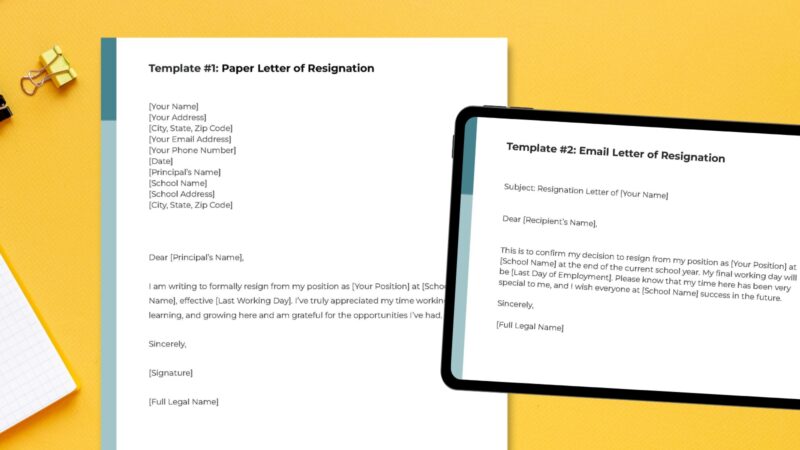
Get both of the teacher resignation letter examples above as an editable Google Doc template on letterhead. All you need to do is customize them and print!